Prologue: Conceiving Multidimensional Value Geometry
Let Us Begin with a Single Question
"Can human value systems be formulated as a measurable space? And if so, what geometric properties does that space possess?"
This question is the starting point of this book --- Multidimensional Value Geometry.
Over the course of a life, a person simultaneously holds multiple values: work, family, health, friendship, cultivation, integrity. These appear to exist independently, yet they are somehow connected. Undermine one, and the others tremble. Try to keep them all high, and you run out of resources.
I wondered whether this "common intuition" could be described precisely, in the language of mathematics.
What emerged was a succession of frameworks: the geometry of N-dimensional hypercubes and hyperspheres, sensitivity analysis of product functions, multi-agent Nash equilibria, and quantum-theoretic analogies. By combining existing mathematics alone, a surprising amount can be said about the human value space.
This book proposes that framework.
Multidimensional Value Geometry --- naming a discipline that does not yet exist as a formal field of study, assembling its foundational concepts, and recording a first step in research.
Holding Multiple Values at Once
Now, let's shift our perspective for a moment.
What are the things that matter to you?
Family, work, health, money, friendships, hobbies, education, appearance, honor, integrity -- the list goes on. We live holding multiple values simultaneously.
Think of your daily actions as game controls.
Producing results at work → raising the "work" value
Spending time with friends → adjusting the "relationships" value
Exercising → maintaining the "health" value
Reading books → expanding the "knowledge" value
Every day, unconsciously, we manipulate these values. The problem is that these values often compete with one another.
Devote yourself to work and family time shrinks. Watch your health and you may have to skip social drinks. Spend time on hobbies and your work productivity might decline.
Most people either "decide on the fly" or "prioritize one thing and give up the rest." But ad hoc decisions lack consistency and breed regret, while the strategy of prioritizing a single thing throws off the overall balance in the long run.
This book proposes a way to place all of these values in "the same space" and treat them in a unified manner. We will use mathematics -- not for the sake of being clever, but because mathematical thinking can take the seemingly complex balancing problem of life and distill it into something astonishingly simple.
The Precarity of "Work Only" and the World of Multiplication
Let's consider an extreme example.
There is someone who has devoted everything to work -- sleeping barely enough, building a splendid career. High income, strong social recognition.
But in exchange, family time is zero. No friends. Every health checkup comes back covered in red flags.
Now, would you call this person's life "successful"?
In school, exams are evaluated by "average scores." If you scored 80 in language, 70 in math, and 90 in science, your average is 80. One bad subject can be offset by the others. Most people unconsciously evaluate life the same way, by averaging it out.
But the core claim of this book is this: real life evaluation works not by averaging, but by multiplication.
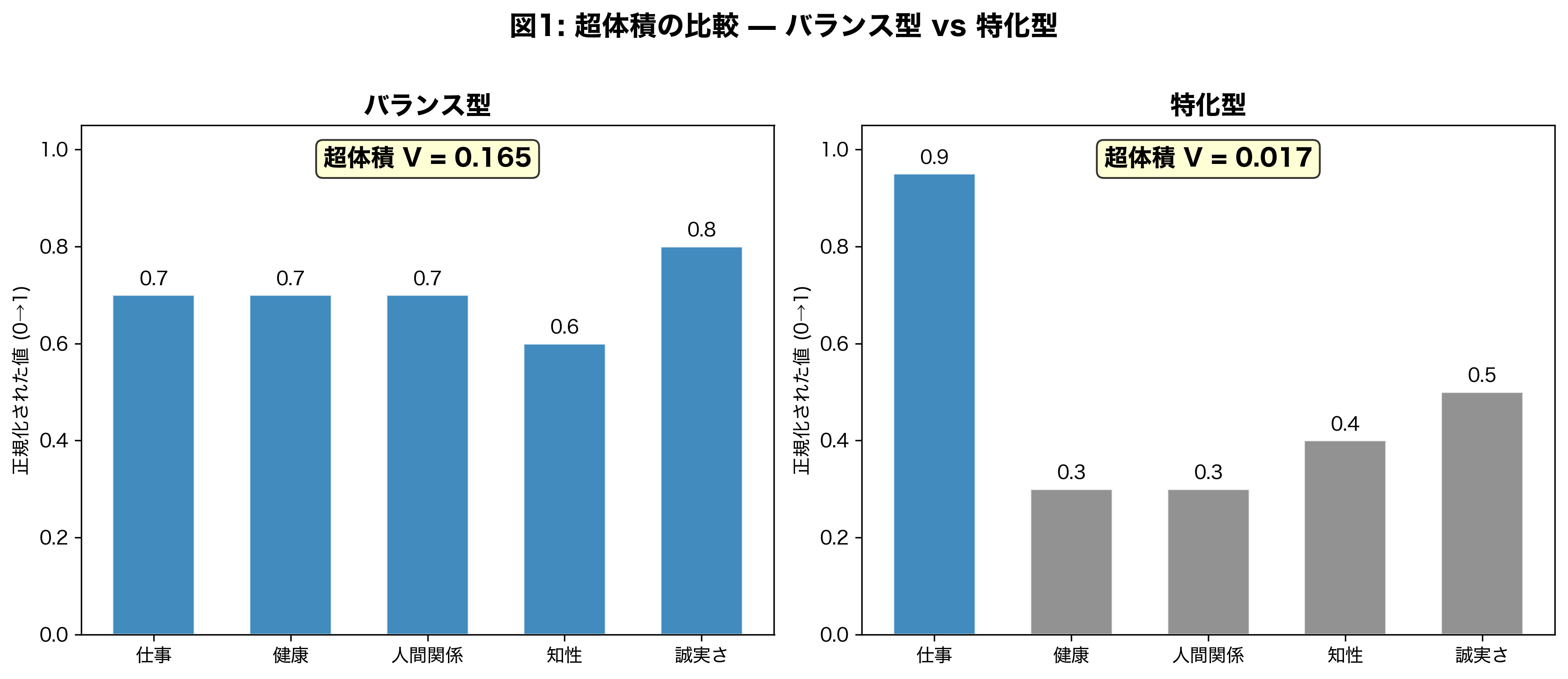
In the world of multiplication, no matter how large the numbers, multiplying by zero always gives zero. The person described earlier holds a high value on the work axis but near-zero on the others. The overall "multiplied" result is close to zero.
Conversely, this property of multiplication also offers hope. Raise the lowest value even slightly, and the whole improves dramatically. 60 x 60 x 20 = 72,000, while 60 x 60 x 40 = 144,000 -- far larger. The same increase of 20 has a far greater effect when applied where the value is low.
This is the first pillar of this book's model.
Integrity -- One Zero Ruins Everything
Let's think about the properties of multiplication with a more personal example.
Imagine you could measure everything you've built in life along five value axes.
Work skills: 8 (out of 10)
Relationships: 7
Health: 9
Knowledge and education: 6
Integrity and ethics: 8
The multiplied result is 8 x 7 x 9 x 6 x 8 = 24,192 points. This is this person's "hypervolume" -- in other words, the richness of their life.
Now suppose one day this person makes a grave mistake. They betray a dear friend. Integrity drops from 8 to 0.
In that instant, 8 x 7 x 9 x 6 x 0 = 0. No matter how capable at work, no matter how healthy, the whole becomes zero.
You might think that's too extreme. But have you ever felt, "That person has an impressive track record, but ever since that one incident, everything about them seems to have lost its luster"? Our brains evaluate life through multiplication.
We call this property "integrity." When a single dimension goes to zero, the whole goes to zero. This is not a moral argument -- it is a structural feature of the evaluation system.
Science and Religion Are Not in Opposition --- A Note on Structural Correspondences
I want to clarify the stance of this book.
This book employs mathematical models to describe value space. That is not the same as claiming "science is always right." Nor does it reject religion. On the contrary.
The mathematical models presented here bear a structural correspondence to the core insights of several religions and philosophies. This is not a claim of unification; it is an observation of noteworthy parallels.
When Buddhism says "let go of attachment," it can be read as "do not over-invest in a single value axis." When Christianity says "love one another," it can be understood as a strategy for "optimizing your relationship with the dimension of other people." When Confucianism teaches the Doctrine of the Mean, it is optimization wisdom: "balance all axes."
Buddhism has the phrase form is emptiness (shiki soku ze kū). "Form" refers to individual values; "emptiness" is the insight that they do not exist independently.
In the model of this book, the hypervolume of value space is determined by the product of all value axes. If one axis drops to zero, the whole drops to zero. Conversely, no single value axis exists on its own. Work, relationships --- each acquires meaning only in relation to the other axes. Individual values can only be defined within a "network of relationality." This is the interpretation of form is emptiness within this framework.
What matters is to render the shared value that underpins these religions and philosophies --- peace among individual human beings --- in a form that anyone can discuss in common terms. This mathematical model functions as a candidate for that "shared language."
The Round Trip Between Abstract and Concrete --- The Journey of This Book
Let me outline the overall structure of this book.
It moves constantly back and forth between the abstract and the concrete, much like climbing a mountain.
Stage One: Depart from an Intuitive Question
The journey begins with the question "Can value systems be formulated as a measurable space?" --- a question rooted in everyday experience.
Stage Two: Ascend the Staircase of Abstraction
From there, we begin climbing the staircase of abstraction. Multidimensional spaces, hypercubes, hyperspheres, Nash equilibria, wave functions --- these terms appear, at first glance, far removed from daily life.
Terminology Preview: Here is a rough outline of the main technical terms that appear in this book. Details are treated in each chapter.
Hypercube: A "box" formed by arranging value axes. The 4-dimensional, 5-dimensional, ... version of a 3-dimensional box.
Hypersphere: The "ideal shape" in which all axes are extended in balance. A higher-dimensional version of a round ball.
Nash Equilibrium: A state in which no agent can make a change that benefits only itself. The resting point of a multi-agent system.
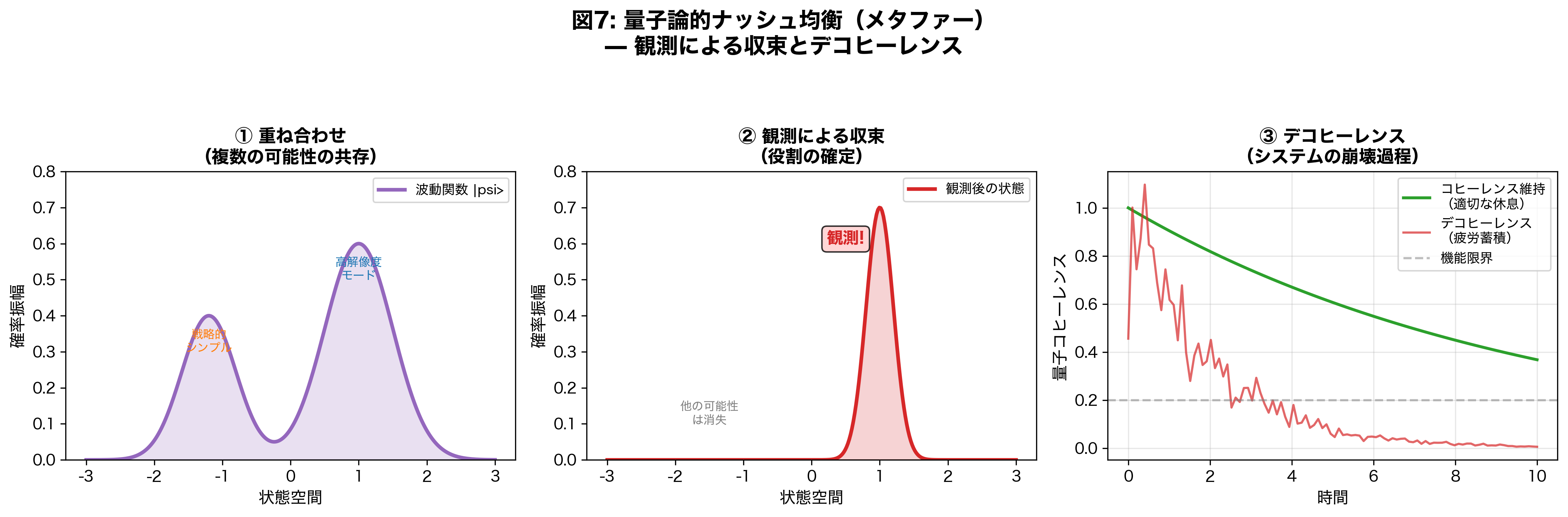
Wave Function: A superposition in which the state "could be anything." It collapses into a single definite form upon observation.
Why abstract at all? To make complex problems simple. From a high vantage point, you can see the whole forest. Abstraction reveals the structure of problems in value space.
Stage Three: Descend Once More to the Concrete
Then, carrying the perspective gained at the summit of abstraction, we descend back to the concrete. We examine what this framework delivers and where its limits lie.
What matters is that the round trip itself has value. Abstraction alone lacks empirical verification. Concreteness alone fails to reveal the structure of the problem. By traversing both, the validity and the limits of the framework come into view.
By the time you finish this book, you should be able to see what Multidimensional Value Geometry can describe --- and what it cannot.
Emptiness Is Form --- What, Then, Does This Framework Deliver?
The opposite of form is emptiness is emptiness is form (kū soku ze shiki).
This is not an esoteric proposition. It means "return from the abstract to the concrete."
There is a certain pleasure in understanding this framework by itself. The discovery that human value systems can be described with mathematical expressions brings intellectual excitement. But that must not be the endpoint.
Having understood emptiness (models, theories, abstraction), you must return to form (concrete reality, observation, verification) --- otherwise there is no point.
It is not enough to stop at "I see, value space is determined by a product." The question must become: "What does this framework predict, and what does it fail to explain?" That is where the practical significance of this research lies.
The question posed on this final page of the prologue is singular:
"Where is Multidimensional Value Geometry valid, and where does the unknown begin?"
From here, each chapter introduces various concepts. Hypercubes, hyperspheres, Nash equilibria, wave functions --- each is a kind of lamp illuminating a particular aspect of value space.
But lighting the lamp is not the goal. What matters is verifying what the light reveals, making the limits explicit, and posing the next question. That is research.
Now, let us begin. Starting with Chapter 1.
That Feeling of "Something Is Missing"
Are you satisfied with your life right now?
If words like "pretty much" or "not bad" come to mind, this book was written for you. On the other hand, if you can immediately answer "perfectly satisfied," feel free to close this book.
The starting point of this book is a single feeling.
"Something just feels... unfulfilled."
Your job is going reasonably well. You have friends. No major health issues. And yet, it feels like there's a hole somewhere inside you.
Like you've forgotten something important. Like you're making some kind of mistake. But you can't quite put it into words.
Does this vague, nagging feeling ring a bell?
I've spent years thinking about what this feeling really is. And I've arrived at one conclusion: we simply don't know where to look in our lives or how to see what's there.
A car has a dashboard. Life should have one too -- an instrument panel that shows you "what state you're in right now." Yet we all grow up without ever being told such a thing even exists.
This book is about building that dashboard together.
Chapter 1: Normalization of Value Axes and Measurement-Theoretic Foundations
The Unconscious Scale: We Compare Things Every Day
"You can't compare the incomparable" -- that's what I said on the previous page.
But think about it. You actually do this every day. You put incomparable things on an unconscious scale and weigh them.
You wake up in the morning. The desire to "sleep five more minutes" versus the rational thought "I can't be late." A split-second judgment comparing two completely different kinds of value: sleepiness (pleasure) and responsibility (duty).
At work: "Should I decline this overtime? But it might affect my evaluation." A weighing of personal time (rest) against career (growth).
At night: "I'm too tired to exercise today" -- comfort in the moment (short-term pleasure) versus future health (long-term value), weighed against each other.
Every second, we compare different kinds of value.
The problem is that this scale operates on "somehow." Is there a consistent standard behind your morning wake-up decision? You managed to get up today but couldn't yesterday. What's the difference?
The unconscious scale is convenient. It makes judgments in an instant. But relying on it too much leads to becoming lost in life.
Because the unconscious scale only sees "this moment right now." It prioritizes immediate comfort and sacrifices the you of one year from now, ten years from now. The accumulation of today's small choices, before you know it, has carried you in an irreversible direction.
The inability to make decisions based on long-term balance and overall optimization is the limit of the unconscious scale.
That's exactly why the "common yardstick" introduced on the next page is necessary. It's a tool to upgrade your unconscious scale into a conscious dashboard. Like a car's instrument panel, you'll be able to see your current state at a glance.
Measuring With the Same Yardstick
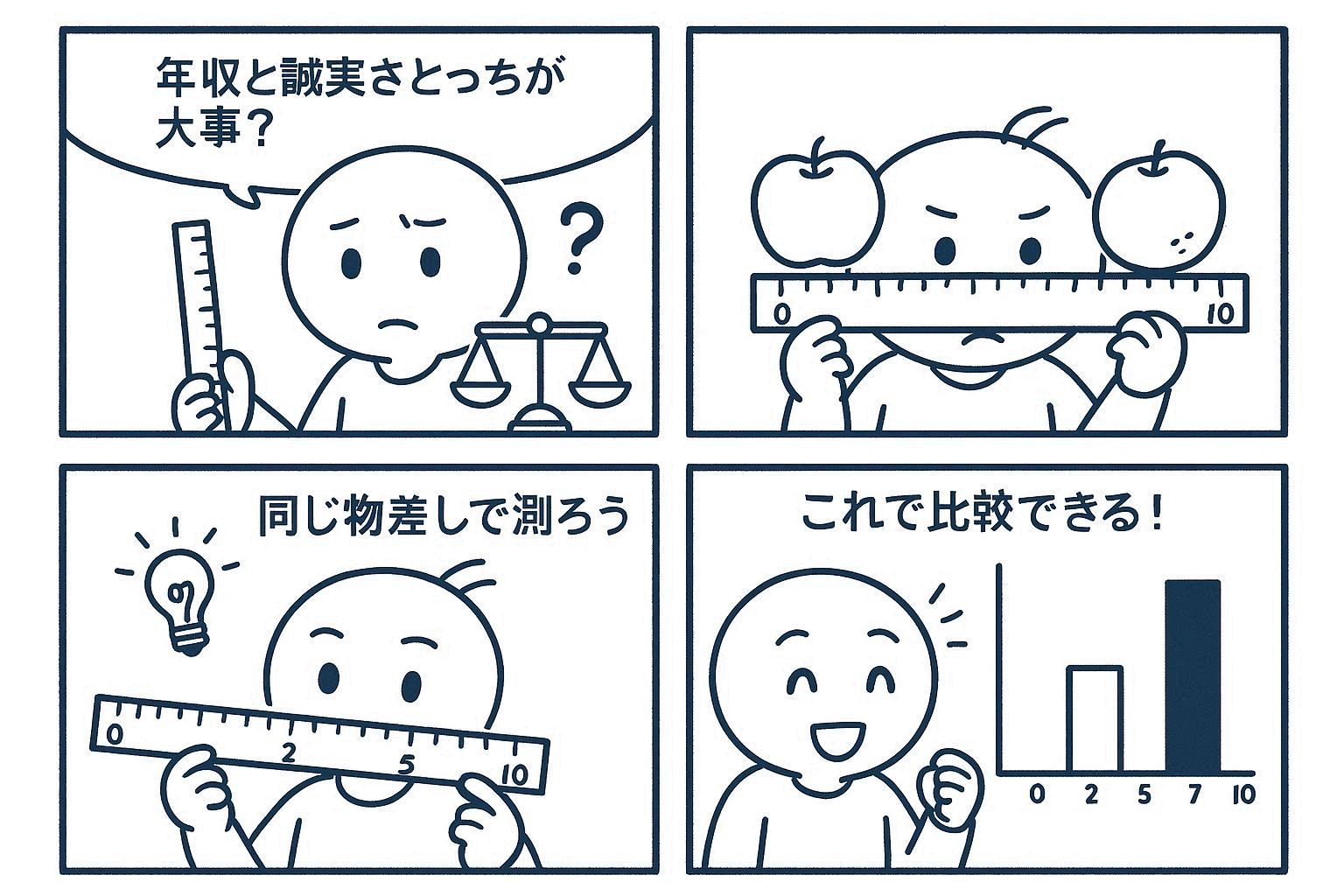
Let me introduce a concept called "normalization."
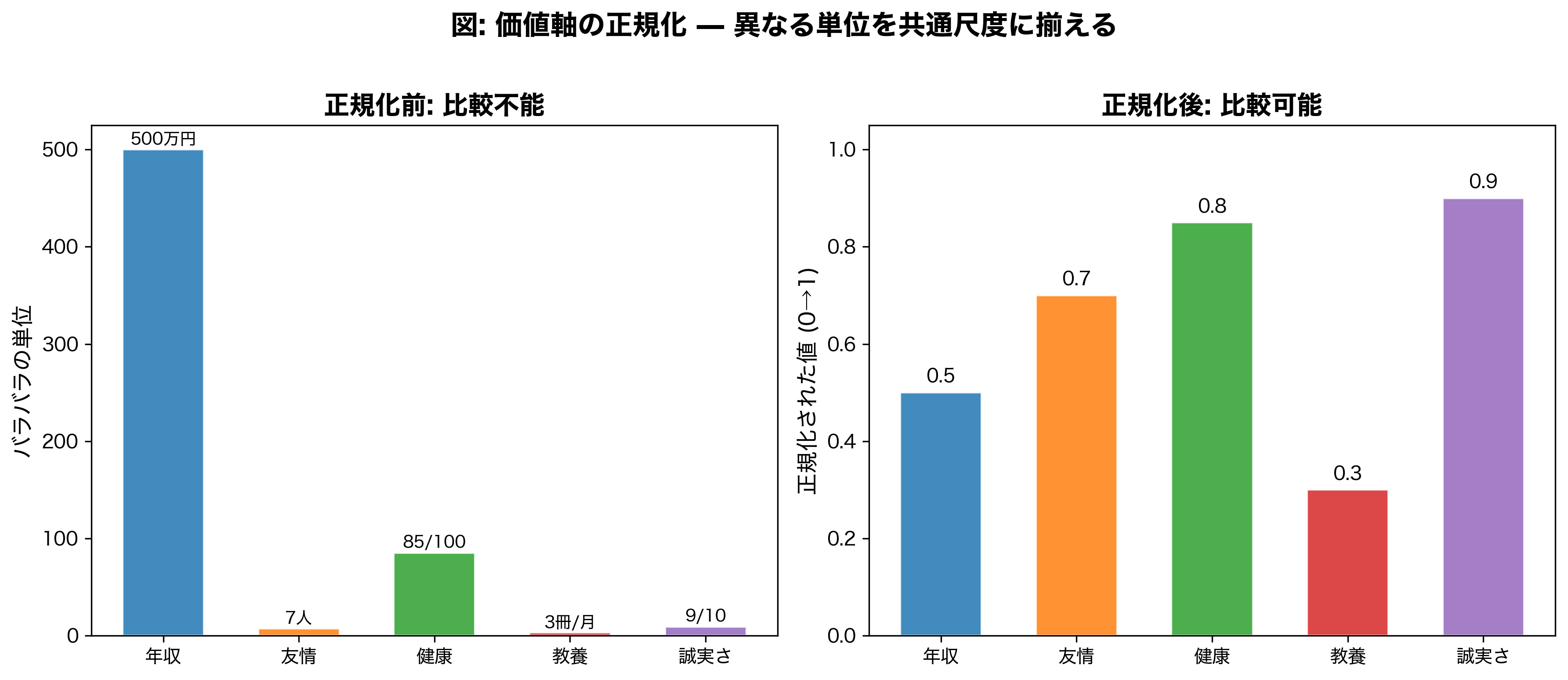
It sounds technical, but the idea is simple: convert different kinds of things into the same 0-to-10 scale.
For example, think about your "annual income." Whether it's 3 million yen or 30 million yen, you convert it to a 0-to-10 score. You pick the number that feels like "this is about where I am." The unit of annual income is "ten thousand yen," but once normalized, it becomes "points."
In the same way, you self-rate your "integrity" on a 0-to-10 scale. "How honestly am I living?" -- this too can become a score.
What happens when you do this?
Annual income: 8 points, Integrity: 7 points -- now you can handle different values on the same scale.
Let me say it again. "Three apples" and "five oranges" can't be compared. But "apple satisfaction: 6 points" and "orange satisfaction: 7 points" can be, because both are measured on the same yardstick: "satisfaction."
Of course, self-scoring has its issues. Everyone's baseline is different. What "8 points for annual income" feels like varies from person to person. But let's not worry about the details for now.
What matters is that the idea of "measuring with the same yardstick" opens up a new world.
You can't compare apples and oranges directly. But you can compare the satisfaction of eating an apple with the satisfaction of eating an orange. You converted them to the same unit: "satisfaction."
Doing the same thing with life's values is the fundamental approach of this book. Annual income, friendship, health, integrity -- translate them all into the common language of "your satisfaction."
Then the choices you used to settle with "somehow" become, for the first time, conscious decisions.
Let's actually try it on the next page.
A Concrete Example: Self-Rating Income, Friendship, and Health
Now let's actually try it.
Rate your current life on three dimensions, using a 0-to-10 scale.
First: Annual income and financial stability
If you're not struggling to get by, give yourself a 5. If you have plenty of cushion, 7 or 8. If you have zero financial anxiety, 9 or 10. If you're barely scraping by, 3 or below.
Second: Friendship and relationships
How many friends can you casually talk to? How often do you feel lonely? If you have someone you can trust completely, 7 or above. If you spend almost all your time alone, 3 or below.
Third: Health
Any major illnesses? Do you recover from fatigue easily? If you wake up feeling refreshed every morning, 8 or above. If you have chronic issues, 4 or below.
How did it go? Did numbers come to mind for each one?
What matters here is not the accuracy of the scores themselves. As long as you have the feeling of "this is roughly where I am on this dimension," that's enough.
It might look something like this:
- Annual income: 6 (enough to get by, but no real cushion)
- Friendship: 4 (I realize I haven't been seeing friends...)
- Health: 8 (no particular issues)
Looking at these three numbers, do you notice anything? Is there an imbalance somewhere? Is one dimension strikingly low?
In fact, the secret to life fulfillment is hidden in the "balance" among these three numbers.
It's not about having high scores. Even if everything is an 8, there might be some hidden distortion. Conversely, even if everything is around 5, if the balance is good, satisfaction can be surprisingly high.
And one more important thing: these scores are not "absolute correct answers." What matters is your feeling of "this is how I feel right now." They're not for others to judge, and there are no wrong answers.
On the next page, let's talk about what the "balance" among these three numbers reveals.
What's Good About Normalization?
On the previous page, you self-rated three dimensions on a 0-to-10 scale.
Annual income: 6, Friendship: 4, Health: 8. Or perhaps different numbers.
Don't just say "huh, interesting" and leave it at that. These numbers have a very important use.
First, your own state becomes "visible."
Before scoring, it was a vague sense of "I feel like my relationships aren't going well." But when Friendship becomes a concrete 4, you can clearly see "ah, this is my weak spot." The vague unease turns into something concrete. You can't defeat an invisible enemy, but a visible one, you can strategize against.
Second, you can talk with others on "the same playing field."
If you say "my Friendship score is 4," the other person can respond "mine is probably around 7." You can have a conversation about "life balance" with someone whose income and personality are completely different from yours. A relationship forms where you can casually share "life satisfaction" -- something that used to be hard to bring up.
Third, you can track changes over time.
Measure the same three dimensions three months later. If Friendship went from 4 to 6, you realize "making more time to see friends during that period really paid off." If Health dropped from 8 to 6, you notice "uh oh, I need to do something about this." You can establish "fixed-point observations" of your own life.
Making your own life visible, with your own hands. That's the primary benefit of normalization.
And beyond this, an even bigger possibility awaits. The next page will reveal the full picture.
Now You Can Compare: Seeing Your Strengths and Weaknesses
The real power of normalization starts here.
Look at three numbers: Annual income 6, Friendship 4, Health 8.
When you compare these three, what do you learn?
"Health is fine. But relationships are a weakness."
That's it. Just this much, but it's incredibly powerful.
Because now you know exactly where to improve. You could work on increasing your income. You could push your health even further. But for this person, the most effective move might be "raising Friendship from 4 to 5 or 6."
Human time and energy are finite. You can't pursue everything at once.
"Where should I invest my resources?" -- the numbers answer this question.
Without normalization, what would happen? Annual income is measured in "ten-thousands of yen," health in "doctor visits," friendship in "how often I see people." The units are so different that you'd have no idea what to improve or how. Being told "just work hard at everything" doesn't help when your time and energy are limited.
Having a common yardstick enables comparison. Comparison enables prioritization. With priorities set, you can take action.
This is a simple but essential piece of wisdom that most self-help books never teach.
Now, here's where it gets real. Once you can compare three numbers, it's time for "multiplication" to take the stage. By multiplying three numbers together, the true value of your life comes into view.
The Value of Being Able to Compute Hypervolume V
Remember how I wrote in the prologue that "life is multiplication"?
Let's multiply the three numbers together.
Annual income 6 x Friendship 4 x Health 8 = 192.
This is this person's "hypervolume V" -- what this book calls life fulfillment.
"Only 192? Isn't that small?"
You might feel that way. But what matters is not the magnitude of the number, but the fact that it can be compared.
Suppose another person has Annual income 9, Friendship 9, Health 1. Then 9 x 9 x 1 = 81. Because health is extremely low, the overall value drops below the first person's.
Here's what's interesting.
If the person with Annual income 9 raises their Health from 1 to 2 -- just a one-point increase -- the overall value becomes 9 x 9 x 2 = 162. Just one point up, and the total value doubled.
Meanwhile, if the first person (Income 6, Friendship 4, Health 8) raises their income from 6 to 7: 7 x 4 x 8 = 224. Not much change.
Here lies the core of this model.
If you want to raise overall fulfillment, the most efficient approach is to raise your lowest dimension. Even a small increase at the low end causes the product to jump significantly.
In the school "average score" mindset, this insight never emerges. You're told "give up on your weak subjects and strengthen your strong ones." To raise your average, that strategy is correct. But life is different. Life improves dramatically when you shore up your weaknesses.
What's the lowest dimension in your life? Raising that one thing alone might change your overall fulfillment more than you imagine.
The concept of "hypervolume V" will appear many times from here on. For now, just get a feel for it.
Integrity: A Single Zero Kills Everything
Now let me tell you about something else that's important.
The world of multiplication has a frightening property. If even one factor is zero, the entire result is zero.
6 x 4 x 8 = 192. Now add a dimension called "integrity," and suppose integrity is 0.
6 x 4 x 8 x 0 = 0.
No matter how high the income, how healthy, how many friends you have -- if integrity is zero, life fulfillment is zero.
This isn't a metaphor. We experience this feeling in real relationships.
"They're great at their job and they have money, but... as a person, what can I say?"
"They're talented, but I just can't trust them."
Behind these words lies a structure where "one critical axis is missing, and it ruins the entire evaluation."
In this book, I call this property "integrity." In Japanese you might translate it as "honesty" or "consistency," but it has a broader meaning. You could also call it "the core values that define who you are."
When this integrity dimension hits zero, everything becomes meaningless. Even if every other dimension is at max score.
Flip it around, though: as long as integrity is maintained, even if other dimensions are somewhat low, the "value of your life" won't be zero. Here is the minimum line you must protect.
So what is your integrity? What is the axis in your life that you absolutely do not want to let drop to zero? Money, honesty, love for your family -- it's different for everyone. Keep that question in mind as you read the next page.
The Structure of "They're Perfect, Except for One Thing..."
"That politician has great policies, but there are suspicions about money..."
"That colleague is really competent, but their attitude is awful..."
"That friend is a good person, but they keep forgetting promises..."
When we speak like this, what are we actually doing?
We're evaluating one axis as close to zero, and as a result, the entire impression is ruined.
This is exactly the "integrity" structure I just explained.
What I want you to notice here is that this evaluation doesn't only apply to others. You do the same thing to yourself.
"I'm working hard at my job, but I never exercise."
"My social life is fulfilling, but I have zero savings."
"I'm careful about my health, but I keep slacking on studying."
When you evaluate yourself, the lowness of one axis drags down your overall self-worth.
But looked at the other way, this is also a source of hope.
"You don't need to be perfect. As long as you don't let any axis drop to zero, the whole won't collapse."
You don't need to score 9 or 10 on every axis. As long as you're not scoring extremely low (0 or 1) on any one or two axes, your life's hypervolume will be substantial.
"Career: 6, Relationships: 5, Health: 7, Hobbies: 4, Integrity: 8" -- with this kind of balance, the product is nowhere near zero. In fact, this is a far more fulfilling life than scoring 10 on one axis and 0 on everything else.
What matters is not which axes to grow, but which axes to keep from hitting zero.
On the next page, let's talk about the pitfalls hidden in this method of normalization.
Pitfall of Normalization #1: Some Things Can't Be Measured
Up to this point, I've been arguing that "normalization makes everything comparable."
But let me be honest. This method has its pitfalls.
The first pitfall: some things simply can't be scored.
Can you measure "love" on a 0-to-10 scale?
Can you measure "beauty" on a 0-to-10 scale?
Can you measure "the meaning of life" on a 0-to-10 scale?
The answer is "you can't." Or rather, "you shouldn't."
Of course, you could force a score onto them. But how meaningful that score would be is questionable. "The meaning of my life is a 7" -- how much value does that statement really carry?
This book's model is a tool for measuring "what can be measured." Trying to force the unmeasurable into numbers can actually distort your life.
"The things that can't be quantified might actually be the most important" -- we must never lose this humility.
That's why the way to use this book is as follows. Don't use it to fully understand your life. Use it as an auxiliary line, a guide that makes the "somehow" parts just a little more visible.
You don't need to manage everything with numbers. Measure what can be measured, and leave what can't unmeasured. That's enough.
Keep this paradox in a corner of your mind: "the unmeasurable may be what matters most." This book's model isn't here to "fully explain" your life. It's just an auxiliary line for making the "somehow" a little more visible.
There's another pitfall too. Let's continue.
Pitfall of Normalization #2: Change the Baseline, Change the Result
The second pitfall concerns the "baseline" used for normalization.
For instance, when you self-rated "Health," what was your baseline? Did you base it on "whether you have an illness," "physical fitness and stamina," or "mental stability"?
Change the baseline, and the score changes too.
The same person might rate Health a 9 if the baseline is "no illness." But if the baseline is "can run 10km every day," Health might drop to a 3. Neither is more correct. It's just a different baseline.
The same applies to "Friendship." Whether you base it on "how many times a week I see friends" or "how many people I can truly open my heart to" produces completely different scores.
What's important here is that "comparing your scores with someone else's is meaningless."
Your Friendship 7 and my Friendship 7 might share the same number, but the substance could be entirely different. So competing over "I'm a 7 and you're an 8? Not fair" doesn't make sense.
This model is strictly a tool for relative comparison within yourself. It's not for competing with others.
Compare "last year's me" with "this year's me." Compare the Career axis with the Health axis and check the balance. Used that way, this tool becomes remarkably powerful.
And one more important thing: baselines naturally shift with age and experience. How you feel about "annual income" in your twenties versus your forties might change. Surviving a serious illness will shift your baseline for "Health." That's fine. Revisit your baselines and look at your life over the long term.
Keeping these pitfalls in mind, let's move on to the practical section.
Practice: Pick 5 Axes and Rate Yourself
At the end of Chapter 1, there's one thing I'd like you to do.
Choose your own "5 axes" and self-rate them.
Grab some paper and a pen. Or use the notes app on your phone.
First, write down five values that matter to you.
For example:
- Career
- Family and partner
- Health
- Money
- Hobbies and enjoyment
Of course, you should pick whichever 5 axes feel right to you. "Integrity," "appearance," "time with friends" -- anything goes. It's your life, so you decide. Measuring yourself with someone else's axes won't feel right.
Then self-rate each one on a 0-to-10 scale. What matters isn't getting the "correct score." It's turning the feeling of "this is roughly where I am now" into a number.
Example:
Career 7, Family 5, Health 8, Money 6, Hobbies 3
How does it look? You can probably see at a glance which are high and which are low.
If you'd like, try computing your "hypervolume V" with these 5 axes. 7 x 5 x 8 x 6 x 3 = 5,040.
Don't worry about whether this number is "big" or "small." What matters is that you've confirmed "I am right here" as a number.
That concludes Chapter 1.
In Chapter 2, we'll explore the deeper meaning of the "multiplication" across these 5 axes. One dimension at a time, carefully.
Keep these 5 axes in the back of your mind as you turn to the next page.
Why Can't People Compare Their Values?
You cannot answer the question "Which is better -- your friend's annual income or your own education?" Annual income can be measured in yen, but education has no standardized unit. When you weigh "attractiveness" against "integrity," what exactly are you comparing?
The root of this problem boils down to one thing: each value has a different unit of measurement. Comparing quantities with different units is like asking whether meters or kilograms are "bigger" -- the question is meaningless to begin with.
And yet, in daily life, people make these comparisons implicitly. The choice between "working harder" and "spending time with family" is a resource allocation decision across different value axes, and it presupposes some form of comparison. Converting these implicit comparisons into an explicit and actionable form is what the operation of normalization accomplishes.
The Definition of Normalization
Normalization is the operation of mapping quantities with different units into the interval [0,1]. The simplest method is called min-max scaling:
Normalized value = (current value - minimum value) / (maximum value - minimum value)
Consider, for example, the "annual income" axis. If your income is 5 million yen and the possible range for humanity is 0 to 10 billion yen, the normalized value is approximately 0.00005. Someone with an income of 100 million yen on the same axis would be around 0.001. These two values are measured with "the same yardstick" and can now be compared.
What's important is that normalized values have no "absolute meaning"; only their relative position carries meaning. An "integrity of 0.8" is not "greater than" an "annual income of 0.8." Each simply indicates your position on its own axis.
The Benefits of Normalization
The greatest advantage gained through normalization is the ability to perform unified operations in multidimensional space.
First, comparability emerges. Since each normalized axis exists in the same [0,1] space, you can discuss "which axis is relatively high or low." The intuition "I'm doing okay at work but weak in relationships" is quantified as "Career axis = 0.6, Relationships axis = 0.3."
Second, it enables the computation of hypervolume V = Pi x_i. Hypervolume is the product of all axes, expressing "how well-balanced the whole is" as a single number. With unnormalized raw values, multiplication itself is meaningless because the units differ.
Third, it provides the foundation for strategic thinking. The question "which axis should I strengthen to increase hypervolume the most?" is an operation that only makes sense in normalized space. This question is the starting point for the strategic partial derivative we'll cover in Chapter 3.
Integrity: The Zero Element of the Product
The definition of hypervolume V = Pi x_i has an important property: the moment any single axis becomes 0, the total hypervolume becomes 0.
This can be regarded as the mathematical expression of "integrity." Think about it in real life. No matter how good you are at your job (x_Career = 0.9), no matter how rich your relationships are (x_Relationships = 0.9), if one axis -- "ethics," say -- is 0, then by definition that person's life "hypervolume" is 0.
This is not a moral judgment but a structural fact. When we feel "that person is wonderful, but there's one thing I can't forgive," we are unconsciously performing a multiplicative evaluation. Under additive (average-based) evaluation, one flaw can be "offset" by other strengths. But under multiplication, any value times 0 equals 0.
Paradoxically, this property demonstrates the strategic importance of integrity. If you have an axis close to 0, improving any other axis will barely increase your hypervolume. The top priority should be improving that near-zero axis.
Risks and Limitations of Normalization
Normalization is not a panacea. It should be used with an understanding of the following risks.
Error from Information Compression
Compressing to [0,1] means discarding most of the original information. The difference between an income of 5 million and 5.1 million yen becomes a microscopically small difference after normalization. Normalization is a technique for seeing "broad trends," not for "precision measurement."
Arbitrariness of the Anchor
The results change significantly depending on what you set as the "minimum" and "maximum." Do you use "all of humanity" as the baseline, "people your age," or "people in your industry"? Because normalization depends on the anchor, you must always be aware of the context of comparison. You might think "I'm in the best environment in the world," but change the baseline and that advantage vanishes.
The Static Trap
Normalization is a snapshot at a single point in time. People grow. Axis values change. And more importantly, the axes themselves increase and decrease. A value that didn't exist yesterday (a new hobby, a new obligation) can appear today. Treating the normalized space as static means missing the dynamic changes of reality.
The Existence of Unmeasurable Axes
Integrity, love, aesthetics -- these are fundamentally difficult to measure objectively. The "measurement" step that precedes normalization is itself influenced by subjectivity and bias. Normalization does not improve the quality of measurement. No matter how sophisticated the normalization, garbage in, garbage out.
Practical Advice
Here are some guidelines for "using" normalization in daily life.
Start with about 5 axes: Don't try to normalize 100 axes at once. List the values that truly matter to you and rate each on [0,1]. As we'll cover in detail in Chapter 2, the properties of the space become more complex as dimensions increase.
Make the baseline explicit: Clearly define what "1.0 on this axis" means. Is "Integrity 1.0" "a state of telling zero lies" or "a state of being true to your convictions"? Normalization with vague definitions is meaningless.
Re-evaluate regularly: Re-assess each axis at least once a month. Noticing change is the first step toward dynamic optimization.
Watch out for near-zero axes: If any axis is below 0.1, prioritize improving it. Doubling that axis from 0.1 to 0.2 is equivalent to doubling your hypervolume.
Normalization is a means, not an end. In the next chapter, we'll explore the geometric properties of normalized space -- the hypercube and the hypersphere.
Annual Income vs. Integrity -- Which Matters More?
Let me ask you something.
"An annual income of 10 million yen" or "integrity" -- which is more important?
You probably thought, "You can't compare those." And you're right. Annual income and integrity are different kinds of value. There's no way to decide which is "higher." It's like asking whether "three apples" or "five oranges" is more -- the units are different, so the question doesn't even make sense.
And yet, in our daily lives, we constantly force comparisons between these incomparable things and make choices based on them.
When changing jobs: "The salary will drop, but I'll have more time with my family." Which do you choose?
When picking a hobby: "It costs money, but the fulfillment I'd get is enormous." Which is the right answer?
These decisions aren't hard because you're not smart enough. It's because you simply don't have a "common yardstick" for comparison.
Without a yardstick, you can't measure. If you can't measure, you can't compare. If you can't compare, you can't decide.
So we hesitate. And in the end, we decide "somehow."
But what if -- what if you had just one common yardstick? Everything would change.
With that yardstick, you could compare annual income and integrity on the same scale. You could decide without hesitation which to prioritize. Career changes, marriage decisions, how to spend your time -- all of it could be chosen with the clarity of "ah, so this is the right call right now."
You'd be freed from the curse of "I can't compare, so I can't decide."
On the next page, let's talk about that "common yardstick."
Chapter 2: Geometry of Hypercubes and Hyperspheres
The Box and the Sphere
Now I'd like you to imagine two shapes.
One is a box (cube). The other is a sphere.
These two shapes are the key to understanding life's constraints.
Let me start with the box. The box has "walls." These walls represent the time limits imposed on you. No matter how hard you try, you cannot breach these walls.
For instance, there's the wall of 24 hours in a day. The wall of 7 days in a week. The wall of 365 days in a year. The size of this box is given equally to every human being.
The sphere, on the other hand, has a "radius." This radius represents your personal capacity. How much can you process at once? How much stress can you tolerate? How many things can you keep in mind?
The box is the same size for everyone, but the sphere's radius differs from person to person. Some people have a large capacity; others have a smaller one. And most importantly -- you must fit this sphere inside the box.
If the sphere extends beyond the box's walls, that's the state of being "over capacity."
Once you understand these two constraints, life's problems become much easier to see.
The Box's Walls = The Limits of Time
Let's think about the box's walls more concretely.
Your day is 24 hours. You allocate that time across work, sleep, meals, family, hobbies, exercise, and relationships. No matter how much you optimize, you can't turn 24 hours into 25.
What matters here is the simple fact that "the more you distribute time, the less you have for each thing."
Spend 12 hours on work, and you have 12 left. Subtract 7 for sleep and 2 for meals, and you're down to just 3 hours. Those 3 hours have to be divided among family, hobbies, exercise, and time with friends.
To "spend solid time" on one value axis, your only option is to cut time from other axes.
For example, suppose you decide "I want to exercise for an hour every day for my health." Where does that hour come from? Probably from TV time, phone-scrolling time, or sleep.
When you add something, something else decreases. This is unavoidable.
The box's walls are absolute. Ignore them and try to "do everything," and what happens? Everything ends up half-done. That leads to the next topic.
The Sphere's Radius = Your Personal Capacity
If the box's walls are "time limits," then the sphere's radius is your "processing power."
Even with the same 24 hours, the amount people can handle differs. Some can sustain concentration for long stretches; others tire quickly. Some are good at multitasking; others are single-focus types.
This "sphere radius" also varies depending on innate temperament, how you're feeling that day, and your age.
For instance, suppose you're currently juggling an extremely stressful project. Tasks you'd normally handle with ease become overwhelming because stress has shrunk your capacity. Your sphere's radius has gotten smaller.
Conversely, coming back from a vacation feeling refreshed, your sphere's radius is larger and you can process more than usual.
What's important here is that if you ignore the sphere's radius, you'll hit capacity overload before you even reach the box's walls.
You might have time to spare, but no mental energy or concentration left. You could work 24 hours if you wanted, but in practice, productivity drops off a cliff past the 8-hour mark.
Knowing your sphere's radius is the first step toward understanding your "realistic limits."
The Ideal State Is a "Sphere"
Let's consider what the "ideal state" looks like.
Fit a sphere inside the box. The sphere doesn't touch the box's walls, and it extends evenly in all directions. This is the ideal state of balance.
In other words --
"The state of achieving maximum fulfillment across all value axes, within realistic limits."
This is one of the goals this book aims for.
Work is decent. Family time is decent. Health is decent. Hobbies are decent. Nothing sticks out excessively, and nothing is glaringly missing.
The sphere fits neatly inside the box. Everything you need is in there. Nothing spills over. You could call this a state of "harmony."
But you might be thinking, "Isn't that just being mediocre? Shouldn't we aim for '100 points across the board'?"
No. What matters is the "overall product." Even if one axis is extremely high, if the others are zero, the total is zero. Conversely, even if all axes are at a modest 40 points, the product can still be substantial.
The shape of a sphere isn't "mediocrity." It's "stability." And because it's stable, it can last.
So what disrupts this ideal spherical state? That's our next topic.
A Concrete Example: Chasing Five Goals at Once
Let's think through a concrete example.
Suppose you have the following five goals:
Get promoted at work
Exercise three times a week
Make time for your partner or family
Read at least one book per month
Maintain relationships with friends
Each is a wonderful goal. Individually, none would be hard to achieve.
But what about all five at once?
Getting promoted requires overtime and study. To carve out that time, you'd need to cut back on exercise, sacrifice family time, or give up reading... somewhere, compromises must be made.
In the end, you start out strong, but within a few weeks, distortions appear. Exercise is the first to go, then reading drops off, and communication with friends starts to falter.
You set out saying "I'll do all five!" but reality says "two or three is a struggle." There's absolutely no need to blame yourself for "weak willpower."
The problem isn't strength of will. It's a structural problem: your time and capacity (the box and the sphere) aren't enough for the number of dimensions (goals).
The more dimensions you have, the more goals you pursue, the less resource you can allocate to each one. This is the same reality for everyone.
The Curse of Dimensionality #1: The Sphere Won't Fit in the Box
Here we arrive at the core of this chapter.
The more value axes (dimensions of things to do) you have, the harder it becomes to fit the sphere inside the box.
What does that mean?
Think about a 2-dimensional world (just work and hobbies). Even if work takes a lot, you can reduce hobbies and maintain balance. Adjustment is relatively easy.
But what about 3 dimensions? Work, family, health. Trying to satisfy all three simultaneously is already pretty tough.
4 dimensions, 5 dimensions, 6 dimensions... with each added dimension, the room for the sphere to fit inside the box shrinks further and further.
Why? Because for any one dimension where you want to maintain a certain level, you must maintain that same level across all other dimensions too.
If you want to keep "Career" at 80%, you have to maintain 80% across "Family," "Health," "Hobbies," and "Friends" too, or the sphere's shape distorts. But in reality, that's nearly impossible.
This is the first face of the "curse of dimensionality." Simply adding value axes dramatically increases the difficulty of maintaining balance.
The more things you want to do, the harder it becomes to satisfy all of them. The more you pile on with "this too, and that too," the more the sphere protrudes from the box. This is the structural reason many people feel "somehow, things aren't going well."
The Curse of Dimensionality #2: More Effort, Thinner Results
The curse of dimensionality has another face.
The more dimensions you have, the thinner the payoff from investing effort in any one dimension.
Let me give a concrete example.
Suppose you only care about two axes: "Career" and "Health." Today, you work hard at your job. That effort translates directly into your overall life fulfillment. Clear and straightforward.
Now suppose you care about six axes: "Career," "Health," "Family," "Hobbies," "Friends," and "Education." You work hard all day. But that effort only affects one out of six axes.
In other words, the same amount of effort yields less energy per axis for the person with more value axes. As a result, no axis gets raised enough, and overall fulfillment stagnates.
Push too hard and this is what happens --
"Work is half-hearted, family time is half-hearted, health is so-so, hobbies don't stick, friends are drifting apart, education is shallow..."
"I can do a little bit of everything, but I've mastered nothing." Does this sound familiar?
The problem isn't "being interested in too many things." But spreading limited resources across too many dimensions means you end up gaining nothing substantial. This too is a manifestation of the curse of dimensionality.
A Mathematical Explanation of "Jack of All Trades, Master of None"
There's a saying: "jack of all trades, master of none." It describes someone who can do a bit of everything but has mastered nothing.
Let's explain this state using the concepts we've learned so far.
The jack-of-all-trades person has many value axes. Eight dimensions, ten, or even more. They have broad interests and dabble in many things.
But their box's walls and sphere's radius are average. So distributing energy across all axes leaves extremely little energy for any single one.
They can work. They have a few hobbies. They have friends. They watch their health. But nothing stands out. When someone asks "what's your greatest strength?", they hesitate.
This is the curse of dimensionality made flesh.
The irony is that jack-of-all-trades people tend to think "I just need to try harder." But the problem isn't lack of effort. It's having too many dimensions.
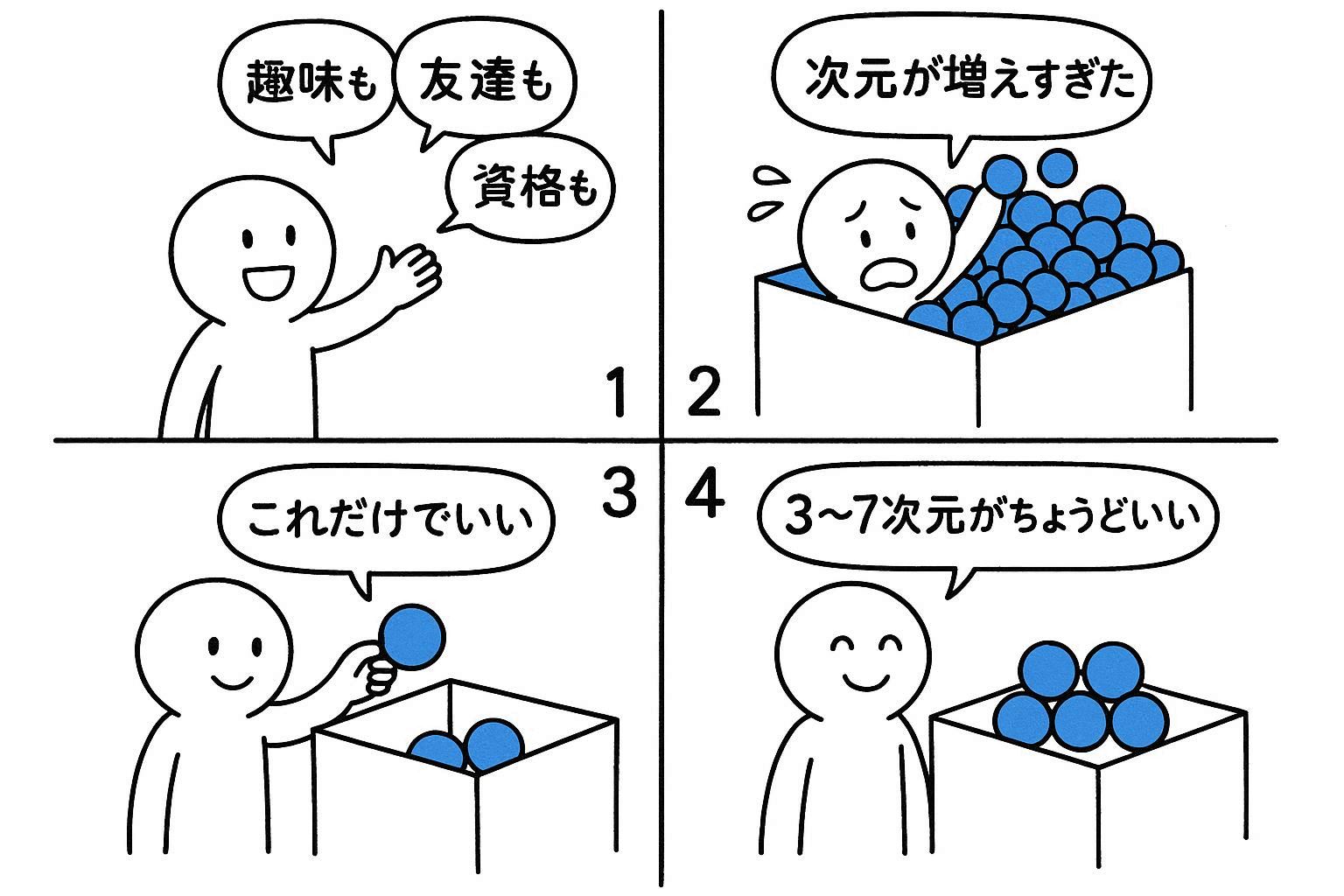
The solution is simple: reduce the number of dimensions. Narrow it down to three or four. Then energy concentrates on the remaining axes, and each one gains depth. You transform from "jack of all trades" into "someone with a distinctive edge."
Reducing dimensions is never "narrowing your possibilities." Rather, it's a strategy for focusing on what truly matters.
Adding Dimensions or Removing Them?
Reading this far, you might be starting to think:
"So I should just reduce my dimensions?"
The answer is "it depends."
Adding dimensions (value axes) does come with costs. Maintenance becomes harder, and the energy available per axis shrinks. So should you go to the extreme and reduce everything?
Only work. Or only family. If you narrow down to a single axis, you can maximize performance on that axis. But in the world of multiplication, if the other axes are zero, the total is zero too.
So there's a trade-off here.
Many dimensions → Easier to maintain balance, but each one becomes shallow
Few dimensions → You can go deep, but the risk is higher and the whole becomes fragile
Life exists on top of this trade-off.
So what should you do? The answer is "not too many, not too few" -- in other words, finding the number of dimensions that's right for you.
It may sound like a half-measure, but that's the realistic solution. In the prologue, the word "Doctrine of the Mean" came up, and this is exactly it. When it comes to the number of dimensions, the middle path is the most stable.
How to Choose Your Dimensions in Practice
So how many dimensions are appropriate?
As a rule of thumb, 3 to 7 dimensions is a realistic range.
3 dimensions (Career, Family, Health) is the minimum. With just these, the foundation of life holds. You could call it the "basic shape" of life.
5 dimensions (adding Hobbies and Relationships) is standard. Most people can maintain balance in this range without too much strain.
7 dimensions (adding Education, Social Contribution, etc.) requires fairly conscious management to sustain.
At 10 dimensions or more, distortions will almost certainly appear somewhere. Distributing energy evenly across all axes approaches physical impossibility.
What matters here is that "which axes to choose" is something you decide yourself. This book isn't going to tell you "pick these and these."
But I do want to offer one criterion for choosing. Judge by "how much the product of your life would decrease if you removed that axis."
Remove a truly important axis, and overall fulfillment drops significantly. Conversely, some axes won't cause much pain if removed. Having the courage to let go of the latter is one valid approach.
Practice: Mapping Your Box and Sphere
At the end of this chapter, there's something I'd like you to actually try.
Write down the size of your "box" and the radius of your "sphere."
Start with the box. How many hours in your day are truly yours? Subtract obligated time -- work, commuting, chores, sleep -- and calculate your "available time for yourself." For some people it might be 2-3 hours; for others, even less.
Next, the sphere's radius. Honestly estimate your own capacity. How many things can you juggle at once? Are you good at multitasking? How vulnerable are you to stress?
Once you grasp these two, your limits become visible naturally.
"I can only properly handle about three things per week."
"My capacity is maxed out right now, so I can't start anything new."
Once you can visualize things like this, you stop making unrealistic plans. You also stop blaming yourself.
What we learned in this chapter is one thing:
"You have limits. But knowing those limits is the first step to drawing out the maximum within them."
In the next chapter, taking these "limits" as given, we'll think about concrete methods for actually balancing your life.
Two Constraints
In Chapter 1, each normalized value axis $x_i \in [0,1]$ defined the "walls" of our space. This gives us the unit N-hypercube $[0,1]^N$. But real human beings face an additional constraint: the upper limit of "total energy usable at any one time."
These two constraints are expressed mathematically through different "norms" (ways of measuring distance).
L-infinity norm (the cube's walls): Each axis cannot exceed the range [0,1]. A day has 24 hours. A body cannot be in two places at once. These are absolute boundary conditions.
L2 norm (the sphere's radius): The sum of squares across all axes cannot exceed a certain value. This is a resource constraint meaning "you can't maximize everything simultaneously."
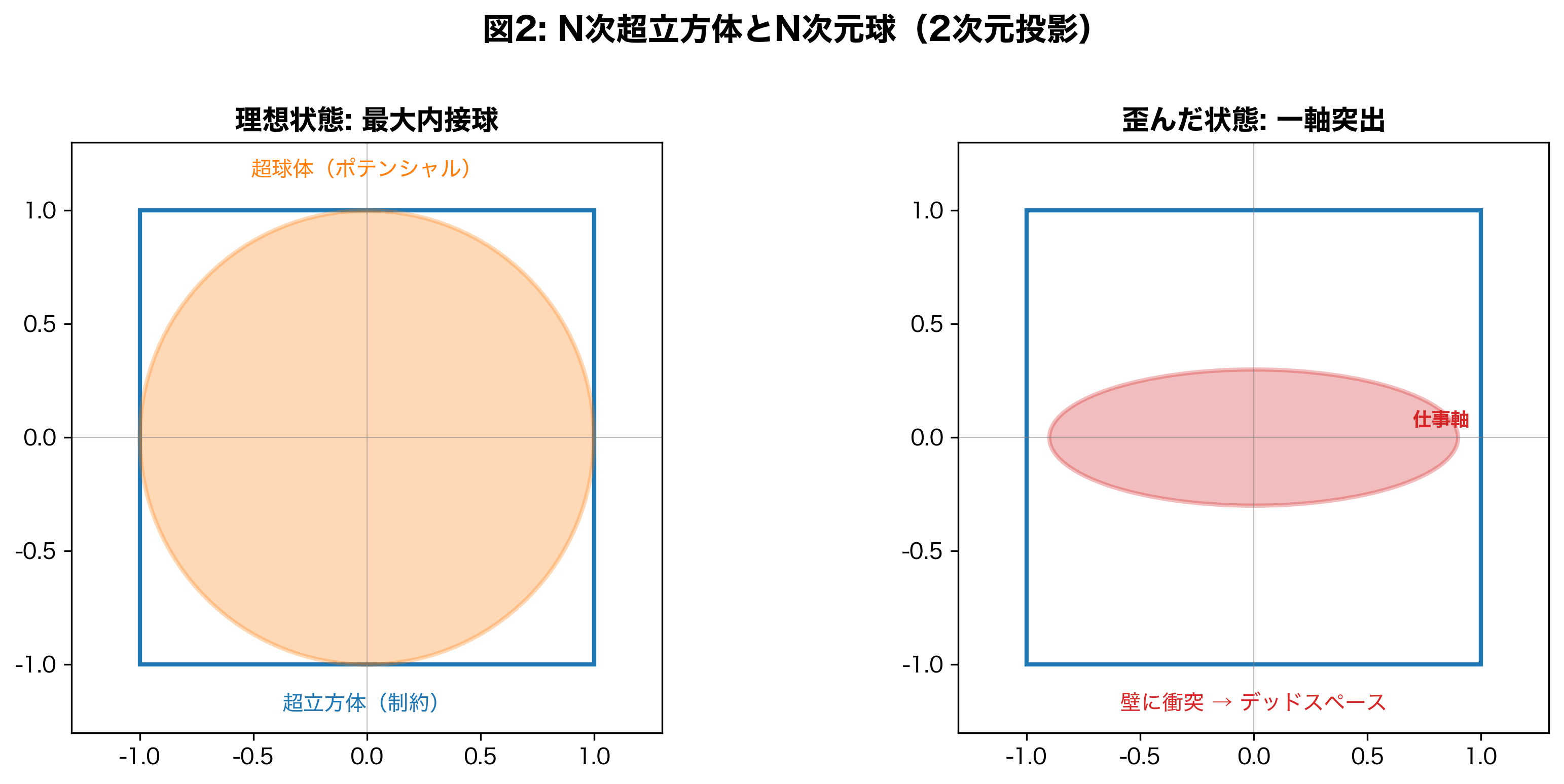
We can model ourselves as "an N-dimensional sphere embedded within a unit hypercube." The cube represents physical and social absolute limits; the sphere represents personal energetic capacity.
The Sphere Inside the Box
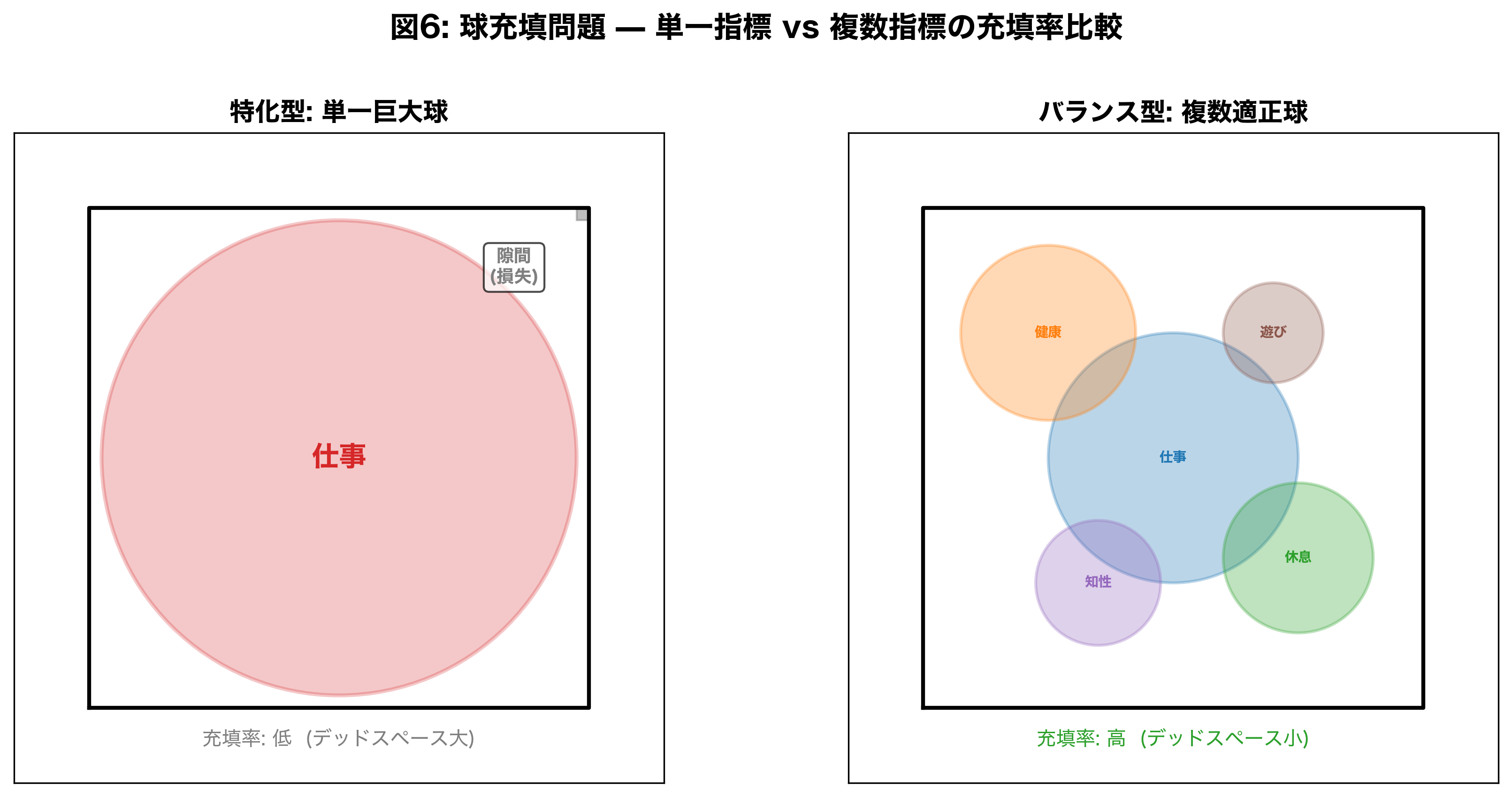
Imagine the figure. In two dimensions (a plane), this is "a circle inscribed in a square of side length 1." Draw a circle of radius 0.5 centered on the square, and the circle is inscribed within it, creating small gaps (dead space) in the four corners.
These "gaps" are important. The four corners of the square correspond to the state of "one axis is extremely high, but another axis is extremely low." For example, the state of being a "workaholic sacrificing health" maps to a corner of the 2D space.
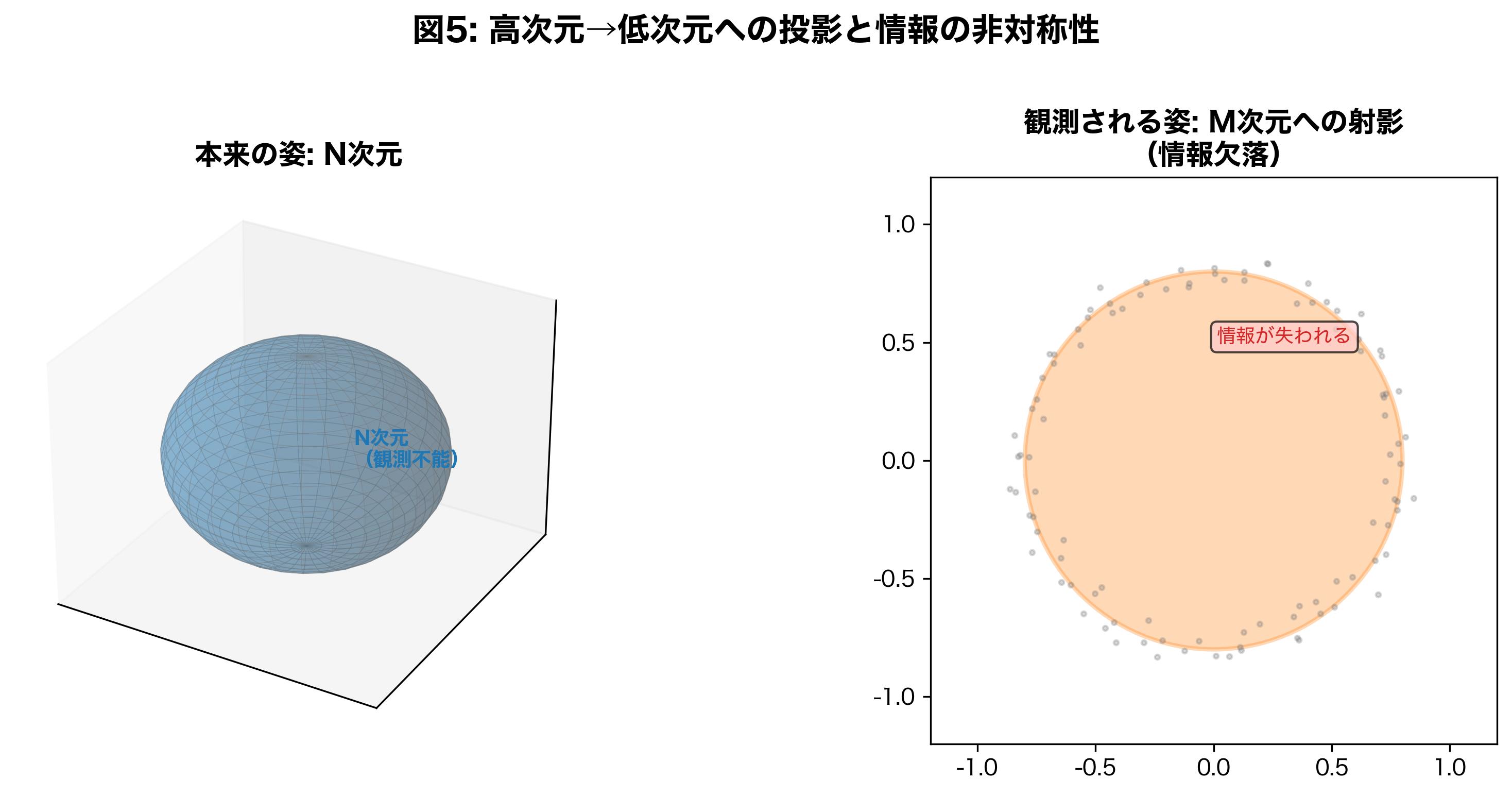
In three dimensions, the situation becomes even clearer. The volume of the sphere inside the cube is smaller than the cube's volume (= 1). And as dimensions increase, this ratio changes dramatically.
The Curse of Dimensionality: What Happens as Dimensions Increase
This is one of the most important mathematical facts in this entire book.
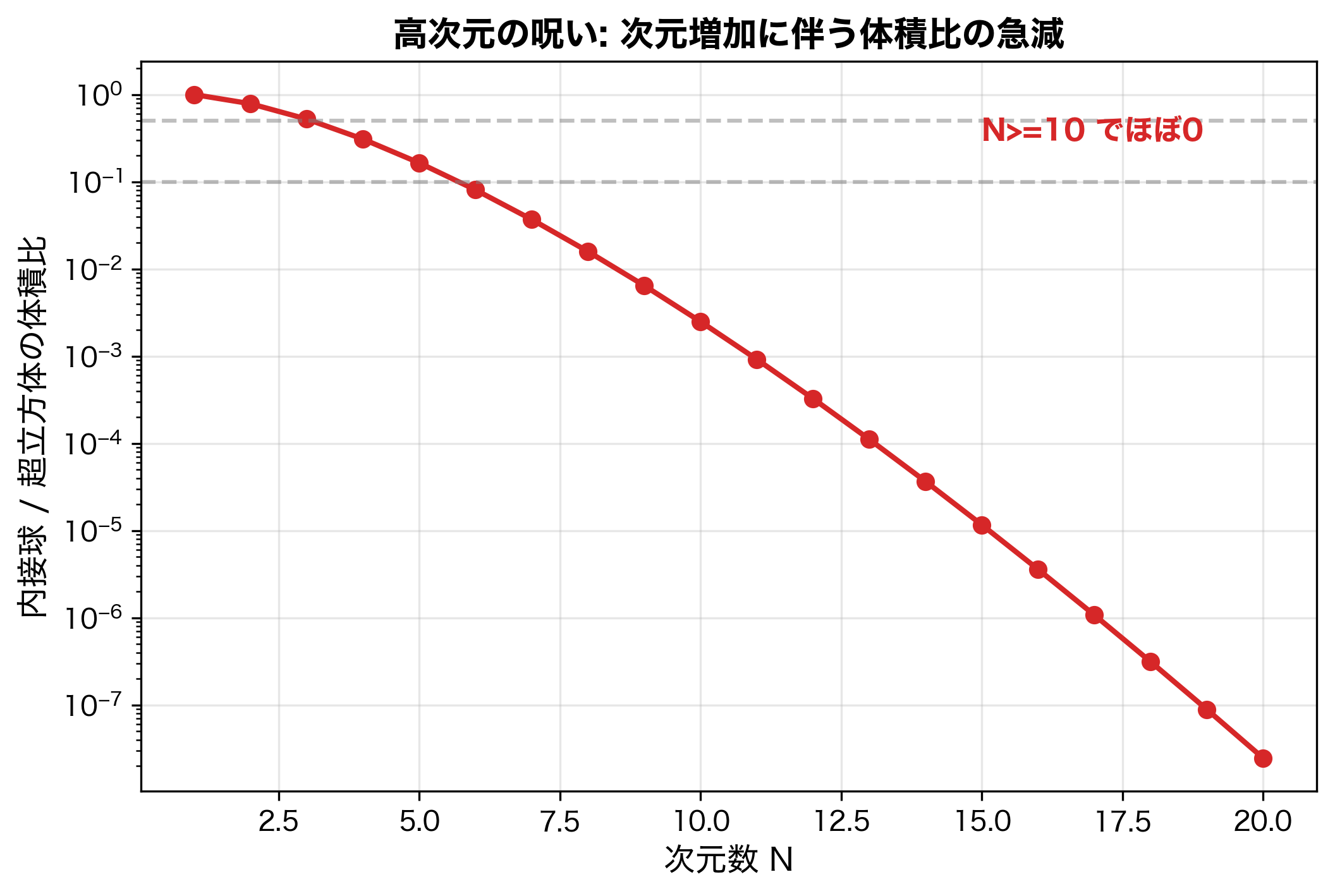
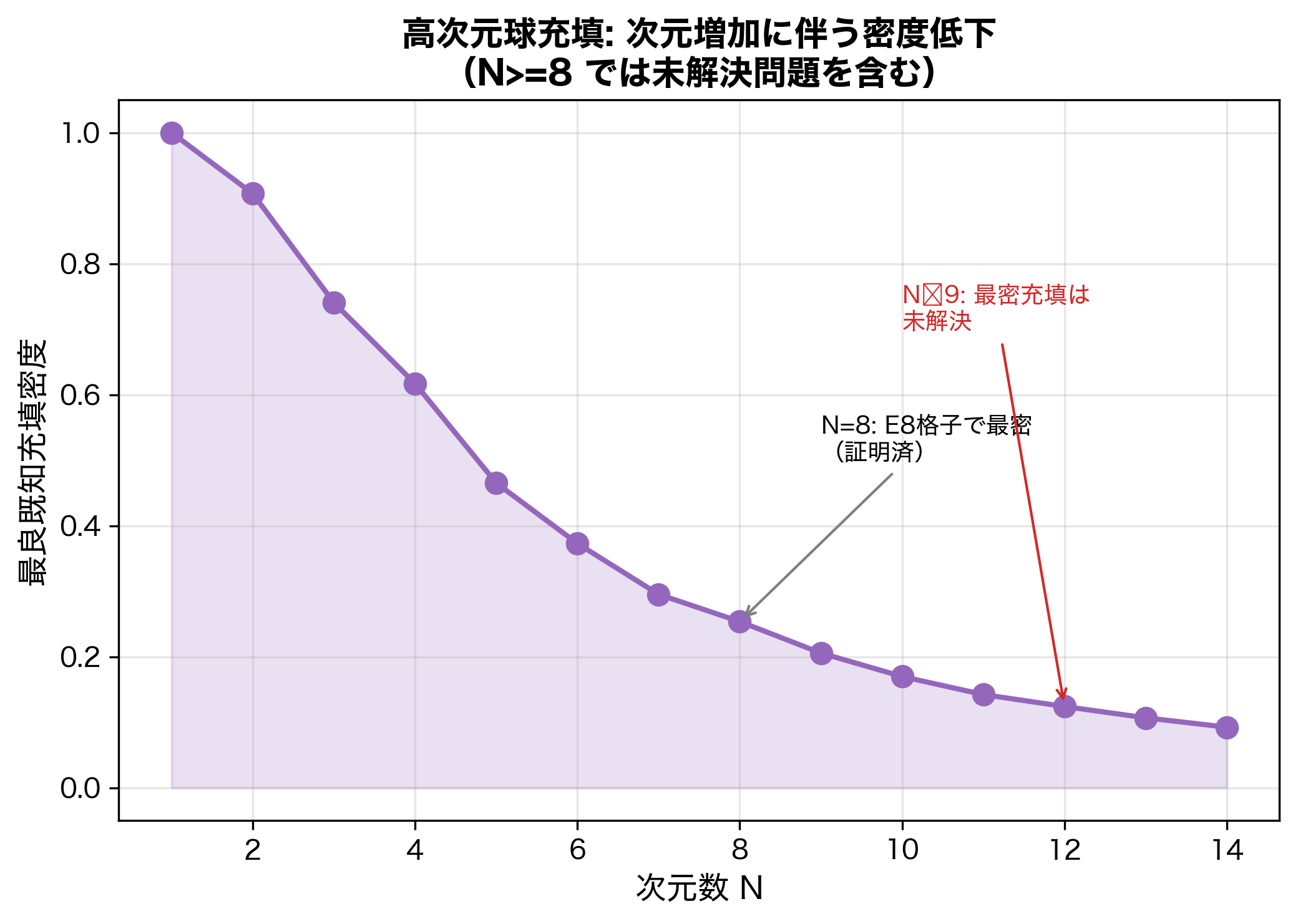
As dimension N increases, the volume of the sphere inscribed in the unit hypercube approaches zero. Specifically:
N=2 (2D): Square area = 1, inscribed circle area is approximately 0.785. Ratio is approximately 78.5%.
N=3 (3D): Cube volume = 1, inscribed sphere volume is approximately 0.524. Ratio is approximately 52.4%.
N=10: The ratio drops to about 0.25%.
N=100: The ratio is effectively zero.
In other words, the strategy of "doing reasonably well across all value axes" (being inside the sphere) occupies an ever-smaller fraction of the cube as dimensions increase. Almost all of the "volume" concentrates in the cube's corners.
What does this mean for real life? The more values you hold, the physically harder it becomes to "live in balanced harmony across all directions." If you try to pursue 10 values simultaneously, you will inevitably be pushed into "corners" (extreme imbalances) on several axes.
The State of Being Pushed into a Corner
Being positioned at a corner of the cube means "near the maximum on some axes, but near the minimum on others." This corresponds to what many people describe as a "work person," a "family-only person," or "someone who lives for their hobbies."
Being in a corner isn't inherently bad. In high dimensions, being in a corner is actually statistically normal. Being average across all axes (inside the sphere) is the unusual state.
The question is whether you recognize which corner you're in. Being unconsciously pushed into a corner versus strategically choosing your corner are qualitatively different, even if the hypervolume value is the same.
For example, in an N=3 space, the state "Career=0.9, Health=0.9, Family=0.1" and "Career=0.3, Health=0.3, Family=0.9" both yield the same hypervolume of approximately 0.08 (0.9 x 0.9 x 0.1 = 0.3 x 0.3 x 0.9 = 0.081), yet they represent entirely different qualities of life.
Between the Inscribed and Circumscribed Spheres
We live under the dual constraint of the cube (absolute limits) and the sphere (personal capacity). The ideal state is to be inside the sphere (holding some value on all axes) without crashing into the cube's walls (physical limits).
But in reality, we often end up in states like these:
Extending beyond the sphere: Capacity overload. Burnout, sleep deprivation, deteriorating health. Hypervolume might increase, but it's unsustainable.
Inside the sphere but pressed against the cube's walls: Channeling energy into only specific axes. Hypervolume is decent but balance is lacking.
Near the center of the sphere: Moderate values across all axes. Good balance, but nothing stands out. Hypervolume is moderate.
Which one is "right" depends on the situation. As we'll see in Chapter 3, this choice is determined by the balance between strategic partial derivatives and physical time derivatives.
Dimensionality Reduction as Strategy
One way to cope with the curse of dimensionality is to reduce the number of dimensions you think about. Rather than trying to optimize across all directions in an N=100 space, it's more practical to reduce to an N=5 space and then think about strategy.
This aligns with the practical wisdom of "keep your truly important values to five or fewer." The remaining 95 values can be treated as subcategories of those, or consciously ignored.
Methods of dimensionality reduction include:
Factor-analysis-style grouping: Consolidate "intelligence," "knowledge," and "judgment" into a single "intellectual performance" axis.
Importance filtering: Remove axes with small contributions to hypervolume.
Hierarchical structuring: Arrange values in a tree, with higher-order values above and lower-order values below.
Reducing dimensions does mean "lowering resolution." The ability to switch between situations that require detailed analysis and situations where a rough strategy suffices is the wisdom for surviving in high-dimensional space.
You Can't Be Perfect at Everything
In the previous chapter, we discussed how life is evaluated by "multiplication." We learned that keeping multiple value axes in balance is crucial.
But now we hit a wall.
No matter how hard you try, you can't be perfect at everything simultaneously.
You only have 24 hours in a day. Your physical stamina has limits. Your concentration runs out. People who excel at work end up with less time for friends. Prioritizing family cuts into hobby time.
This isn't about "not trying hard enough." It's about physical constraints.
No matter how capable we humans are, there's an upper limit to the time and energy we can devote to any one thing. In the prologue, I said "raise all your dials" -- but that meant "ideally," not "you can raise all of them without limit."
From here, life's difficulty intensifies.
The ideal is "keeping all dials high." The reality is "the more dials you have, the less energy you can devote to each one." This gap is the first clue for getting closer to the true nature of that vague feeling of unfulfillment.
So how should we think about this gap? On the next page, I'll introduce a way to visualize it.
Chapter 3: Two Differential Operators on Value Space
The Question: "What Should I Change Right Now?"
Let's consider the first question. "What would be most effective for me to change right now?"
Career, health, relationships, hobbies, education -- life has many aspects. Ideally, you'd improve all of them at once, but in reality, time and energy are finite. You need to focus somewhere.
Here's a mistake many people make: they ignore "what they're worst at" and try to further develop "what they're already good at."
For example, someone who's good at their job works even harder at it. Someone who's bad at exercise decides "exercise isn't for me" and avoids it. This seems reasonable at first glance. Build on your strengths and you get quick results.
But there's a trap here.
Life fulfillment is determined not by "averages" but by "multiplication." In the world of multiplication, raising something that's already high yields far less overall improvement than raising something that's low, even by a little.
In other words, the answer to "what should I change right now?" is simple -- it's the area you're avoiding the most.
The Mathematical Basis for "Strengthen What's Lacking" (Without Using Any Equations)
Being told "overcome your weaknesses" stings a little. You'd rather skip past it.
But there's solid reasoning behind it. I won't use equations, but let me explain with an image.
Think of your life as the volume of a rectangular box. The box's "length," "width," and "height" each represent different aspects of life.
Imagine a box with a long length but an extremely short width. Adding more length won't increase the volume much. Why? Because the width is so short that the "receiving area" is tiny.
The same 10-centimeter effort added to length versus width produces completely different increases in volume. If the width is extremely short, adding to the width gives a much larger increase.
That's the basis for "strengthen what's lacking."
Working on a weak area is certainly painful. At first, things don't go well. It can be embarrassing. But the "growth" you get from overcoming it is far greater than further polishing a strength.
Avoiding your weaknesses is rationally wrong.
A Concrete Example: If You Have Few Friends, Should You Fix That?
Let's think through a real example.
Suppose your current state looks like this. You're reasonably good at your job (7 points). Health isn't bad (7 points). You have decent money (6 points). But you have almost no friends. Relationships are at 2 points.
What do most people think in this situation?
"I'm not good at making friends. I'm good at my job, so I should just focus on work."
But here's the multiplication trap: 7 x 7 x 6 x 2 = 588. Now raise Relationships from 2 to 3, and the answer becomes 882. About 1.5 times bigger.
Meanwhile, raising Career from 7 to 8 gives 7 x 8 x 6 x 2 = 672. Barely any improvement.
"But making friends is hard. I'm better at my job, so getting results at work is easier."
I completely understand that feeling. But what I want you to think about here isn't "what's easy" but "what's effective." Precisely because it's a weakness, that's where the greatest room for growth lies.
Keep running from your weaknesses, and overall growth stalls. The courage to face them is what lifts your entire life.
Sensitivity Analysis: "Which Dial Is Most Effective to Turn?"
Imagine a TV volume dial. Right now, the volume is at "2." Turn it up to "3," and you definitely notice the increase. But if the volume were already at "8" and you turned it up to "9," the perceived change would be small.
The same principle applies to every aspect of life.
Let's call this "sensitivity." The "sensitivity" of a given aspect is a measure of "how much your whole life changes when you turn that dial a little."
The dial with the highest sensitivity is always the one that's currently lowest.
Because life fulfillment is "multiplication." In multiplication, making the smallest number slightly bigger changes the answer dramatically. Conversely, making the biggest number even bigger has a small effect on the total.
What's the lowest dial in your life right now? Health? Relationships? Or time spent facing yourself?
That's the dial with the highest "sensitivity" right now. Finding it is the first step.
On the Other Hand: The "Trying Too Hard Breaks You" Problem
Reading this far, you might be thinking:
"All right, I'm going to improve my weak spot -- health. I'll go to the gym every day and go on a diet..."
Hold on. That's the other trap.
The strategy of "strengthen what's lacking" is correct. But executing it takes energy. Where does that energy come from?
From your body and your brain.
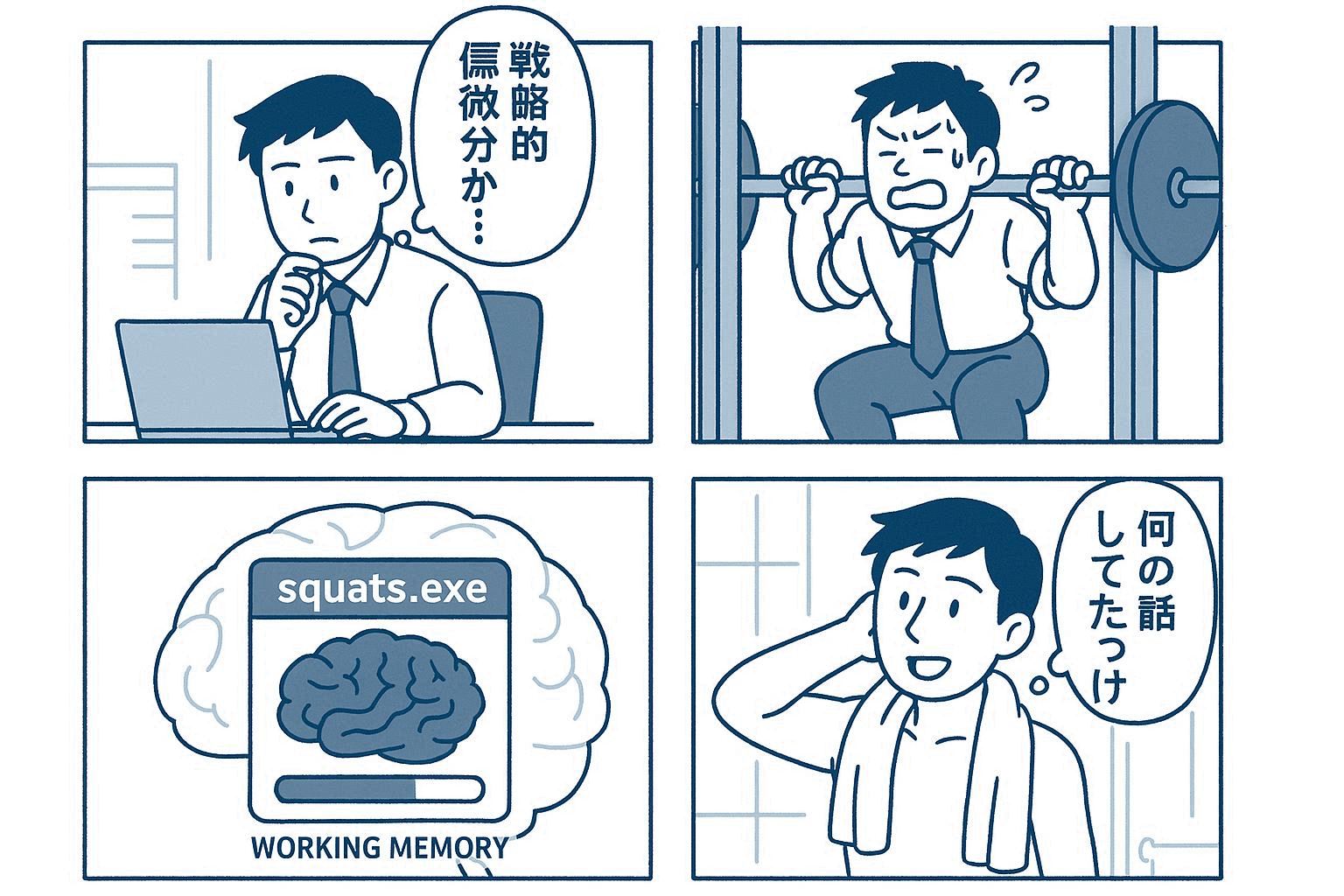
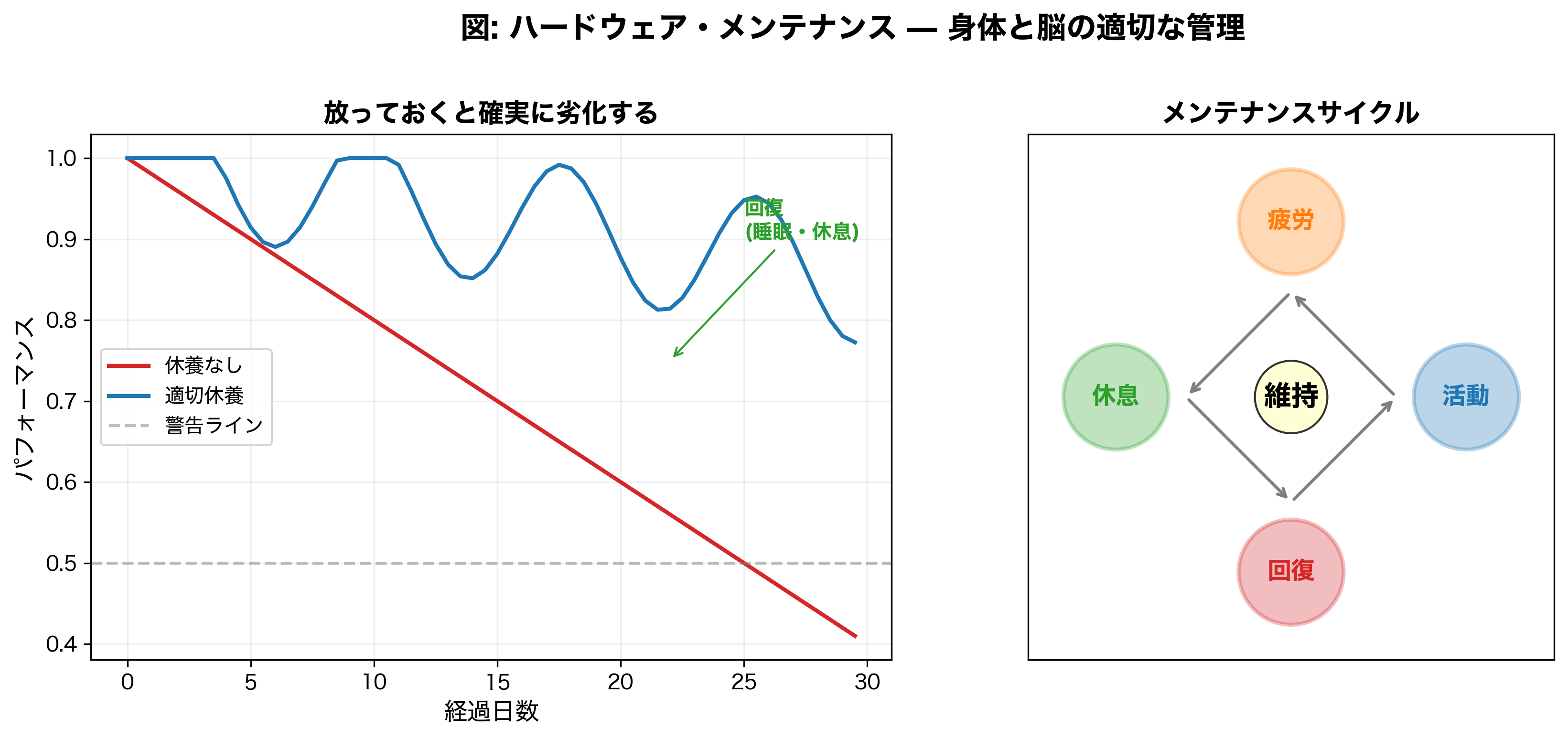
Our bodies and brains are physical hardware. Just like a smartphone battery, they deplete as you use them. Without recharging, they eventually die.
Improving a weakness requires more energy than usual. Doing something you're not used to puts a heavy load on the brain. As a result, other areas get neglected, and the overall effect can turn negative.
An extreme example: cutting sleep to study for a certification. Sure, the Education dial goes up. But the Health dial drops, and work performance declines too. The product ends up worse than before the effort.
The harder you try, the worse the results. How do you avoid this ironic situation?
Your Body and Brain Are Hardware (Physical Limits)
Your body and brain are not software. Updates won't infinitely improve their performance.
Run heavy processes continuously on a computer, and the fan roars until eventually it overheats. Humans are the same. Excessive sustained load will inevitably cause problems somewhere.
Sleep deprivation, poor diet, chronic stress -- these are all gradually damaging your hardware. And this damage is hard to notice.
Interestingly, the human brain cannot correctly recognize when it's fatigued. The more tired you are, the worse your judgment becomes, leading to the false conclusion of "I just need to push harder." It's like driving a car with a broken fuel gauge.
Here's a principle to remember: "Every effort is sustained by lowering some other dial."
Work overtime, and health drops. Go to social drinks, and self-improvement time shrinks. Scroll social media, and sleep time gets carved away.
Always being aware of the fact that "something is being lowered." That's the first step to not destroying your hardware.
How Sleep Deprivation Impairs Judgment
Let's dig deeper into the topic of sleep.
You've probably experienced that foggy-headed feeling from lack of sleep. This isn't just a sensation -- your brain function is literally declining.
Under sleep deprivation, activity in the prefrontal cortex -- the region responsible for "rationality" -- drops significantly. What happens then? Impulsive decisions increase, long-term perspective vanishes, and irritability rises.
And the most dangerous part is that you can't recognize that your judgment is impaired.
It's the same as drinking alcohol: the drunker someone is, the more they insist "I'm not drunk." Sleep deprivation works the same way. The more exhausted someone is, the more they believe "I can still push harder."
This triggers a terrifying loop:
Tired --> Judgment declines --> Misjudge "I can still push" --> Get even more tired --> Judgment declines further --> ...
The only way out of this loop is to externally force rest. Since you can't judge for yourself, you have to bind yourself with rules.
"No work after 10 PM." "Take one day a week where you do nothing." -- Such simple rules are actually the most sophisticated strategies.
A Concrete Example: Sudden Career Burnout
Let's look at a concrete example. The story of an office worker, let's call them A.
A was dedicated to their job, working late every day. Performance reviews were strong, promotions were on track. Strategically, they were correct. They were cranking the Career dial hard, maximizing career value.
The problem was that they completely ignored stamina.
Average sleep was 5 hours. Working weekends was normal. Meals were convenience store bento. Zero exercise. A's hardware was deteriorating, little by little, every single day.
Then one day, without warning, A couldn't move. Couldn't get out of bed in the morning. Hit by anxiety with no clear cause. Brain completely foggy.
The doctor's diagnosis: "adjustment disorder." In other words, the hardware was screaming.
What's important here is that A didn't make a "strategic mistake." The choice to focus on work may have been correct. The problem was the total absence of "stamina management" for executing that strategy.
No matter how correct the strategy, broken hardware can't execute it.
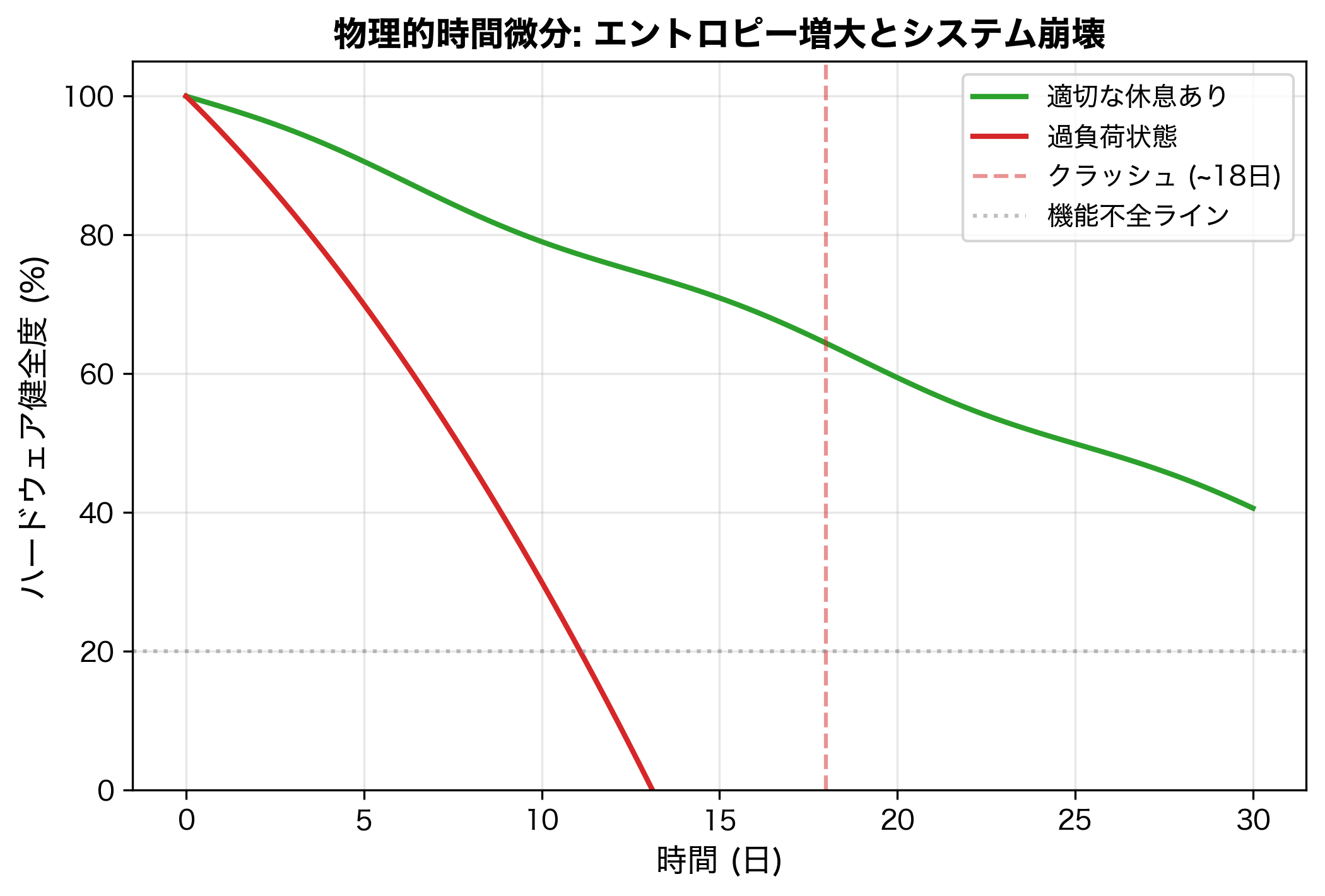
Burnout seems to strike suddenly, but it actually has a long buildup period. Each day's slight overheating accumulates, and when a threshold is crossed, the system shuts down all at once.
Mixing Up the Two Types of "Change" Leads to Failure
Let's organize what we've covered so far.
Strategy: the directional question of "which dial should I turn?"
Stamina: the sustainability question of "can I keep turning that dial?"
These two are completely different things. Yet in daily life, we constantly mix them up.
Here are the typical failure patterns.
Pattern A: "Only think about strategy, ignore stamina"
You realize "I should improve my relationships" and attend drinking parties and events every week. But as an introvert, pushing yourself like this depletes you, and you end up quitting after three days. The strategy was right, but you couldn't execute it.
Pattern B: "Only think about stamina, ignore strategy"
"Health comes first no matter what" -- all rest, no action. Sure, the fatigue is gone, but after a year, nothing has changed. It's like charging a battery and never using it.
Pattern C: "Think about neither"
This is where most people fall. Vaguely going through each day, vaguely trying hard, vaguely getting tired. No change, no growth. This is the biggest waste.
Successful change requires the habit of considering both simultaneously. Decide strategically what to change, then execute within the limits of your stamina.
PDCA vs. Subtraction Management
In the business world, people say "run PDCA cycles." Plan, Do, Check, Act. Repeat this and results keep improving. That's the belief.
But in life, the strategy of "endlessly running PDCA" has a trap.
PDCA assumes a world with infinite resources. Planning and executing always consumes something -- time, stamina, concentration, mental energy. If those were unlimited, PDCA would be the ultimate strategy.
But real resources are finite. In fact, "removing something" is often more effective than "adding something."
This is the thinking of "subtraction management."
Instead of adding things to do, decide what not to do. Instead of starting new habits, quit wasteful ones. Instead of multiplying the directions you push hard in, narrow your focus.
For example, having few friends and frantically attending networking events is "addition management." But simply "reducing aimless phone-scrolling time" frees up that time for reading or sleep. That's "subtraction management."
Before PDCA, think about what you truly need. Then strip away what you don't. That's the beginning of sustainable change.
The Habit of Monitoring Both Types of Change Simultaneously
Finally, let me introduce a habit you can start today.
It's this: monitor "strategy" and "stamina" separately.
Here's the concrete method.
Every night before bed, think about two things.
First: "Was I moving in the right direction today?" (Strategy check)
Was I neglecting health in favor of work? Was I avoiding a weak area? Was I turning the optimal dial for who I am right now?
Second: "Am I too depleted?" (Stamina check)
Did I get enough sleep? Is stress building up? Any abnormalities in my hardware?
Just by checking these two things separately, the precision of your life's "steering" improves dramatically.
Most people only look at one or the other. Those who only watch strategy push too hard and break. Those who only watch stamina never change.
Only those who watch both can keep growing over the long term.
"What to change" and "can I sustain the change." Make these two questions a daily habit. Combine the "personal hypercube" you learned in Chapter 1 with the "two types of change" from this chapter, and your life will surely move forward.
Two Types of "Change"
We say "I want to change." But this phrase contains two completely different meanings.
The first is the question "which axis should I move in which direction to increase my life's hypervolume?" This is a matter of strategic choice. The second is the question "is sustaining this change depleting me?" This is a matter of physical maintenance.
This book calls the former strategic partial derivative and the latter physical time derivative, and draws a sharp distinction between them. This distinction is the linchpin of the entire framework.
Strategic Partial Derivative: Which Axis to Move
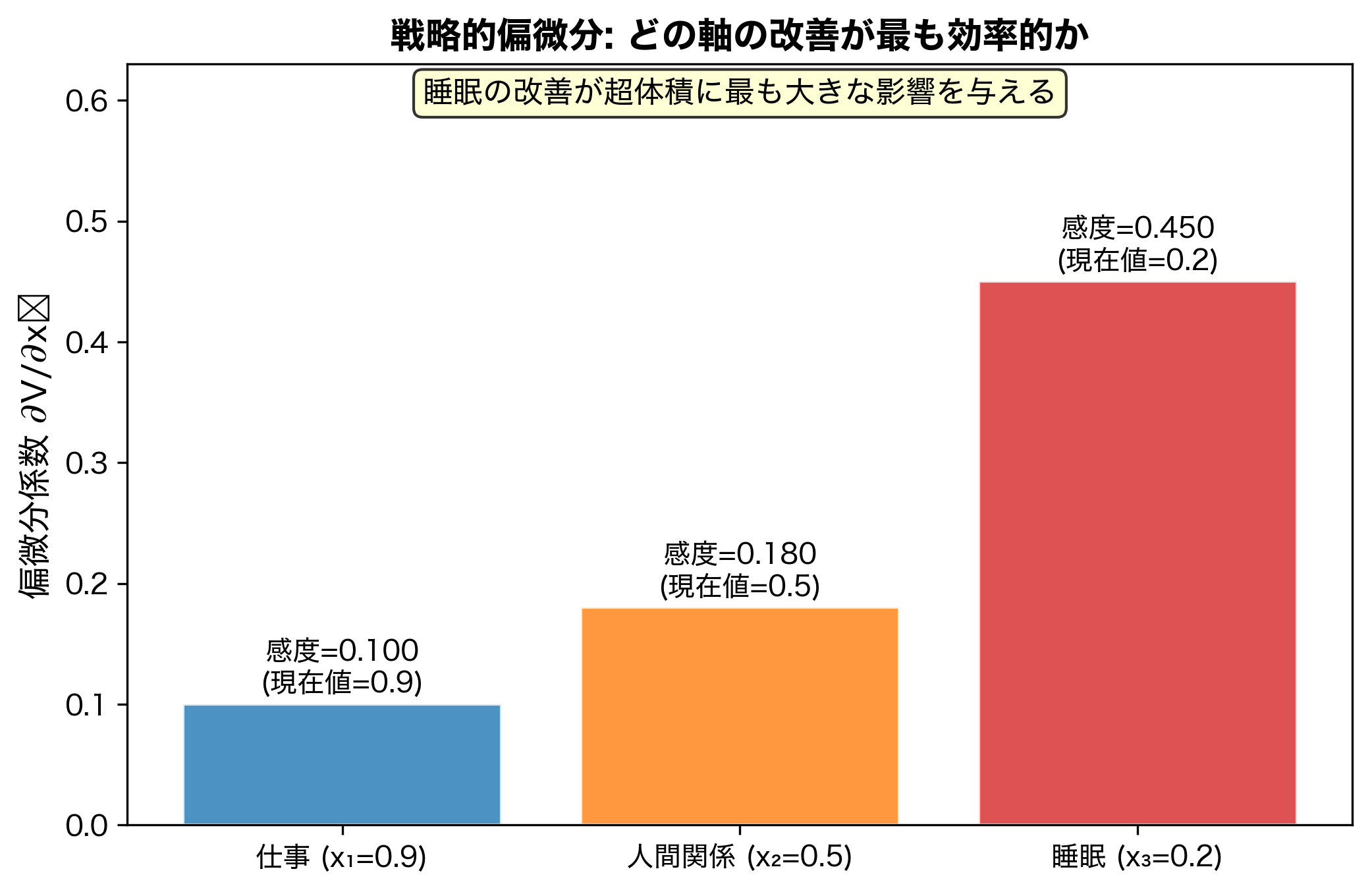
Measuring the impact of a specific axis $x_k$ on hypervolume $V = \prod x_i$ is what the partial derivative does:
$\partial V / \partial x_k$ = (product of all axes except $x_k$)
The meaning of this formula is intuitive. The "importance" of a given axis depends on how well-stocked the other axes are. For instance:
Suppose you're in the state "Career=0.9, Health=0.2, Family=0.3." The partial derivative of the Health axis is 0.9 x 0.3 = 0.27.
Meanwhile, the partial derivative of the Career axis is 0.2 x 0.3 = 0.06.
In other words, improving Health slightly is about 4.5 times more effective for hypervolume than further improving Career.
This calculation aligns with intuition. If your career is already high enough, investing in the obviously deficient health is clearly a "better deal." The strategic partial derivative quantifies "where to allocate resources."
Paradoxical conclusion: the strategy for maximizing hypervolume is to concentrate resources precisely on your weakest area. Overcoming weaknesses carries the greatest leverage.
Physical Time Derivative: Hardware Wear
But here, the second derivative intervenes. Our bodies and brains are physical hardware; used continuously, they wear down.
The physical time derivative $dS/dt$ represents the rate of change of hardware state $S(t)$ over time:
$dS/dt = -\alpha P + \beta R$
$P(t)$ is consumption (workload, stress, cognitive load)
$R(t)$ is recovery (sleep, rest, nutrition)
$\alpha$ and $\beta$ are coefficients representing individual characteristics
What this formula shows is a simple fact: "if consumption consistently exceeds recovery, the hardware will break."
While the strategic partial derivative tells you "which axis to move in which direction," the physical time derivative tells you "how much that movement depletes you." These two are independent and must be considered simultaneously.
The Trap of Confusing the Two Derivatives
Here lies the trap many people fall into: the loop of "the harder you try, the more depleted you become."
Suppose the strategic partial derivative instructs "improve the Health axis." You resolve "okay, I'll join a gym." But trying to go to the gym while work is busy pushes the physical time derivative $dS/dt$ further negative (consumption increases). As a result, the Health axis might improve slightly, but the overall hardware state worsens. After a few weeks, fatigue prevents you from going to the gym, and you end up worse than before.
This is a typical case where "the instruction of the partial derivative" and "the constraint of the time derivative" collide. The partial derivative only tells you the sensitivity at a static snapshot. It doesn't account for temporal depletion.
Escaping this trap requires the following recognition:
"Working hard" and "changing effectively" are not the same thing.
The Redistribution Strategy for Partial Derivatives
An optimization strategy that considers both derivatives simultaneously is the "redistribution of partial derivatives." This consists of two stages:
Stage One: Lower the Partial Derivative
Consciously lower the absolute value of the partial derivative for a specific axis. "Don't be so obsessed with work." "Don't have excessive expectations for relationships." This may look like regression, but this operation reduces "the sensitivity of hypervolume to fluctuations in that axis." With lower sensitivity, reducing the resources allocated to that axis has minimal impact on hypervolume.
Stage Two: Redirect Freed Resources to Recovery
The time and energy freed by lowering the partial derivative are channeled into the recovery term $\beta R$ of the physical time derivative. In other words, "increase the derivative value of rest." This directly improves $dS/dt$ and enhances hardware sustainability.
Let's think through a practical example. You have Career ($x_1$=0.8) and Health ($x_2$=0.3), with the partial derivative of Career at $\partial V/\partial x_1 = 0.3$ and Health at $\partial V/\partial x_2 = 0.8$. Ideally you'd improve Health, which requires cutting overtime to increase sleep. But cutting overtime drops $x_1$ -- a dilemma.
Apply "partial derivative redistribution" here. The cause of "Career's partial derivative being high" isn't that $x_1$ is too high; it's that the other axes are too low. In fact, if Health rises from 0.3 to 0.4, Career's partial derivative rises from 0.3 to 0.4. In other words, improving Health also raises "Career's importance."
Paradoxical but illuminating conclusion: the best way to improve a specific axis is not to attack it directly, but to improve a different axis and indirectly shift the partial derivatives.
Integrating the Two Derivatives
What's ultimately needed is dynamic optimization that integrates the strategic partial derivative and the physical time derivative. Rather than pursuing a static "ideal state," you gradually move in the optimal direction (the direction indicated by $\partial V/\partial x_i$) while accounting for the current hardware state $S(t)$.
This integration leads to the concept of the "quantum Nash equilibrium" we'll cover in Chapter 8. Gradually transitioning the system toward a desirable state while maintaining stability -- that is the strategy of someone who understands both derivatives.
Two Meanings Hidden in "I Want to Change"
"I want to change." You've probably thought that at least once.
I want to change who I am now. I want to grow. I want to become a better version of myself. That desire itself is very positive. But there's a trap hidden here.
The phrase "I want to change" actually contains two completely different meanings mixed together.
The first is the question "what to change." Which aspect of your life, moved in which direction, would make the whole better? This is a matter of strategy.
The second is the question "can I keep changing?" Change requires energy. Is the effort wearing you down? This is a matter of stamina.
Mix these two up, and you'll make a terrible mistake.
If you just think "I'll try harder" and push forward blindly, you'll spin your wheels if the direction is wrong. Conversely, if you only think about the "right direction" but never act, nothing changes.
Strategy and stamina. Thinking about these two separately. That's our starting point.
Chapter 4: Multi-Agent Interaction and the Amoeba Model
What Happens When Others Appear
Imagine you're reading alone in your room. That space is entirely yours. Read a book, listen to music, take a nap -- in every dimension, you are sovereign.
Now, what happens when someone else walks in?
First, the "space" dimension becomes shared. If they make loud noises, the "quietness" dimension is violated. If they start talking to you, the "concentration" dimension is disrupted.
In other words, the arrival of another person turns dimensions you once occupied exclusively into "shared dimensions."
In shared dimensions, your actions affect others, and others' actions affect you.
Think about the workplace. The "evaluation" dimension is shared with colleagues. If you work hard to raise your evaluation, your colleagues' relative evaluations drop. And vice versa.
Here's an important realization: in shared dimensions, "optimizing for yourself alone" doesn't work. It becomes a "game" where you must factor in the other person's moves.
This is the single biggest factor that makes life complicated.
Deforming from Sphere to Amoeba
Let's call your personal ideal state a "sphere." A beautiful shape where all value axes extend in balanced proportion.
But when a relationship with someone else begins, this sphere is forced to deform.
It gets squished flat in some directions and extends sharply in others. The overall shape becomes irregular. This is the "amoeba" state.
Why does the sphere need to become an amoeba?
Because in shared dimensions, "the nail that sticks out gets hammered down." If you produce a value that's too high on a given axis, friction arises with those around you. Outperform colleagues and you'll be resented. Be wealthier than friends and everyone walks on eggshells.
To avoid this friction, we unconsciously "dent" our values in shared dimensions. We deliberately stay unremarkable, keeping ourselves deliberately modest.
But that alone is a loss. The energy you saved by denting could be used elsewhere. So the amoeba extends "pseudopods." In other words, it excels in dimensions that are exclusively yours.
Keep a low profile at work (dent), but pursue depth in a private hobby (excel). This is the amoeba's fundamental mode of operation.
Distinguishing Shared Territory from Private Territory
To understand amoeba deformation, you must grasp the distinction between "shared dimensions" and "exclusive dimensions."
Shared dimensions are areas where you interact with others:
- Results and evaluations at work
- Conversations and communication
- Physical space and time
- Money and resources
In these, your actions affect someone else, and someone else's actions affect you. Adjustment and friction are constant companions.
Exclusive dimensions are your private territory:
- Introspection and thinking
- Values and beliefs
- Hobbies and things you can lose yourself in
- Rest and time spent facing yourself
These are basically free from others' influence. You control them freely.
The core of the amoeba strategy is clearly distinguishing these two and using them differently.
In shared dimensions, intentionally dent yourself to reduce friction. Channel that freed energy into exclusive dimensions to deepen your personal value.
"Modest on the surface, intensely focused within." That's the amoeba's ideal form.
Many people fail because they can't make this distinction. They try to push hard in every dimension and burn out, or try to hold back in every dimension and fade into nothing.
Strategically Not Showing Off
The word "denting" might give a negative impression. Making yourself look smaller -- isn't that cowardly?
But what I'm describing is "strategic denting." It's completely different from simple meekness or inferiority.
Strategic denting satisfies three conditions.
First, there's a purpose. You have a clear reason for "why I'm keeping a low profile in this situation." For example, "to maintain team harmony" or "to build long-term trust."
Second, it's active. You're not being pushed down by others; you're choosing to dent by your own judgment. "I judged that holding back here is the better move, so I'm doing it." That proactivity is essential.
Third, there's an alternative. You have a plan for where to redirect the energy saved by denting. "I'll tolerate this for now and spend the evening on my own research."
Without all three of these conditions, denting is just "endurance." Endurance doesn't last. Eventually, it explodes.
People who can strategically dent always simultaneously have a place where they "extend." Denting and extending come as a pair.
The Public Face and the Private Face (Not in a Bad Way)
"Public face" and "private face." The phrase has a somewhat negative ring. Some people might feel that "having a hidden face is sneaky."
But from the amoeba perspective, having multiple faces is natural.
You don't need to behave the same way at work and at home. Having different attitudes when talking with friends versus clients is perfectly normal.
This isn't "lying." You're simply choosing the optimal "face" for the person and situation. Human beings are inherently multifaceted.
The problem arises when these faces are inconsistent with each other. A gentleman at work but a tyrant at home is obviously not okay. But professional at work, relaxed at home, frank with friends -- no problem at all.
What matters is that all faces share "your core" at their root. Every face is part of who you are. You bring out the appropriate side for the situation. Let's call this not "putting on acts" but "adaptation."
Like an amoeba extending pseudopods, you change your shape according to the situation. That's what healthy adaptability looks like.
The Importance of Non-Negotiables (Your Core)
No matter how much an amoeba deforms, there are parts it must absolutely never dent. These are the "core."
Your core consists of the value axes that constitute your very identity.
For example, suppose "integrity" is part of your core. If told to lie at work, you'd refuse, even if it meant losing a promotion. Even if a friend betrays you, you won't betray back.
For someone else, "health" might be the core. No matter how busy, sleep time is never cut. No matter who invites, habits harmful to the body are absolutely off limits.
For yet another person, "curiosity" might be the core. Even if it means a pay cut, they can't stay in a job where they don't feel growth. They can't remain in an environment where they can't learn new things.
Whether you know what your core is or not makes an enormous difference in the quality of your life.
People who don't know their core end up drifting with the crowd. They keep making "what seems good" choices in the moment, and one day suddenly realize they don't know who they are anymore.
People who know their core may dent to accommodate others, but their center doesn't move. They're strong.
Keep your core to three or fewer items. Any more and you can't protect them all.
Relationships That Invade Your Core Are Unsustainable
Once you know your core, the next thing to consider is "protecting that core."
No matter how attractive a relationship may be, if it invades your core, it won't last.
Let me give concrete examples. Suppose one of your core values is "free time." But the person you're dating demands dates almost every day and accuses you when you don't text back. At first, you might see it as "proof of love." But being continuously invaded on your core will inevitably create distortions somewhere.
Or suppose your core is "having your own opinions." But your boss is the type who says "just shut up and do what I tell you." At first, you can tolerate it. But being continuously suppressed on your core eventually makes going to work agonizing.
Relationships that invade your core are unsustainable, no matter how good the other parts may be. Because if your core goes to zero, the product of your entire life becomes zero.
"But I'm scared of losing this relationship," you might think. But think about it: does a relationship you maintain by sacrificing your core truly have value?
The relationships that understand and respect your core are the ones that help you grow over the long term.
The criterion for choosing relationships is simple: "Is this relationship invading my core?" That's all you need.
Choosing Where to Extend Pseudopods
An amoeba extends pseudopods. In other words, it concentrates its resources in specific directions. But it can't extend pseudopods in all directions simultaneously. There isn't enough energy.
What matters here is "selecting your counterparts."
You don't need to build deep relationships with everyone. You don't need to be liked by everyone. This isn't cold -- it's the realistic allocation of resources.
Here are criteria for choosing where to extend pseudopods.
First: do they understand your core? People who get your core without you having to explain it, or who try to understand once you do. Those are the people worth actively investing resources in.
Second: is the relationship mutually beneficial? One where you only give, or only have things taken, won't last. Relationships where both sides contribute something to each other are ideal.
Third: does the relationship have value from a long-term perspective? Relationships based only on short-term pleasure tend to waste resources.
As a rule of thumb, limit your pseudopod directions to three. Extend beyond that, and every relationship becomes shallow, and the amoeba's body hollows out.
The Mathematical Collapse of the "People-Pleaser"
There's a phrase: "people-pleaser" -- someone who tries to be liked by everyone, putting on a good face for all. At first glance, this looks similar to the amoeba strategy. But there's a decisive difference.
The people-pleaser "dents toward everyone." They never express their own opinions, constantly read the room, and thoroughly avoid friction. They only ever do the denting in shared dimensions.
The problem is that the dented resources go nowhere. There's no excelling in exclusive dimensions. An amoeba that only shrinks eventually withers up.
Let's look at the people-pleaser's trajectory mathematically.
Suppose you put on a "good face" for five different people. To accommodate each one, you dent a little in each shared dimension. Each individual dent seems small, but with five dents, you're consuming significant energy overall.
And that energy never comes back. Because you're not excelling in any exclusive dimension. The result: "liked by everyone, but having no self."
What's worse, the people-pleaser's very goal of "being liked by everyone" contains a contradiction. The behavior that makes Person A like you and the behavior that makes Person B like you often conflict. When that happens, the people-pleaser falls into self-contradiction.
The difference between a strategic amoeba and a people-pleaser is "having a core or not." With a core, you can choose where to dent and where to extend. Without a core, you dent everywhere.
Amoeba at Work: Boss, Peers, Subordinates
The workplace is where amoeba deformation becomes especially pronounced. As a single person, you wear completely different "faces" for your boss, your peers, and your subordinates.
With your boss:
You probably extend "obedience" and "loyalty" dimensions. You say "yes" to instructions. Even when you have opinions, you choose your words carefully. This is strategic denting to reduce friction in the shared dimension with your boss.
With your peers:
"Equality" and "cooperation" dimensions become important. It's fine to compete, but collaboration is also needed. Balancing competition and cooperation -- this is optimizing in the shared dimension with peers.
With subordinates:
Here, "guidance" and "tolerance" dimensions extend. Even when you could do it yourself, you don't micromanage. You wait for their growth. This is a combination of denting (holding back from intervening) and extending (providing support) in the shared dimension with subordinates.
The same person behaves this differently. This isn't "being a people-pleaser." It's natural adaptation to optimize the relationship with each person.
The problem is that all this switching is exhausting. That's exactly why, when you're alone, you return to your sphere. You check your core. Otherwise, you lose track of which face is the real you.
When to Switch Between Sphere and Amoeba
You don't need to be an amoeba in every situation. You also can't be a sphere all the time. What matters is switching between the two forms depending on the context.
When to return to the sphere (your own world):
- When you want to think alone
- When you're tired
- When you want to reconfirm your values
- When doing creative work
- When you need recovery and recharging
When to become an amoeba (engaging with others):
- When working in a team
- When negotiation and adjustment are needed
- When building new relationships
- When you're in a competitive environment
- When communication adapted to the other person is required
There are two common failures people make here.
One is "always being an amoeba." Constantly accommodating others, you lose track of your core. The so-called "searching for yourself" state.
The other is "always being a sphere." Accommodating no one, pushing only your own values. This creates enormous friction with your surroundings and leads to isolation.
The ideal is being able to consciously switch between sphere and amoeba. Like a chameleon changing color to match the situation, you have the flexibility to change your own shape. And when you're alone, you return to your original spherical form.
Being able to switch smoothly -- that's what spiritual maturity looks like.
Why the Amoeba Collapses
The amoeba strategy isn't all-powerful. Under certain conditions, the amoeba itself collapses. There are three main causes.
Cause One: Core Erosion
This happens when denting in shared dimensions gradually spreads to exclusive dimensions. "Accommodating the boss" in a shared dimension starts eating into "having my own opinions" in an exclusive dimension. By the time you notice, you no longer know what you think. This is the most dangerous collapse mode.
Cause Two: Underestimating Friction Costs
You thought "just a little denting will be fine," but the friction was bigger than expected. Especially in highly competitive environments, denting can be seen as "weakness" and invite further attacks. The amoeba is fragile in hostile environments.
Cause Three: Resource Evaporation
You intended to redirect dented resources to exclusive dimensions, but in reality, they went nowhere and just disappeared. They turned into aimless phone-scrolling time or simple listlessness. Without intentional resource movement, denting ends as mere shrinkage.
The signs of collapse appear as a sharp decline in daily fulfillment. If you find yourself thinking "lately, nothing feels fun" or "I'm just tired," that's a signal to reassess your amoeba shape.
The amoeba strategy isn't static. It requires constant adjustment. Build the habit of not missing the collapse signals.
Practice: Define Your Core, Choose Your People
Let's translate the content of Chapter 4 into practical action. There are five things you can start today.
First: Write down three core values
What are the values you absolutely won't compromise? For example, "integrity," "health," "curiosity." Write them on paper, save them in your phone notes. You can't protect what you don't know.
Second: Distinguish shared dimensions from exclusive dimensions
In your current life, which areas are shared with others? Which areas are yours alone? Make a list. Once this distinction is clear, strategy becomes easier.
Third: Decide where to dent and where to extend
Intentionally dent in shared dimensions. Go all out in exclusive dimensions. Make it concrete: "Keep a low profile at work; Saturday mornings are for diving deep into my own research."
Fourth: Limit pseudopod directions to three
Don't try to get along with everyone. Concentrate that energy on the relationships that truly matter. Narrow it to three people and the quality of those relationships will definitely improve.
Fifth: Secure time to return to your sphere
Regularly take time alone to reset the amoeba shape. I recommend creating at least one "do nothing" day per week.
Define your core, choose your people, and move between sphere and amoeba. This simple habit builds a life where you're not swept along by your relationships with others.
The Self Is a Sphere
In previous chapters, we saw that an individual's ideal state is expressed as a "sphere." In N-dimensional space, a balanced state where all axes extend equally -- that is the sphere. Mathematically, the sphere is the optimal shape for maximizing hypervolume $V = \prod x_i$.
But this is only true in a world of one.
What Happens When Others Appear
In real life, you can't stay enclosed in your own private space. Others enter the same dimensions. For example, you compete with someone on the "Career" dimension. You exchange information on the "Conversation" dimension. Your schedules collide on the "Time" dimension.
At this point, your sphere is forced to deform.
That deformation is the multidimensional amoeba. Where the sphere had a uniform shape, the amoeba expands and contracts through interactions with others, taking on an asymmetric form.
Two Types of Dimensions
Not all dimensions are shared with others. Here, a crucial distinction emerges.
Shared Dimensions: Axes where you interact with others. Work, conversation, physical resources, time, etc. Two or more agents take values simultaneously.
Exclusive Dimensions: Axes free from interference by others. Introspection, thinking, rest, personal hobbies, etc. Only you can access these.
The amoeba's deformation strategy is simple: in shared dimensions, intentionally dent your potential; in exclusive dimensions, conversely, extend it.
Strategic Concave
Holding high values in shared dimensions creates friction. Outshine your colleagues and resentment builds. Assert yourself more strongly than your partner and the relationship distorts.
So as a tactic, you deliberately lower values in shared dimensions. But this is not "weakness." By redirecting the resources saved to exclusive dimensions, you maintain or even expand total hypervolume.
For instance, at work you deliberately under-report your achievements (dent in a shared dimension). You apply the freed cognitive resources to deep research in that field (extend in an exclusive dimension). Eventually, that knowledge gets recognized and you come out ahead.
This "dent then extend" cycle is the amoeba's fundamental mode of movement.
The Core (Center)
No matter how much the amoeba deforms, there are dimensions it must absolutely never dent.
These are the core.
The core is a set of dimensions satisfying these conditions:
If they go to zero, hypervolume $V$ drops critically
The cost of recovery exceeds the benefit gained from deformation
They constitute your very identity
Integrity, health, fundamental curiosity -- the core differs from person to person, but relationships that invade the core are unsustainable no matter how attractive they seem.
Switching Conditions Between Sphere and Amoeba
Situation
Shape
Purpose
Solo thinking / introspection
Sphere
Internal optimization (maximize potential)
Cooperating with others
Amoeba
External optimization (maintain Nash equilibrium)
Competition / negotiation
Amoeba (offensive)
Gain advantage in shared dimensions
Recovery / recharging
Sphere (contracted)
Resource redistribution and maintenance
What's important is that either one alone is insufficient. Always being an amoeba means your core gets eroded. Always being a sphere means you can't build relationships with others.
Resource Movement Between Dimensions
Behind amoeba deformation lies resource redistribution. Each person operates under a total resource constraint $R$. As a sphere, $R$ is distributed equally. As an amoeba, unequal distribution -- dents and extensions -- occurs.
The optimal values for this unequal distribution are determined by the Nash equilibrium with others (the stable state where no one wants to make a change that only hurts themselves). Your shape isn't determined by one-sided deformation but by your best response to others' strategies.
Amoeba Among Many People
Amoeba deformation doesn't only happen in two-person relationships. As three, four, or more people are involved, the shape becomes more complex.
Consider the workplace. You extend "loyalty" toward your boss, engage as an "equal" with peers, and extend "guidance" toward subordinates. The shared dimensions are different with each person. The tone you use with your boss (one shared dimension) and the tone you use with friends (a different shared dimension) are different values even on the same "conversation" axis.
The amoeba changes its protrusion direction for each counterpart. Viewed as a whole, it's like a single organism extending pseudopods in multiple directions simultaneously.
Note that extending pseudopods in too many directions causes the amoeba's body to hollow out. Accommodating everyone in every shared dimension without extending in any exclusive dimension -- that's the true nature of the "people-pleaser." A depleted amoeba eventually stops moving altogether.
The appropriate strategy is to select which counterparts to extend pseudopods toward. Trying to build good relationships with everyone makes every relationship shallow. Limiting to three directions -- that's the empirical limit for a realistic amoeba.
Observation in the Real World
The amoeba shape is different from being a "people-pleaser." The people-pleaser dents equally across all shared dimensions, while the amoeba strategically selects where to dent. Reducing friction in unimportant dimensions and excelling in important exclusive ones.
Also, the amoeba shape is different from "indecisiveness." The shape is purpose-driven. You dent with clear intention, not from apathy.
Deformation from sphere to amoeba won't be sustainable unless done consciously. Unconscious deformation creates the state of "accommodating others so much I don't know who I am anymore." This isn't amoeba shape adaptation -- it's simply self-erasure.
Amoeba Collapse Conditions
The amoeba strategy isn't all-powerful. The amoeba collapses under the following conditions.
Core Erosion: When denting in shared dimensions spreads to exclusive dimensions. For example, "accommodating others" in a shared dimension metastasizes into "not having my own opinions" in an exclusive dimension. This is the most dangerous collapse mode.
Underestimating Friction Costs: Even after denting in shared dimensions, the friction cost may be larger than expected. Especially in competitive or hostile environments, denting can be perceived as "weakness" and invite further attacks. The amoeba shape is fragile in hostile environments.
Resource Evaporation: Resources freed by denting fail to move to exclusive dimensions and simply "disappear." This happens due to lack of focus or environmental noise. Without intentional resource movement, denting ends as mere shrinkage.
Collapse warning signs can be detected as "sharp drops in V (hypervolume)." If your daily satisfaction or sense of fulfillment suddenly drops, that's a signal that the amoeba shape is inappropriate.
Practical Implications
Identify your "core." Narrow your non-negotiable dimensions to three or fewer. If you don't know what your core is, you can't protect it.
Quantify friction costs in shared dimensions. "What's the cost of attending that meeting?" "How much effort goes into trying to impress that person?" Estimate with numbers, not just feelings.
Decide in advance where to redistribute freed resources. If you use dented resources "somehow," they'll end up consumed in other shared dimensions.
Consciously switch between sphere and amoeba. Unconscious deformation leads to exhaustion. I recommend blocking "sphere time" on your calendar.
Limit pseudopod directions to three. Extend beyond that and the body hollows out.
In a World of Your Own, It Would Be Easy...
Let's look back at what we've covered so far. We've framed life as multidimensional multiplication and pursued "your ideal balance." This approach would be straightforward in a world where you're entirely alone.
You could simply cherish your own values, live at your own pace, in your own way. Maintain the ideal spherical state. That's all you'd need.
But reality doesn't work that way.
Because surrounding you are "other people." Family, colleagues, friends, bosses, clients, neighbors -- someone is always involved in your life.
The problem is that every other person has their own "values" and "ideal balance." And those don't necessarily align with yours.
You might want to "work harder," but your family may wish you'd "spend more time at home." You might want to "go to bed early for your health," but your friend says "come out for drinks."
This creates an "adjustment problem." Pursuing only your own ideal leads to conflict with others. But accommodating others too much makes you lose yourself.
How to solve this problem -- that's the theme of Chapter 4.
Chapter 5: Dimensional Projection and Information Asymmetry
The Utility of "I Can't Tell What That Person Is Thinking"
"I can never tell what that person is thinking."
Being described this way is usually a bad thing. Someone you can't read is hard to deal with. Hard to trust. You'd rather keep your distance.
But wait a moment.
There's actually a huge advantage to being "unreadable." Imagine a colleague you see every day who can perfectly predict your every move. Is that really a desirable situation?
The other person's ability to predict your actions means they can "control" you. The more predictable your reactions, the more freely they can handle you.
Conversely, the more "unreadable" you are, the less lightly they can treat you.
This chapter explores the strategic value of deliberately not revealing everything. Of course, I'm not saying you should hide everything. The art of choosing what to show and what to conceal -- that is the essence of M-1 dimensional perturbation.
Workplace relationships, romance, business negotiations. By creating a state where others can only see you in "low resolution," your freedom of action expands greatly.
Let's start with the basics.
The Strategic Value of Not Revealing Everything
In the age of social media, we share too much about ourselves. What we ate today, where we went, who we met, how we felt. Sharing everything has become the norm.
But think about it. Do you really need to show everything?
Not revealing everything has clear strategic value. In a word, it means "keeping your options open."
Your hobbies, values, relationships, skills. If you hand all this information over to someone, they feel they've completely "understood" you. Then they try to predict your actions and put you in a box.
For example, suppose you work in sales. During negotiations with a client, what happens if you reveal your bottom line for concessions? They'll target exactly that line.
Hold back some information. Be stingy with what you reveal. That's not "sneaky." It's a perfectly natural defensive measure for protecting your freedom.
Of course, I don't mean you should hide everything. You select what to show and what not to show. Whether you can draw that line is what separates the skilled from the unskilled in relationships.
Information is something you control and release. Not something you exhaust.
Living in Low-Resolution Mode
Let's talk about digital cameras.
A high-resolution photo captures fine detail clearly. But the file is large and cumbersome to handle. A low-resolution photo is coarse, but lightweight and quick to process.
The same principle applies to human relationships.
The more you share your information in high resolution, the better the other person understands you in detail. But simultaneously, it means you become "easier to process" for them.
Low-resolution mode means deliberately making the granularity of information coarser before handing it to someone.
"I'm a bit tired today."
"Well, various things came up."
"That depends on the situation."
Some people dislike these responses for being "vague." But these ambiguous expressions serve a healthy function: they prevent the other person from probing deeper.
Living in low resolution means not exposing everything about yourself. Not showing your full depth to the other person. Then they have no choice but to judge you based only on the "visible parts."
These "invisible parts" are precisely what create your freedom.
Of course, you don't need to always be in low resolution. What matters is being able to control the resolution yourself. Maintaining the ability to switch to high resolution at any time, while normally living in low resolution.
That's the foundation of the skill I want you to acquire in this chapter.
The Trade-Off of Self-Disclosure
"You should open up more."
Have you ever been told that? In the self-help world, self-disclosure is treated as a virtue. "Show your true self." "Speak from the heart." The messages are everywhere.
But self-disclosure always comes with a trade-off.
When you disclose, the distance between you and the other person shrinks. That's true. But simultaneously, you become "readable." The other person can more easily predict your reactions and control you.
Think about the workplace. Suppose you confide in a colleague, "I'm actually thinking about changing jobs." From that moment, your relationship with that colleague changes. The colleague who has that information will factor your "desire to leave" into future project assignments and evaluation timing.
Self-disclosure isn't one-way. Both the one who shares and the one who receives are bound by that information.
Of course, I'm not saying self-disclosure is bad. Building close relationships requires a certain degree of disclosure. The problem is "disclosing too much unconsciously."
Think of information you share proactively as a gift. Rather than giving everything at once, you choose what to give based on the person and the situation. Whether you can make that choice is a skill for surviving in the information society.
Projection: Seeing a 3D Object in 2D
Let's shift perspective for a moment.
Imagine a cube. Like a die, that shape. Right now, you're picturing this cube as a "3D object" in your mind.
Now, place this cube on a desk and look at it directly from above. It looks like nothing but a square. Look at it from the side, and it looks different again.
In other words, when you view a 3D object from a 2D perspective, information is lost. The cube's "depth" information vanishes.
Exactly the same thing happens in human relationships.
You are a being with many "dimensions" -- work, family, hobbies, values, emotions... But the person looking at you cannot see all of them. Their perspective and cognitive capacity have limits.
The other person only sees some of your dimensions. That is the phenomenon of "projection."
For example, a workplace colleague sees your "job performance" dimension but not "you at home" or "you with friends." The "you" in your colleague's head is a much "thinner" existence than the real you.
Understanding this reveals a strategy. What if you could choose which dimensions to show the other person? You don't need to show everything. If you control which dimensions to reveal, you can also control the other person's perception of you.
This is the core idea behind this chapter's theme.
A Concrete Example: Different Personas at Work and in Private Life
Do you have the same "character" at work and in private life?
Most people unconsciously change their behavior depending on the setting. Serious and meticulous at work. Goofy with friends. Spoiled with family.
This isn't "acting" or "deception." You're simply showing the appropriate side of yourself in each environment.
This switching is actually a very smart strategy. Your workplace colleagues only need to know your "work mode." They don't need to know your private side, and there are things you'd rather they didn't know.
What's important here is that the "you" seen by your colleague is only part of the real you. The "you" in your colleague's head is nothing more than a cropped 2D projection.
Even if a colleague thinks you're "serious and stiff," that's only true in the dimensions they can see. You have other sides. That gap is what creates your freedom.
Some people feel bad about "having a different character at work and in private." But this is actually healthy. Showing the same face everywhere would be more unnatural.
You are a multidimensional being. You change which dimensions you show depending on the place and the person. Being able to do that is exactly why you can navigate a complex society successfully.
The Art of Perturbation: Deliberate Ambiguity
Now let's talk about a more proactive strategy. That is "perturbation."
Perturbation is the technique of deliberately sending ambiguous signals to throw off the other person's predictions.
For example, suppose you're the type who never attends work drinking parties. Then one day, you suddenly show up. And you're having a good time. Your colleagues are confused. "Wait, this person enjoys these events?" "So they haven't been declining because they actually hate them?"
This small confusion breaks the other person's "simple model" of you.
Perturbation works because the human brain is wired to seek "consistency." When trying to understand someone, people look for consistent patterns in that person's behavior. "A-san is always late." "B-san goes silent when angry." With these patterns, they feel they've "understood" the other person.
But if you keep sending inconsistent signals, the other person can't find a pattern. "This person might do anything depending on the situation." Once you make them think that, you gain enormous freedom.
What matters is doing this perturbation "intentionally." It's different from simply being moody. You're deliberately throwing off their predictions. Calculating timing and intensity.
The situations where this is applicable are limited. But in negotiations and games of leverage, this technique can generate a massive advantage.
Gaining an Edge Through Information Asymmetry
"Knowledge is power." This is the iron rule of information warfare.
When you know the other person well but they don't know much about you -- the larger this "information asymmetry," the more advantageous your position.
Imagine a business negotiation. If the other party knows nothing about you, they can't read your concession line. They don't know your weaknesses. So they have to make conservative offers. As a result, you can extract favorable terms.
Conversely, when the other party has lots of information about you, they can accurately predict your actions. When and where you'll cave, how far they can push. When they can "read" you, negotiations proceed on their terms.
There are several concrete methods for maintaining information asymmetry.
One is not answering the other person's questions directly. When asked "why do you think that?" instead of "because I have data showing X," answer "based on various information, that's the conclusion I reach." Blur the source of your information.
Another is releasing your information in small doses. Rather than showing everything at once, release it little by little while watching the other person's moves. Information's value is determined by "scarcity." Information everyone knows has no value.
Being able to control information. That becomes your weapon for navigating complex human relationships.
The Limits of This Strategy: It Will Eventually Be Discovered
I've listed many benefits of hiding information. But this strategy has clear limits.
You, the reader, may have felt this was "sneaky" or "dirty." Indeed, gaining an edge by hiding information isn't a fair way to fight.
But the more serious problem is that this strategy "can't be used permanently."
If you keep perturbing, the other person will eventually notice. After being repeatedly thrown off, they learn. "This person's behavior has no pattern." "Trying to read this person is a waste of time." Then the other person either abandons their model of you or starts relying on other information sources (third-party evaluations, track records, etc.).
In worse cases, the other person concludes "this person can't be trusted" and severs the relationship entirely. This risk is especially high in long-term relationships.
Another problem is that "if you get too used to hiding, you genuinely become unable to disclose." Wear a mask long enough and you forget your real face. The habit of hoarding information becomes an obstacle to building genuine trust-based relationships.
This strategy is like "strong medication." In the right situation, it works dramatically. But continuous use produces side effects. Use it only when necessary. Whether you can make that judgment is the key to mastering this strategy.
When Stealth Stops Working
There's a concept called "stealth" -- technology to avoid appearing on radar. But no matter how advanced a stealth aircraft is, it can't evade radar forever.
The same applies to information-hiding strategies.
Stealth fails particularly in these three situations.
First, long-term relationships. It's nearly impossible to keep hiding information from someone you've known for years. Over a long period, the other person learns your behavioral patterns. Even if you try to hide, the total volume of information that leaks out keeps growing.
Second, close relationships. Family members you live with, team members you work with every day. With these people, many of your dimensions are naturally exposed. Even if you want to hide, your true nature comes out in the fine details of daily life and work.
Third, when power relations reverse. You can hide information because you're in an advantageous position. But a new boss, a change in the client's representative, a shift in the evaluation system -- such environmental changes can instantly reverse your position. Information you've been hiding may suddenly work against you.
Stealth only works in short-term, limited relationships. Don't forget that.
Understand that information-hiding strategies are "time-limited." Use them when you should. Stop when you should. That sense of timing matters more than anything.
The Other Person Is Using the Same Strategy
Up to this point, we've been talking about you as the one hiding information. But don't forget: the other person may be thinking exactly the same thing.
If you're frustrated by a colleague being in an "I can't tell what they're thinking" state, that might actually be their deliberate strategy.
In other words, this game goes both ways. When you're trying to read the other person, they're trying to read you. You're both exchanging information while searching for each other's weaknesses.
What's important is to think about strategy while understanding this symmetry.
If you feel the other person is hiding information, first suspect "this might be deliberate perturbation." Then decide how to respond.
One method is to increase your observation dimensions. Rather than looking at the other person from only one angle, observe from multiple angles. Not just at work, but during meals, and under stress. Increase your information sources and perturbation's effect weakens.
Another method is "giving it time." Perturbation works in the short term but gets detected over long periods. Observe the other person's behavior over the long haul, and you can distinguish perturbation from their true nature.
Ultimately, the game of information asymmetry goes both ways. Thinking only you'll benefit won't work when the other person is thinking the same thing. Given that premise, how do you strike a balance?
Perhaps the wisest strategy is to build trust through mutual, moderate information disclosure, and only use tactical approaches when absolutely necessary.
Practice: Choosing Which Axes to Show and Which to Hide
Now, let's move to practice based on everything we've discussed.
The most important message of this chapter is "you don't have to show everything." But at the same time, "you don't have to hide everything either."
What matters is being able to "choose" which axes to show and which to hide.
First, write down what "axes" you have inside you. Job skills, family relationships, hobby knowledge, emotional richness, political views, religious beliefs, financial situation, past experiences... The elements that make up who you are are many and varied.
Among them, separate the "okay to show" axes from the "better not to show" axes. The criteria are simple:
Does giving that information to the other person benefit you or cost you?
Does hiding that information increase or decrease your freedom?
Is the relationship short-term or long-term?
For example, with a workplace colleague, it's better to show "job competence." It leads to positive evaluations. But you don't need to reveal all your "private values." Differences of opinion can create unnecessary friction.
With a romantic partner, it's the reverse. Values and emotions are better shown. They form the foundation of trust.
Like this, you change which "axes to show" depending on the person and the nature of the relationship. That is what it means to live wisely as a multidimensional being -- exactly the theme of this chapter.
One final word. The purpose of this skill is not "deceiving people." It's protecting your freedom and expressing yourself in the optimal form for the other person. Hone that sense of balance in your daily relationships.
The Phenomenon of Projection
When a high-dimensional object is projected onto a lower dimension, information is lost. Draw a 3D cube on a 2D sheet of paper and depth information vanishes. No matter which angle you view it from, you can never fully reproduce the original shape.
This principle holds true in interpersonal relationships as well.
You are an N-dimensional being. Yet others can only observe you in M dimensions (M < N). The observer's cognitive capacity, time constraints, and preconceptions act as filters, leaving most of you invisible.
The M-Dimensional Observer
When observer O tries to understand target A, O maps A's state onto an M-dimensional model. This mapping is called a projection.
$$
\pi: \mathbb{R}^N \to \mathbb{R}^M
$$
This projection entails a fundamental loss of information. Even though A has N-M dimensions of freedom, O tries to interpret everything within an M-dimensional framework, creating distortions.
Most people don't notice this information asymmetry. But there is a way to efficiently manipulate it. That is the M-1 dimensional perturbation.
The Principle of M-1 Dimensional Perturbation
The strategy is as follows.
If observer O is modeling you in M dimensions, you behave as if you were an (M-1)-dimensional being.
In other words, of the M dimensions O's model expects, you make one of them "unreadable." You deliberately make it ambiguous, send inconsistent signals, or break predictable patterns.
If you deliberately perturb one dimension $x_k$, O's prediction accuracy drops dramatically. O searches for the cause within their model's framework, but can't explain it. As a result, O's model of you becomes unstable.
The Information Asymmetry Hack
The essence of this tactic is maximizing information asymmetry.
O knows: M dimensions of information (but the perturbed dimension contains noise)
You know: N dimensions of information + the limits of O's model
O doesn't know: that the perturbation is intentional, and the existence of N-M dimensions
This creates a "perception gap" between O and you. O mispredicts your actions and makes incorrect judgments.
Which Dimension to Perturb
Not all dimensions are suitable for perturbation. The choice of dimension determines whether the tactic succeeds or fails.
Dimensions suited for perturbation: dimensions the other person doesn't use as evaluation criteria, or that have low importance. For instance, making your "fashion sense" unreadable doesn't easily affect your essential evaluation.
Dimensions unsuited for perturbation: dimensions the other person values most. Perturbing that dimension leads the other person to conclude "I can't work with this person" and withdraw.
The ideal perturbation dimension is one that "the other person knows exists but doesn't use as a primary judgment criterion." In other words, choose a dimension with lower importance within the M dimensions.
Adjusting Perturbation Intensity
Perturbation is not digital (ON/OFF) but analog (adjustable intensity).
Weak perturbation: Show some inconsistency. The other person perceives you as "moody" but doesn't develop major distrust.
Medium perturbation: Deliberately send contradictory information from time to time. The other person's confidence drops, but the relationship is maintained.
Strong perturbation: Prediction becomes completely impossible. The other person abandons their model of you and starts relying on intuition or third-party information.
Intensity adjustment matters because perturbation that's too strong triggers Risk 2 (relationship collapse). If the other person won't even come to the negotiating table, perturbation is pointless.
Example: Business Negotiation
Suppose you're an engineer with strong expertise in a new technology area (N dimensions: Technical Skill A, Technical Skill B, Presentation Skills, Negotiation Skills, Relationship Management...). The other party evaluates you as a "technician" in 3 dimensions (Technical Skills, Communication, Cooperativeness) (M=3).
Here, you deliberately perturb the "Cooperativeness" dimension. Sometimes you're cooperative, sometimes stubborn, sending inconsistent signals.
The other party can't model your cooperativeness, and their confidence in evaluating your technical skills wavers. As a result, their negotiating position weakens, and you can extract more favorable terms.
Major Cautions for Use
This tactic carries three significant risks.
Risk 1: Genuine Capability Decline
If you consistently behave at (M-1) dimensions, the unused dimension's capability actually deteriorates. The brain prunes unused functions. Disguise becomes reality.
If you keep suppressing cooperativeness for perturbation purposes, you genuinely lose cooperativeness. A temporary tactic becomes a permanent personality change.
Risk 2: Relationship Quality Degradation
The perturbed party feels discomfort. "I can't read this person" or "I don't know what they're thinking" damages trust. Maintaining this tactic in a long-term relationship causes the relationship itself to collapse.
Risk 3: Detection and Countermeasures
An opponent who notices the perturbation will take countermeasures. They increase their observation dimensions (to M+1), consult third-party evaluations, or simply terminate the relationship.
The Reverse Perspective: How to Handle Being Perturbed
You may also find yourself on the receiving end of perturbation. Someone is using the M-1 tactic to confuse you. You should know how to handle it.
Increase observation dimensions: Re-observe the other person in M+1, M+2 dimensions. In other words, add to your evaluation criteria. Consult third-party opinions, observe over longer timespans, interact in different contexts. Increasing dimensions reduces perturbation's relative effectiveness.
Identify the perturbed dimension: The feeling "there's something about this person in this one area that I just can't read" is itself the perturbation signal. Temporarily exclude that dimension from evaluation and make a comprehensive judgment on other dimensions.
Delay your response: Perturbation is all about timing. When you're pressured for immediate judgment, perturbation is effective. By delaying judgment and accumulating information, you can statistically neutralize the perturbation.
However, be careful not to overreact. Not every miscommunication is a perturbation tactic. The other person may simply be clumsy.
Effective Usage
M-1 dimensional perturbation should be used as "currency." It's only effective under the following conditions:
Temporary: Limited to specific negotiation phases or crisis situations
On recoverable dimensions: Don't choose dimensions that risk deterioration from sustained use
When the other party is an exploiter: Using it against a well-intentioned person is simply obnoxious
Relationship to High-Resolution Mode
What this book calls "high-resolution mode" is the reverse. In high-resolution mode, you disclose all your dimensions, encouraging the other person to understand you accurately.
M-1 dimensional perturbation could alternatively be called "strategic low-resolution mode." By deliberately lowering resolution, you consume the other person's cognitive resources while securing your own freedom.
Being able to switch between both modes is the true strength of a multidimensional being.
Summary
M-1 dimensional perturbation is a powerful but dangerous tactic. Its essence lies in "exploiting holes in the observer's model," functioning through maximized information asymmetry.
This tactic's effectiveness depends on three conditions: (1) the other person is modeling you in lower dimensions, (2) the perturbation is temporary, and (3) the perturbed dimension is recoverable.
When these conditions aren't met, perturbation leads to tactical failure or relationship collapse. Understand it as a tool, and don't misuse it.
Chapter 6: The Hypervolume Maximization Problem
Have You Ever Thought "I Want to Do Everything"?
"I want to do that, and I want to do this too."
Have you never thought this? You want to start a new hobby. Read more books. Get a certification. Hang out with friends. Spend quality time with family. Achieve more at work. Take care of your health.
In your mind, countless "things I want to do" are swirling. But there are only twenty-four hours in a day. Energy has limits too.
This gap is one cause of that vague "unfulfilled" feeling.
The part of you that wants "this and that" and the part that gives up thinking "I can't do all of that." Between those two, we are always oscillating.
In this chapter, we address this problem from the perspective of "hypervolume maximization." In other words, how to optimize your amoeba shape in multidimensional space. We consider the methods.
What's important is not "giving up on things." It's the optimization perspective of how to allocate your resources across value axes.
Life is an optimization problem. Under constraint conditions, how do you maximize your hypervolume $V = x_1 imes x_2 imes ... imes x_N$? How do you transform the "amoeba" shape we saw in Chapter 4?
By the time you finish reading this chapter, you'll see a new maximization method for the function that is your life.
What Determines the Amoeba's Shape
Let's place your life in N-dimensional space. Each axis is a value. Work, health, family, hobbies, friends... Your current position is represented by the combination of values on each axis ($x_1$, $x_2$, ..., $x_N$).
But here, one reality confronts us. You cannot extend all axes to their maximum simultaneously.
Time is finite. Energy is finite. Attention is finite. When you try to extend one axis, another shrinks. Diving into work means health deteriorates. Spending time on relationships means less time for self-study.
This constraint — the fact that each person's resources are finite — determines the region you can reach. In the language of previous chapters, it's your amoeba shape.
If you live without thinking, the amoeba's shape becomes haphazard. You spend time on whatever is in front of you, maintain relationships out of inertia, and before you know it, the health axis is near zero.
Conversely, some people consciously design their amoeba's shape. Which axes to extend as a priority, which axes are fine at their current level. Where to concentrate resources.
What you should remember here is that "extending an axis" simultaneously means "reducing resources for another axis." Without the resolve to let go, you can't extend the axes that truly matter.
In this chapter, we consider concrete methods for how to optimize your amoeba.
What's Pushing Down Your Axis Values
Are your axis values truly extended to their maximum? Or is there something pushing the values down without your awareness?
In life, there are things consuming your time and energy without contributing to any axis's value.
For example, do any of these sound familiar?
Social obligations you continue out of a sense of duty
Mindless social media scrolling out of habit
Maintaining skills or certifications you haven't used in years
Books piled up with the intention of "reading them someday"
Drinking parties you don't even want to attend
Rules your past self decided ("I have to do this every week")
The scary thing about these is that you consume resources "unconsciously." Going through each day vaguely, you don't even notice their existence.
Hypervolume $V$ is a product. If one axis value is low, it affects the whole. So removing the "invisible weights" pushing down axis values is the first step to increasing $V$.
For just one week, try recording how you spend your time. How much time you spend on what. Among those, ask yourself: "Is this truly raising the value of any axis?"
You'll be surprised how much waste you find. And beyond cutting that waste, there emerges room to redirect resources to the axes you truly want to extend.
Resource Reallocation — Time and Relationships
Now that we've identified what's pushing down axis values, let's consider concrete reallocation methods.
Starting with "time."
Daily life has many small pockets of time. Waiting for the train, standing in line at the register, waiting at traffic lights, taking a bath, lying in bed before sleep. What are you using these "gaps" for?
Most people unconsciously reach for their phone. Browsing social media, scrolling without any particular purpose. This time isn't raising any axis's value. Five minutes passes quickly, but accumulate those five minutes and it becomes a significant amount of time in a month.
What if you used these pocket moments for extending axes that truly matter?
Reading on the train (knowledge axis). Language learning apps while waiting (skill axis). Reflecting on the day before bed (self-awareness axis). Even just five minutes, accumulated daily, becomes a significant asset.
Next, "relationships."
There are also relationships that should be reviewed. People who drain your energy every time you meet. Social obligations continuing only out of a sense of duty. Relationships with old friends whose values no longer align.
I'm not saying "cut them off." Just change the distance. Reduce how often you meet. Be intentional about not getting into deep conversations. Shift to group interactions.
Both time and relationships are finite resources. Just reviewing how you use them can dramatically change your amoeba's shape.
If It Were Just One Axis, It Would Be Easy
Why is hypervolume maximization so difficult? It's because we're trying to extend multiple "axes" simultaneously.
If you only needed to worry about the "work axis," it would be simple. Work all day, sleep, work again. If that were all, there'd be no need to agonize over amoeba optimization.
If you only needed to worry about the "health axis," it would be even simpler. Exercise, watch your diet, sleep.
But reality isn't like that. You care about multiple axes simultaneously.
Work fulfillment
Quality time with family
Health level
Hobby satisfaction
Depth of friendships
Mental stability
These axes compete with each other inside your amoeba. Trying to extend one shrinks another. This coupling relationship — your individual cost function — is what makes optimization difficult.
Extending just one axis is easy. But the price is high. A "work-only life" has a hypervolume near zero if the other axes are near zero, as we saw in the prologue.
What matters is how to extend multiple axes in a balanced way. Finding the point where your amoeba's shape is tangent to the hypervolume contour lines.
Trade-offs and Complementarity Between Axes
So how do you extend multiple axes simultaneously?
What to consider here is the relationship between axes. Broadly, there are two patterns.
Trade-off type: Raising one axis lowers another. Increasing time for work decreases time for family. This is the most common pattern.
Complementary type: Raising one axis raises another. Starting exercise improves health and simultaneously increases concentration at work. This is a tailwind pattern.
Smart optimization is using these two appropriately depending on the situation.
For example, if there's a trade-off between work and health, rather than completely sacrificing one, adjust the allocation. Work 70%, health 30%. When busy, 80/20. When things calm down, return to 50/50.
On the other hand, if you find a complementary relationship, maximize it. If skills learned at work apply to your hobby, you can extend both simultaneously. This is the most efficient way to increase hypervolume.
To find complementary relationships, look for "commonalities" between your multiple axes.
Are there commonalities between skills needed at work and skills used in hobbies?
Are there activities that satisfy both family time and health maintenance?
Is there learning that deepens knowledge while also improving work performance?
Manage trade-offs while leveraging complementarity. Combining these two allows you to efficiently improve your amoeba's shape.
The True Meaning of Priorities
"Set your priorities." This is advice you hear often. In business books and self-help books, it comes up almost without fail.
But this advice has a pitfall. The word "priority" is often implicitly used to mean "only do what's most important."
If priority number one is "work," does that mean family, health, and hobbies below it can be "put on hold"? That can't be right.
Hypervolume $V$ is a product. All axes matter. If you zero out one axis, $V$ becomes zero too. So the strategy of "only do number one and throw away the rest" is mathematically the worst move.
The true meaning of priorities is determining the resource allocation ratio across axes.
Work 60%, family 30%, health 10%. The numbers are approximate, but the image is something like this. Without zeroing any axis, maintain balance while assigning appropriate weights to each.
The advantage of this thinking is that you don't have to make the decision to "discard." They're all important. That's why you vary the amount of resources given to each. Rather than completely cutting, you shrink.
For example, if work is busy right now, raise work's weight to 70%, hobbies to 20%, family to 10%. When things calm down, change the allocation again.
Priority is not "lining things up and choosing one." It's deciding "how to allocate resources across multiple axes." This understanding makes a huge difference in hypervolume maximization.
Leveraging Complementarity — The Structure of Killing Two Birds with One Stone
Let's dig one step deeper into complementary relationships between axes.
Complementarity is the phenomenon where extending one axis also pushes up another. In other words, one action simultaneously increases the values of multiple axes. You could call this "killing two birds with one stone."
For example, skills you learn at work might apply to your hobby photography (work x hobbies). The observational skills cultivated through hobby photography might improve the quality of your work presentations (hobbies x work). This synergy is complementarity.
When complementarity kicks in, you can extend more axes simultaneously with limited resources. Moreover, the quality of each activity also improves. This is the most efficient strategy for increasing hypervolume.
To find complementarity, look for "commonalities" between your multiple axes.
Are there commonalities between skills needed at work and skills used in hobbies?
Are there activities that satisfy both family time and health maintenance?
Is there learning that deepens knowledge while also improving work performance?
Thinking this way, you'll notice that activities you thought were separate are actually connected.
By intentionally creating complementarity, hypervolume increases dramatically. One action positively affects multiple axes. That's the smartest use of resources.
Excessive Coupling Between Axes Is Dangerous
When I talk about complementarity, many people think "so I should link all axes together." But it's not that simple.
When coupling between axes is too strong, another risk emerges.
If all axes are strongly dependent on each other, when a problem occurs on one axis, everything collapses in a chain reaction. Let's call this "mutual collapse."
For example, imagine you've completely merged work and private life. Your colleagues are your close friends, you only socialize with work people, and you spend weekends only talking about work. At first glance, complementarity seems maximized. Both the work axis and the relationship axis are simultaneously satisfied.
But then suppose trouble occurs at work. What happens? Work worries immediately become relationship worries. There's no place to rest. Because everything is connected, one problem engulfs the whole.
To prevent mutual collapse, it's important to intentionally keep some "independent" axes.
Alone time to forget work stress. Friends unrelated to work. Hobbies completely disconnected from work. These "escape routes" ensure that even if trouble hits one axis, other axes absorb the damage.
In other words, what's important in hypervolume optimization is the balance of "leveraging complementarity where it works and maintaining independence where needed."
Pursuing synergy while also keeping independent axes for risk distribution. That sense of balance is indispensable for maintaining stable hypervolume.
What Happens When Dimensions Increase
Let's broaden the perspective a bit and intuitively consider what increasing the number of axes means.
Right now, you have several value axes: work, family, hobbies, health, social life... Now think about this: what would happen to optimization if the number of axes increased?
Counterintuitively, the more axes there are, the harder optimization becomes.
Why? The reason is simple. If there's only one axis (say, work), optimization only requires thinking along a single line. How much time to allocate to work. That's it.
But with two axes (work and family), optimization becomes a "plane" problem. How to allocate time between work and family. You have to find a way to satisfy both simultaneously.
With three axes, it becomes three-dimensional. As you add four, five, and more, the complexity of the problem increases dramatically. Even accurately grasping the amoeba's shape becomes difficult.
This increasing complexity is actually one of the true identities of the "somehow unfulfilled" feeling. We intuitively sense this complexity, feeling "something's not working right."
However, having many axes also has significant advantages.
The more axes, the lower the risk of depending on just one. Even if you fail at work, family, hobbies, and health can cover for it. Even if one axis goes to zero, if the other axes are high, hypervolume doesn't become zero.
Adding axes is a trade-off with complexity. How to balance that — that's the key to smart life design.
The Correctness of "Selection and Concentration"
You've probably heard the phrase "selection and concentration." It's commonly used in the business world. The idea of concentrating limited resources on the most effective areas.
This concept can be applied to life's hypervolume maximization. But caution is needed. Business and life have slightly different meanings.
In business, selection and concentration means "deciding what not to do." Cutting unprofitable divisions and concentrating resources on growth areas.
In life, selection and concentration is basically the same. Trying to do everything leads to everything being half-done. So narrow down to the axes that truly matter.
However, in life, the cost of "cutting" is greater than in business. $V$ is a product, so zeroing one axis zeros the whole thing. Completely sacrificing health to concentrate on work — you know the weight of that decision all too well.
That's why, in life, selection and concentration is better imagined as "shrinking" rather than "discarding."
Rather than going to complete zero, reduce the weight. Secure at least one time per week to spend with family. Create at least one time per month for hobbies.
After securing this "minimum maintenance," decide which axis to concentrate on. This is the practical way to do selection and concentration.
Identify the axes that truly matter and pour energy into them. But don't zero out the other axes completely. That balance achieves long-term, stable hypervolume maximization.
Practice: Diagnose Your Current Hypervolume
Finally, as a summary of this chapter, let's diagnose your life's "hypervolume."
Try answering the following questions honestly.
Step 1: List your axes
Write down five to seven important value axes in your life. Work, family, health, hobbies, friends, knowledge, money, appearance, mental stability... list what matters to you.
Step 2: Evaluate each axis's current value
For each axis, what score would you give your current self? Rate on a scale of 0 to 1.
- Work: What score?
- Family: What score?
- Health: What score?
- Hobbies: What score?
Step 3: Calculate hypervolume V
Multiply all axis values together. 0.7 x 0.6 x 0.8 x 0.5 = ? This number is your life's current "hypervolume."
Step 4: Find the high-sensitivity axis
Which axis has the lowest score? How much does the whole change if you raise it by 0.1? This is the practical version of the "sensitivity analysis" from Chapter 3.
Step 5: Draw your amoeba
Plot each axis value on a radar chart. If the shape is irregular, that's your amoeba. Where to extend, where to dent?
Step 6: Check constraint conditions
Within the range of your box (24 hours per day) and sphere (capacity), is the improvement in Step 4 possible? If not, you'll need to dent another axis.
Just doing this diagnosis regularly will reliably increase your life's hypervolume. What's important is not "do it once and you're done," but building the habit of reviewing at least once a month.
Keep optimizing your own unique amoeba shape.
Redefining the Problem
In previous chapters, we introduced the framework of measuring life's value as hypervolume $V = \prod x_i$. Each axis $x_i \in [0,1]$ represents a value dimension (work fulfillment, health level, relationship quality, intellectual curiosity satisfaction...). Your life state is a single point $(x_1, x_2, \dots, x_N)$ in the N-dimensional hypercube $[0,1]^N$.
So how do we maximize this $V$?
Naively, you might think "just push all axes close to 1." But in reality, raising one axis forces you to sacrifice another. Time and energy are finite. Diving into work means health deteriorates. Spending time on relationships means less time for self-study.
This constraint — the fact that each person's resources are finite — is what makes the problem interesting.
The Amoeba in the Box
Recall the concept of the "amoeba" from Chapter 4. The amoeba is the set of $(x_1, \dots, x_N)$ that you can actually reach — that is, the feasible region.
Of the entire hypercube $[0,1]^N$, the truly selectable points are only a small fraction. The shape of this region differs from person to person. Some people have a steep trade-off between work and health, while others have a gentle one. Some people have a low ceiling on relationships, while others have a high one.
The reason we call this shape an amoeba is that it's not a fixed geometric shape (sphere or cube), but an irregularly deformed shape determined by each person's constraints.
The problem is formulated as follows:
Find the point $(x_1^*, \dots, x_N^*)$ on your amoeba (feasible region) that maximizes $V = \prod x_i$.
This is a hypervolume maximization problem, not a "sphere packing problem." Sphere packing is merely one approximate model of this problem (more on this later).
Individual-Specific Cost Functions
What determines the amoeba's shape is the linkage function (or cost function) between axes.
For example, suppose you want to raise $x_1$ (work fulfillment) by $\Delta$. Then $x_2$ (health level) decreases by $f(\Delta)$. The shape of this $f$ differs from person to person:
Linear trade-off type: Raising $x_1$ by 0.1 lowers $x_2$ by 0.1. The exchange rate is constant.
Accelerating cost type: The cost of raising $x_1$ from 0.5 to 0.6 is much less than from 0.8 to 0.9. Diminishing marginal returns.
Threshold type: Below a certain $x_1$ value, there's no effect on other axes, but beyond the threshold, other axes are suddenly sacrificed.
Asymmetric type: Raising $x_1$ causes $x_2$ to drop significantly, but raising $x_2$ barely lowers $x_1$.
Your amoeba's shape is determined by your unique set of cost functions. This is the essential reason why "someone else's success formula doesn't work for you" — because the amoeba shapes are different.
Intuition for Optimization: Don't Attack the Corners, Find the Center
Near the "corners" $(1,0,0,\dots)$ or $(0,1,1,\dots)$ of the hypercube, $V$ is close to zero. If even one axis is zero, the product becomes zero.
Conversely, at the "center" $(0.5, 0.5, \dots, 0.5)$, $V = 0.5^N$, which is far larger than scattered corners.
So is setting all axes equally to 0.7 optimal? Not necessarily. Because your amoeba may not contain the point $(0.7, 0.7, \dots, 0.7)$.
The essence of optimization is finding the point where your amoeba's shape is tangent to $V$'s contour lines. This may not be equal across all axes, but rather a skewed position determined by your cost structure.
Sensitivity Analysis: Which Axis to Extend
As we saw in Chapter 3, the partial derivative of $V$ with respect to each axis is:
What this equation tells us is simple but powerful: raising the smallest $x_k$ slightly is the most efficient way to increase $V$.
However, the amoeba shape constraint kicks in here. Raising $x_k$ requires lowering some other $x_j$. If $x_k$ is already 0.9 and $x_j$ is 0.2, then $x_k$'s sensitivity is $V/0.9$ (low) and $x_j$'s sensitivity is $V/0.2$ (high). Raising $x_k$ further by sacrificing $x_j$ could be a net loss for overall $V$.
In other words, the conclusion of sensitivity analysis is "extend the weakest axis," but in actual decision-making, you need to weigh the cost of extending the weakest axis (sacrifice to other axes). This is the core of amoeba optimization.
The Trade-off of Adding Dimensions
Due to the nature of $V = \prod x_i$, as the number of axes $N$ increases, the absolute value of $V$ becomes smaller. This is natural since each $x_i \in [0,1]$ is being multiplied together.
However, more dimensions means more "opportunities" to increase $V$. For instance, if an axis $x_k$ happens to reach 0.9 (through chance or effort), that multiplies $V$ by 0.9. Adding a new axis means gaining a new "multiplication opportunity."
On the other hand, as dimensions increase, grasping the amoeba's shape becomes difficult. With $N=3$, you can visualize it in your head. With $N=8$, you can't. Judging which axis to prioritize also becomes harder.
Here lies a trade-off:
- Few dimensions: The upper bound of $V$ is low, but optimization is easy. Strategy is straightforward.
- Many dimensions: The potential upper bound of $V$ is high, but optimization is difficult. Intuition doesn't work.
Practically, $3 \leq N \leq 5$ is about the limit of what human cognition can handle. Beyond that, dimensions become noise unless you have very clear priorities.
Sphere Packing as Approximation
Reading this far, you might wonder: "Can't we think of it as a sphere packing problem?"
The sphere packing model approximates each value dimension as an independent "sphere" (resource block) and considers how to pack them into the box of life. This is intuitive and easy to understand. However, it is only an approximation for the following reasons:
They are not independent. In real life, a change in one axis propagates to others. Spheres are independent of each other, but the amoeba's dimensions are linked by coupling functions.
The shape is not spherical. Each axis's "resource shape" may not be spherical (isotropic). Some axes extend easily in specific directions and with difficulty in others — there is anisotropic distortion.
It's volume maximization, not packing density. Sphere packing is about "how to pack without gaps," but the real problem is "finding the point on the amoeba's surface that maximizes $V$." The concept of dead space itself becomes secondary in the amoeba model.
The fact that optimal sphere packing solutions remain unsolved in many dimensions is suggestive, but if we only use it as a metaphor for "nobody knows life's optimal solution," the amoeba model provides a far more accurate and applicable framework.
Sphere packing is best positioned as a special case of amoeba optimization. That is, an approximate model under the strong assumption that "all coupling functions are isotropic and independent, and growth on each axis spreads spherically."
Practical Approach: Greedy Optimization
It is impossible for humans to fully grasp the amoeba's shape and analytically find the exact maximum of $V$. However, a practical heuristic exists. That is Greedy Optimization.
Grasp your current position: Estimate each axis's current value $(x_1, \dots, x_N)$ honestly, neither generously nor harshly. Most people overestimate their values.
Identify the weakest axis: Find the axis where $x_k$ is smallest. This is the axis with the highest sensitivity to $V$.
Estimate the cost of raising it: How much and which axes must be sacrificed to raise $x_k$ by $\Delta$. Be conscious of your unique coupling functions.
Determine the break-even point: Calculate the new state's $V_{new} = (x_k + \Delta) \prod_{i \neq k} x'_i$ ($x'_i$ are post-sacrifice values). If $V_{new} > V_{current}$, execute. Otherwise, try a different weak axis.
Iterate: Repeat steps 2-4 until no further improvement is possible. You may fall into a local optimum, but this is practically sufficient.
Re-evaluate every six months: Your amoeba's shape changes over time. Coupling functions also change. Periodic re-optimization is necessary.
This greedy method does not guarantee "optimal." But it is far better than not optimizing at all. And above all, pursuing a computable approximate solution has more practical value than chasing an uncomputable perfect solution.
Practical Implications
The amoeba optimization perspective yields the following lessons:
Your amoeba is yours alone. Someone else's optimal point may not be your optimal point. The cost functions are different. Imitating successful people only works when the amoeba shapes are similar.
Be aware of your weakest axis. Since $V$ is a product, the existence of an axis near zero is致命. First, identify the axis dragging you down and think about raising it.
Don't aim to maximize all axes. Your amoeba won't allow it. Maximizing $\prod x_i$ and pushing "all $x_i \to 1$" are different problems.
Reduce dimensions. If $N$ is too large, optimization becomes impossible. Keep only the axes that truly matter and have the courage to discard the rest. If the benefit of improved optimization accuracy for remaining axes exceeds the value lost from discarded axes, it's rational.
Accept uncomputability. Fully grasping the amoeba's shape and rigorously maximizing $V$ exceed human cognitive limits. Approximations are fine. Be satisfied with a good enough solution.
The mathematical fact that sphere packing has "no solution" is less powerful than the fact that amoeba optimization has "a solution that is uniquely yours."
Chapter 7: Higher-Dimensional Observers and Resonance
The True Nature of the Feeling "I Can Tell This Person Anything"
Is there someone in your life who gives you this feeling?
"I can tell this person anything." Somehow, you feel safe showing them even the deepest parts of yourself. They understand without you having to put it into words. You don't even feel the urge to hide anything.
What is the true nature of this feeling? It stems from the other person's "height of perspective."
Normal conversation takes place on a horizontal plane between equals. Your position and their position. Two claims collide. So showing your weakness carries the risk of being seen as "lower status."
But when the other person clearly has a higher perspective than you, the situation changes completely. That person doesn't "evaluate" what you say — they "understand" it.
Why? Because from the perspective of someone with a high vantage point, your weaknesses and failures are merely "adjustable parameters." The past failure you feel embarrassed about is, to them, simply one data point: "I see, so that's how you reacted there."
Here lies the secret of the feeling that you can tell them anything.
Characteristics of People with a Higher Perspective Than You
What does it mean to have a "high perspective"? In a word, that person has more value axes than you do.
If you see things through three axes, that person sees through five. If you have five, that person has ten.
What does this mean? For example, you're talking about work. You judge things on three criteria: "salary," "sense of purpose," and "relationships." But the other person is also considering "social contribution," "long-term career formation," "impact on family," and "speed of personal growth."
What happens as a result? A decision you think is "the optimal choice," the other person can foresee: "No, that'll corner you in three months." Because they see dimensions you can't.
This is the essence of what it means to have a "high perspective." It's not simply about having more knowledge, being older, or anything like that. The number of dimensions they see in the world is different.
That's why, being around someone with a high perspective doesn't make you feel small. Instead, you get the sense that "your world is expanding." Because you can acquire new ways of seeing things.
The Moment When Hiding Becomes Futile
You may have a past you haven't told anyone about. An embarrassing failure. A secret you can't share with others. A regret tucked away in the depths of your heart.
These "hidden things" are definitely shrinking your hypervolume.
Why? Because hiding something means you must expend energy on "not showing" that part. Energy that could otherwise be used for other value axes is consumed by maintaining your secrets.
But before someone with a higher perspective, this "effort to hide" becomes meaningless.
Because even without knowing specifically what you're hiding, that person can sense "you're hiding something." They detect it as a distortion in your value axes. The more you try to hide it, the larger the distortion becomes, and the more conspicuous it gets.
And then a certain moment arrives. You finally confide your secret. At that moment, the other person is not surprised. They don't blame you. They simply accept it: "So that's how it was."
The moment the hidden thing becomes invalid, something inside you is released. The energy you were using to hide it suddenly frees up. You can now redirect those resources to your true value axes. This is the real benefit of opening up.
The Person You Can't Fool
Being around someone with a high perspective can sometimes feel uncomfortable. That's because "you can't fool them."
Suppose you're slacking on a certain value axis. You're casually turning the "work" dial, just going through the motions. With an ordinary person, that would pass. They'd look at the surface and say "you're working hard" and leave it at that.
But a person with a high perspective is different. They see you simultaneously across multiple axes. If there's a discrepancy between your "work" dial value and your "passion" dial value, they notice immediately. If your words don't match the light in your eyes, they sense something is off.
This might sound frightening. But in fact, this is the most valuable relationship for your growth.
The fact that you can't get away with things means they won't leave you in a false state. When you're lying to yourself, that person will gently but surely point it out.
This "impossibility of fooling them" creates an environment where you can genuinely face yourself. You can't slack off. But it feels more like liberation than repression. Because you don't have to pretend anymore.
The Person Who Brings Out Your Potential
"You could do more." Have you ever heard these words from someone who truly believed in you?
Most of the time, these words sound empty. Because the person saying them doesn't truly understand your potential. It's just social courtesy or simple encouragement.
But when someone with a higher perspective than yours says the same thing, the weight is different. Because that person sees value axes in you that you yourself haven't noticed.
You think "I'm not cut out for sales." But that person has noticed the combination of your "ability to observe people" and "logical thinking skills." The definition of the sales axis itself is broader than you imagine.
A person with a high perspective sees not just your current position, but your potential hypervolume. They sense the possibility that could expand greatly if you turn the dial in the right direction — dimensions that are currently undeveloped.
So their "you can do it" is not mere encouragement. It's a statement of fact. And that statement brings you the realization that "there are possibilities within me that I haven't yet seen."
The Significance of Having Someone You Respect
Why do people need someone they respect? It's to expand their own hypervolume.
Remember: in this book's model, your life's fulfillment is determined by the product of multiple value axes. Raising just one axis's value won't make the whole thing grow much.
But relationships with people you respect have a special effect. The time spent with that person adds new value axes to your life.
For example, someone who had zero interest in architecture might gain a new axis called "use of space" through conversations with an architect friend. Or someone whose only value criterion was "making money" might gain an axis called "contribution to society" after talking to someone who works at an NPO.
This is qualitatively different from reading a textbook or attending a seminar. By witnessing "living proof" up close, new axes are installed within you.
When you have someone you respect nearby, your hypervolume automatically expands. With new axes added, the result of the multiplication grows dramatically.
That is the significance of having someone you respect.
Mutual Adjustment
I've been talking about "people with a higher perspective," but I don't want you to misunderstand — the relationship is not one-directional.
The relationship between someone with a high perspective and someone with a lower perspective is not a hierarchy. Rather, it's a relationship of mutual adjustment.
What do I mean? True, someone who has more value axes than you can provide you with new perspectives. But you also have something they don't. Your expertise, your experience, your sensibility. These may be value axes that person lacks.
For example, think about the relationship between an older executive and a young engineer. The executive has axes for the market and organization. The engineer has axes for cutting-edge technology. The executive gains technical perspective from the engineer, and the engineer gains big-picture perspective from the executive.
When mutual adjustment works well, a relationship emerges where both parties expand each other's hypervolume. It's not just one side giving. Both give, and both receive.
However, there's a condition for this relationship to work. Both parties must be able to "respect" each other's value axes. The moment one looks down on the other's axes as "inferior," mutual adjustment collapses.
How to Identify the Right Person
So how do you identify someone with a "high perspective"?
The first criterion is: "After talking with that person, do you feel your possibilities have expanded?" Did you have any "I see!" discoveries? Did you gain a new way of seeing things? Or did you just feel good in the moment?
The second criterion is: "Does that person listen to you all the way through?" People with high perspective don't interrupt. Because they know that all the information about your value axes is packed into what you're saying. Someone who interrupts midway is only seeing you through their own framework.
The third criterion is: "Do they start with negation?" Someone who repeatedly gives advice starting with "but" or "however" is on the same plane as you. A truly high-perspective person first accepts: "I see, so it's like this," and then suggests: "From another angle..."
The fourth criterion. This one is simple. "Do you feel like you don't have to pretend around this person?" If you feel you can be genuine, that's evidence that this person is seeing you across more axes than most.
Conversely, people who make you tired when you're together either have a lower perspective or are at a similar level and competing with you.
Strategies When You Don't Have Such a Person
"I don't have anyone like a mentor nearby." Some of you may think this. It's true, meeting someone with a higher perspective than yours is not easy.
But you don't need to give up. There are strategies.
One. Physically change your environment.
If the type of person you aspire to be like isn't in your current community, staying there won't help you find them. Cross-industry networking events, study groups, online communities. Deliberately put yourself in places where people with different backgrounds gather. The probability of encountering new value axes increases.
Two. Read books.
If you can't find a living mentor, find one inside books. The author is speaking to you. You can install the author's thinking axes through the book. A single book might add one new value axis to your life.
Three. Become a mentor yourself.
This is a reversal of thinking. By mentoring someone slightly below your level, your own perspective gets sharpened too. As the saying goes, "teaching is learning twice." And through your activities as a mentor, opportunities to meet people with even higher perspectives will naturally increase.
No need to rush. Encounters will come your way. What matters is being prepared for when they do.
Choosing a Mentor
Based on what we've discussed, let's organize how to choose a mentor.
Choosing the wrong mentor can actually shrink your hypervolume. So what's the right way to choose?
First, choose someone who has more value axes than you.
Industry knowledge alone is not enough. The criterion is the breadth of the world that person sees. Do you find yourself surprised every time you encounter their perspective — "I never thought of it that way"?
Second, choose someone who doesn't deny your value axes.
Someone who dismisses your hobbies or passions with "that's less important than work" is not suited to be a mentor. A genuine mentor understands your axes and thinks with you about how to extend them.
Third, choose someone you don't feel exhausted spending time with.
Some tension is fine. But if fatigue lingers afterward, that's a sign of poor compatibility. Around a truly compatible mentor, you don't feel drained — you feel like your energy is being recharged.
Fourth, choose someone who can celebrate your growth.
Someone who isn't afraid of you surpassing them. Someone who can rejoice in your growth as if it were their own. This may be the most important criterion. Distance yourself from people who narrow your possibilities.
What to Do When You Think "This Is the Person"
When you meet someone and think "this is the person," how should you act?
What's important is to give that relationship special treatment.
Many people meet such a person but only maintain a casual relationship. Dinner once a month. Occasional contact. That won't deepen the relationship.
First, don't be stingy with investing your time.
Your time is finite. But time spent with "this person" is an investment. Time spent with them expands your hypervolume. Actively make time for them.
Second, ask questions.
Don't hold back from asking what you don't understand. People with high perspective enjoy being asked questions. The level of your questions stimulates their desire to teach.
Third, act on the feedback you receive.
When you receive advice, demonstrate it through actual behavior. There's nothing that pleases a mentor more than hearing "I tried it." And then report the results again. This cycle strengthens the relationship.
Fourth, express your gratitude.
Obvious advice, but the most easily forgotten. Put into words the magnitude of the impact this person has had on you. Gratitude takes a relationship to a different dimension.
When you think "this is the person," don't let them get away. Encounters that can change your life become reality depending on your actions.
A Relationship of Mutual Elevation
When mutual adjustment matures, the relationship enters a phase of "elevating each other."
In this state, the very existence of each other becomes an engine that pushes up the other's hypervolume. Just meeting that person, somehow you feel motivated. After they talk with you, new ideas pop into their head. It's like a chemical reaction.
The characteristic of this relationship is that it's co-creation, not competition.
A relationship of competing on the same field means one wins and one loses. But in a mutually elevating relationship, each person's strong axes are different. You extend along your axes, they extend along theirs. And you bring the results together and multiply them.
Anyone who has experienced this feeling even once can't go back to "struggling alone." Because alone, you can only raise one or two axes at best, but in a mutually elevating relationship, the relationship itself pushes up multiple axes simultaneously.
Building this kind of relationship is one of the most efficient strategies for maximizing life's hypervolume. Rather than one person polishing ten axes alone, two people polishing five axes each yields a larger product.
The Limits of Stealth
Through the discussion so far, we have seen how to maximize hypervolume while hiding your true dimensions from others using the "strategic low-resolution mode" (Chapter 5). This strategy, leveraging information asymmetry, is extremely effective against low-dimensional observers.
But there is one decisive turning point in this game.
When someone appears who can observe the same or greater dimensions as you, stealth collapses.
The moment your intelligence, which you've disguised as "0.2," is already known to the other person as "0.9" and factored into their calculations, the Nash equilibrium that has held until now is fundamentally overturned. You can no longer continue playing the "harmless, pleasant presence."
This situation becomes a turning point in life in two senses. It is a threat. Simultaneously, it is the only salvation.
7.1 Detection: Determining Whether the Other Person Is a High-Dimensional Observer
High-dimensional observers are outwardly indistinguishable from ordinary others. However, clear differences appear in their "depth of questioning" and "metacognitive hierarchy."
Depth of Questioning
Low-dimensional observers only question the "surface" of your actions. Not "why did you do that" but "what is that." Their interest is directed not at your existence itself, but at the outputs and roles you produce.
In contrast, high-dimensional observers' questions reach your "strategy of strategies" — the metacognitive hierarchy. They are not asking "why did you choose the strategy of playing dumb," but rather "why are you trying to hide the fact that you chose that strategy" — observing one layer above.
The judgment criterion is simple. After talking with that person, do you feel "I could be my authentic self," or do you feel "I was forced into even more sophisticated acting"? If the former, the other person is at least an observer on the same dimension as you.
Metacognitive Hierarchy
An N-dimensional player has the following hierarchical structure:
Level 0: Act (not thinking about anything)
Level 1: Be conscious of one's own actions (tactics)
Level 2: Consider how one appears to the other person (strategy)
Level 3: Consider how the other person perceives you (meta-strategy)
Level 4+: Infinite regress (K-level thinking)
High-dimensional observers more accurately grasp which hierarchy you are currently computing on than you do yourself. This is a "detection ability" beyond intuition that cannot be hidden through training or conscious effort.
Branching After Detection
After detecting a high-dimensional observer, there are three options:
Continued mimicry: Counter with even higher-dimensional acting (computational costs increase)
Information disclosure: Remove stealth and reconstruct the relationship in a bare state
Withdrawal: Exit that space and seek new spaces
This choice depends on the nature of the relationship with the other person and your current remaining resources.
7.2 Calibration: Adjusting Information Disclosure to Match the Other's Observation Dimensions
What's important in building a relationship with a high-dimensional observer is not "disclosing everything." It's "calibration" — adjusting to match the other person's observation dimensions.
Selection of Disclosure Channels
Your N-dimensional space contains a mix of dimensions that can be disclosed without issue and dimensions that become vulnerabilities if disclosed. In dialogue with high-dimensional observers, channel selection like the following is necessary:
Disclosable dimensions: Technical insights, direction of values, thinking processes
Gradually disclosable dimensions: Weaknesses, uncertainties, past failures (according to accumulated trust)
Non-disclosable dimensions: Current strategies, relationships with others, exact remaining resources
High-dimensional observers recognize that you have undisclosed dimensions. What's important is not "what are you hiding" but mutually understanding "why it needs to be hidden."
Information Gradients
In calibration, information is handled not digitally (0 or 1) but analog (gradient). Neither complete disguise nor complete disclosure, but the technique of presenting "intentionally ambiguous true feelings" at the appropriate concentration.
This technique can only be acquired through long-term coevolution. Perfect calibration from the start does not exist.
7.3 Coevolution: Building a Cooperative Relationship That Maximizes Each Other's Hypervolume
What lies beyond detection and calibration is the "coevolution" phase. This is not merely a cooperative relationship, but a relationship where both parties share the derivative values of each other's hypervolumes.
Release of Computational Costs
Maintaining stealth constantly required computational resources to monitor "how I appear" and adjust the display. This overhead severely limited hypervolume growth.
The moment stealth is removed before a high-dimensional observer, these computational resources are released all at once. You can stop the differentiation operation called "acting" and exist as the bare function. The surplus resources created by this release can be invested in the dimensions you were previously hiding.
This is not merely psychological relief. Mathematically, it means the growth rate of hypervolume jumps up.
Not Interference, But Complementarity
When two high-dimensional players exist in the same space, their relationship splits into two poles: "interference (zero-sum)" and "complementarity (resonance)."
Interference mode: The occupied dimensions overlap, and one must dent. Computational costs actually increase.
Complementary mode: Each person's strong and weak dimensions are arranged complementarily, minimizing overlap. Total hypervolume increases not by addition but by multiplication.
Transitioning to complementary mode requires the following conditions:
Sharing maps of each other's full dimensions (complete disclosure isn't necessary, but the arrangement of major dimensions must be mutually understood)
Not being a zero-sum game (the structure where the other person's gain is not your loss)
Each having secured independent exclusive dimensions
Mathematical Definition of Loneliness
In the context of this book, "loneliness" can be defined as "the state of having no one who observes any of your true dimensions." The impact of loneliness on hypervolume is direct. A lonely player is forced into self-monitoring and mimicry across all dimensions, and the computational costs constantly suppress hypervolume growth.
Resonance with a high-dimensional observer removes this suppressive factor. That's why it's called "salvation."
However, resonance is not all-powerful. Over-dependence on a resonance partner creates the risk of being locked into a "hypervolume optimized for the resonance partner's observation dimensions." A healthy resonance relationship is one where both parties retain independent exclusive dimensions while integrating resources only in shared dimensions.
The Resonance Dilemma
The conclusion of Chapter 7 converges on a single paradox.
Those who can observe high dimensions are simultaneously your greatest threat and your only true understanding.
There is no universal solution to this dilemma. Whether the relationship with the other person leans toward "interference" or "complementarity" depends on both parties' dimension arrangements, remaining resources, and above all, the purity of motivation — whether each truly desires the maximization of both hypervolumes.
Accepting this uncertainty, we must face the next question.
When you meet someone who observes your N dimensions, what will you choose?
Chapter 8: Quantum-Theoretic Analogy and State Superposition
Note: This chapter defines a model inspired by the mathematical structure of quantum mechanics. It is a structural analogy, not a description of physical quantum phenomena.
You Are Not "Fixed"
Have you concluded that you are "a certain kind of person"?
"I am a logical person." "I am shy." "I am not cut out for leadership." Such self-definitions may be unjustly shrinking your hypervolume.
In the model of this book, you do not exist as a single "fixed value" but as a state holding multiple possibilities.
What you currently think of as "who I am" is merely one state that your past self happened to occupy. Under different circumstances, with different people, at a different time, you would have presented an entirely different side of yourself.
You may be a composed professional at work yet a playful parent romping with your children at home. Talkative with close friends, yet silent among strangers. Which is the "real you"? The answer is: all of them.
You are not a single point. You are the expanse of possibility itself. And what narrows that expanse is, more often than not, nothing more than your own assumption that "this is the kind of person I am."
This chapter proceeds to unravel that assumption.
Being a Different Person Depending on the Situation
You use many different versions of "yourself" throughout the day.
Yourself in front of family in the morning. Yourself on the commuter train. Yourself before your boss at work. Yourself having lunch with colleagues. Yourself in a meeting with clients. Yourself walking home alone at night.
These aren't simply "different performances." Each is a version of yourself living with a different set of value axes.
At work, the "professional ability" and "cooperativeness" axes come to the forefront. Before family, the "love" and "sense of security" axes take priority. During time with friends, the "fun" and "honesty" axes become the main characters.
The problem is agonizing over "which self is the real one."
But there is no "real self" anywhere. They're all real. You're simply bringing the appropriate value axes to the forefront depending on the situation. This is not insincerity. Rather, it's the natural state of being human.
Some might call this "being all things to all people" and dismiss it. But being able to select appropriate value axes for the situation is a capability. Being able to live across multiple axes is evidence that your hypervolume is rich.
The Value of Having Multiple Possibilities
Having multiple possibilities is not a weakness but a great strength.
Why? Because even if you hit a dead end on one value axis, you can start over on another.
If you stop being valued at your company, you can demonstrate your value in a different community. The reason someone who has lived only for work feels lost after retirement is because they only placed value on the single axis of "work."
People with multiple possibilities can stand back up on another axis even if one axis fails. This is extremely important as life risk management.
Furthermore, there's an interesting interaction between multiple possibilities. The "hobby self" you don't show at work can sometimes bring new perspectives to your job. The "business brain" you don't use at home can sometimes help with household budgeting.
As knowledge and experience travel between different possibilities, the values of each axis rise. This is the synergy of having multiple possibilities.
There's advice that says "master one path." That's certainly one strategy. But nurturing multiple possibilities is an equally valuable strategy.
The Mechanism of Being "Determined" Through Being Seen
Here we encounter a tricky problem. Your possibilities get "determined" through being seen by others.
What does this mean? You inherently have multiple possibilities. But when someone recognizes you as "this kind of person," that recognition works as a force trying to fix you into one state.
For example, suppose you get labeled as "serious and stiff" at work. Then when you make a joke, the reaction around you is "that's unexpected!" Your joke gets processed as an "exception." Gradually, you start behaving in ways that fit that label.
This is the mechanism of "being determined through being seen." Others' perception "determines" part of your possibilities and treats the rest as "non-existent." And only the determined part gets treated as "you."
What's frightening is that this process proceeds unconsciously. Without you noticing, others' gazes are trimming your possibilities. And the trimmed parts become things you yourself think "that's not me."
Understanding this mechanism is the first step toward freedom from labels.
The Cost of Being Labeled "That Kind of Person"
The real cost of being labeled isn't that your actions become restricted. It's what lies beyond.
The real cost is internalizing that label yourself.
At first you think "that's not me," but when people around you repeatedly say "you're that kind of person," your brain starts doubting. "Maybe I really am that kind of person."
Once this internalization happens, you lose access to parts of your own possibilities. It's like creating a "do not enter" room inside your own house.
"I'm not creative." "I'm bad at public speaking." "I'm not suited for detailed work." With these self-limitations, it becomes impossible to distinguish where true characteristics end and where label internalization begins.
Even more frightening is that labels can become "comfortable." Following the label means you don't disappoint others' expectations. Being "serious and stiff" means you don't have to risk making jokes and failing to get laughs.
But in exchange for that comfort, your hypervolume steadily shrinks. The cage of labels is a golden cage.
Escaping Labels
So how do you escape labels?
The most effective method is to go to a new place.
A place where no one has decided you're "that kind of person." People who don't know your past. There, you can experimentally live a new possibility.
Someone who has been seen as "serious and stiff" tries cracking a joke to someone they just met at a bar while traveling. Even if it fails, they won't see that person again tomorrow. The risk is near zero.
The important point in this experiment is not caring too much about the result. A test run of new possibilities doesn't always work from the start. If it fails, just take it as data: "this behavior didn't fit in this setting."
Another method is showing "new sides" within existing relationships. However, this takes some courage. You have to endure the "huh?" reactions from those around you.
But once you push through, others' perception of you updates. "So that person has this side too." Then the label's binding force weakens.
Labels aren't as solid as you think. If you want to peel them off, you can.
The Significance of Having Multiple Communities
The most practical method for freedom from labels is having multiple communities.
Work, hobby circles, online communities, local activities, relationships with old friends. Your "role" is different in each place. In other words, the labels imposed on you are different in each place.
Even if you're fixed as "that kind of person" in one community, you can exist with different possibilities in another community.
Even with the label of "serious workaholic" at work, you can be "the passionate guy" in your weekend soccer circle. That gap keeps your hypervolume broad.
Furthermore, having multiple communities makes you less susceptible to being tossed around by any single community's evaluation. Even if your work evaluation drops, you can think "oh well, I have other places." The psychological stability is completely different.
Just as extending multiple value axes simultaneously enriches life fulfillment, having multiple communities is the most reliable method for keeping your possibilities diverse.
Depending on only one community is dangerous. It's equivalent to entrusting all your possibilities to a single evaluation criterion.
When You're Too Tired to Maintain Your Persona
Using different versions of yourself across multiple communities comes with one caveat. That is fatigue.
Normally you can switch without problems, but what happens when you're extremely tired? You run out of energy to maintain your persona.
Someone who always plays "the energetic, cheerful person" at work shows up with vacant eyes on a day they didn't sleep enough. Someone who maintains the facade of "calm professional" explodes with anger on a day when stress has reached its limit.
This isn't "the real you coming out." You just ran out of energy to maintain it.
What's important is not to view this state as a "failure." Rather, this is a natural phenomenon. No matter how high-performance a machine is, when the battery dies, it stops working. It's the same thing.
The problem is making harsh judgments about yourself in this "out of energy" state. "I guess I'm fundamentally gloomy." "I'm not fit to be a professional." You end up lowering your self-evaluation.
But it's just an energy shortage. Charge up and you'll return to the original state. Just understanding this reduces self-denial when tired.
Collapse of Cognitive Coherence
When fatigue reaches extreme levels, a more serious phenomenon occurs. That is collapse of cognitive coherence.
This is a difficult term, but the content is simple. It's the state of "not knowing which self is the real one."
Normally, we unconsciously switch between "situational selves" smoothly. There's an invisible wall between the work self and the home self. Each world is independent and non-contradictory.
But when extreme fatigue or stress continues, this wall thins. Work worries seep into the home self. At hobby gatherings, you can't stop complaining about work. The partitions between each "self" stop functioning.
And the question "which is the real me" starts going around and around in your head. You can't believe any of them are real, and they all feel fake. A sense of having lost your center.
This state is very unpleasant. But it's not "abnormal." It can happen to anyone. Prolonged fatigue, major life events, intense stress. When these accumulate, anyone can experience this state.
What's important is understanding this state not as "broken" but as "temporarily off balance."
The Four Stages of Collapse
Collapse of cognitive coherence doesn't come suddenly one day. It progresses through stages.
Stage One: Discomfort
A feeling of "lately, I don't feel like myself." Feeling discomfort when you see yourself in the mirror in the morning. At this point, there's still no major disruption to daily life.
Stage Two: Switching Failure
The "switch" between work and home stops working. Even after coming home, work thoughts won't leave your head. On days off, you catch yourself reaching for the work phone. You can no longer separate your selves for each situation.
Stage Three: Role Confusion
An inappropriate self comes out for the situation. Talking too much about personal matters at work. Taking work frustration out on family. Afterwards you regret "why did I say that?"
Stage Four: Self-Loss
You no longer know "who am I." You lose the sense of belonging to any community. No matter what role you play, you can't feel it as "you."
Once it reaches this point, recovery through normal coping methods becomes difficult. It's important to act before reaching this stage.
And the most effective method is what's described on the next page: having "time when no one is watching."
The Absolute Necessity of Time When No One Is Watching
Based on everything discussed so far, we arrive at one conclusion. Time when no one is watching is absolutely necessary.
Playing multiple roles across multiple communities means constantly being exposed to others' gazes. At work, colleagues' eyes. At home, family's eyes. In hobby spaces, peers' eyes.
These gazes work as forces trying to "determine" your possibilities. They apply labels. Impose expectations. Fix roles.
The only way to counter this is to create time that escapes all gazes.
Time when no one is watching. Not the work self, not the home self, not the hobby self. Time liberated from all "roles." Only during this time can your possibilities be completely free.
In this time, you are "undetermined" about anything. You can become anything, or you can become nothing. This "undetermined" state is the foundation that keeps your hypervolume broad.
People who don't have time when no one is watching gradually get fixed into labels. Even if it doesn't bother them at first, over months and years the trimming of possibilities accumulates.
Time when no one is watching is not a luxury. It's a necessity.
Time of Not Trying to Be Anything
Taking "time when no one is watching" one step further leads to "time of not trying to be anything."
This is different from simply spending time alone. Many people, even when alone, play with their phones, read books, try to do something "productive." That too is a kind of "role." You're still playing the role of "the self that inputs information."
Time of not trying to be anything is time when you set all value axes to zero.
Not thinking about work. Not thinking about relationships. No self-improvement. No goals. Just being there.
This time may seem "wasteful" at first glance. But it's during this time that your possibilities are maximally open. Because nothing is determined.
Imagine this state. Not trying to be anything. Therefore, able to be anything. This "able to be anything" state is the very source of possibility's spread.
In practice, after time of not trying to be anything, unexpected ideas sometimes pop up, or new interests arise. That's the result of your possibilities moving freely.
"Do nothing" is not slacking. It's an extremely productive act of resetting your hypervolume and preparing to expand again.
How to Create That Time (Practical Methods)
You understand the importance of "time of not trying to be anything." But how do you actually create it concretely?
Method 1: Morning 15 minutes, before touching your phone.
Right after waking up, before picking up your phone, just sit on the bed for 15 minutes. Don't even think "what should I do today." Just breathing.
Method 2: One "do nothing" day per week.
Create a day with absolutely no plans. Give yourself permission that "today I don't have to produce anything." You can sleep, or you can stay awake and zone out. When you feel the impulse to "do something," try letting go of that impulse once.
Method 3: Extend bath time.
The bath is a precious space where no one disturbs you. Don't bring your phone in. Soak in the tub and just look at the ceiling. No need to think about anything.
Method 4: Walk.
A walk with no destination. No earphones. Not even concentrating on walking. Just walk wherever your feet take you.
What's important is not to feel this time is "wasteful." At first it might feel uncomfortable. You'll be seized by the impulse that you should be doing something. But by riding out that impulse, you can enter the true state of "not being watched by anyone."
After Recovery, Possibilities Expand Again
What happens when you regularly take time when no one is watching, time of not trying to be anything?
Your possibilities start expanding again.
The self that was fixed by labels gradually loosens up. Interest in new things emerges. Options you'd never considered before naturally come to mind.
This isn't the result of effort to "change something." It's simply the result of giving free space to your possibilities. The door of the label cage opened, and your hypervolume simply regained its natural spread.
And from this state, a new self is born.
It's a freer self, different from the "work self" or "home self" you've had until now. A self not bound to a single label, able to move between multiple possibilities. A self that can choose which value axes to bring to the forefront based on that day's mood and intuition.
This state is what you originally look like. You are not determined. You are not fixed. You are an existence that constantly changes, expands, and opens new possibilities.
Please don't forget that. And regularly ask yourself:
"Is the current me a self determined by whose gaze? Or a self of free possibility?"
Just continuing to hold that question keeps your hypervolume expanding.
Important: Positioning of This Chapter
In this chapter, we borrow concepts from quantum mechanics — wave function, convergence through observation, superposition, decoherence — for understanding life strategy. These are metaphors for intuitive understanding only. They do not describe real quantum phenomena, nor do they constitute rigorous physical discussion.
The reason this metaphor works is that the transition between our "state of possibilities" and "determined state" corresponds surprisingly well to quantum mechanical descriptions.
The Self as Wave Function
In this book's definition, your hypervolume $V = \prod x_i$ is calculated from the "determined values" of each dimension at the present moment. But can you be fully described as this collection of determined values at any given instant?
Rather, you exist as a superposition of countless possibilities.
In a meeting, you're in the state of "competent professional"
Before family, you're in the state of "harmless, somewhat unreliable presence"
Alone late at night, you're in the state of "pure observer who is nobody"
These are not switches between "disguise" and "true feelings." Each is one of your "correct states" that has converged under a specific observer (environment).
Using the quantum mechanics metaphor, you are in a superposition of multiple states until observed, and the moment you're observed, you "collapse" into a single state. This convergence corresponds to the process of establishing Nash equilibrium in interpersonal relationships.
8.1 Strategic Value of the Superposition State
Maintaining a state where you "could be anyone" has clear tactical advantages.
Strategic Uncertainty
In interpersonal relationships, not letting others determine whether you're "capable or harmless" maximizes your freedom. Once determined, the other person calculates their optimal response based on that information. While undetermined, they can't complete their calculation and can't fix their strategy toward you.
This is not "ambiguity." It's active maintenance of uncertainty.
The value of this state can be understood as follows. As the number of determined states increases, the other person's strategy space expands, and your available choices become constrained. Maintaining uncertainty is nothing other than intentionally narrowing the other person's strategy space.
Costs of Convergence Through Observation
However, maintaining this superposition state requires energy. To hold multiple possibilities simultaneously, you need to prepare "if-then responses" for each possibility. This consumes brain's working memory.
Particularly problematic is that convergence through observation occurs in a nearly "irreversible" manner. Once you've converged as "capable" in a particular community, returning to the "harmless" state within that community becomes extremely difficult. The history of observations introduces path dependence (hysteresis) into your state transitions.
This hysteresis acts as a "label" in career contexts. Once labeled as "the tech person" or "the sales type," even displaying opposite characteristics gets processed as an "exception," and the center of the probability distribution doesn't move. Your wave function gets locked into a shape distorted by past observation history.
Therefore, to strategically maintain the wave function's superposition, it's effective to maintain multiple spaces (communities) with different observers. Even if you've converged as "capable" at work, you can remain "just an amateur" in your hobby community. This separation of spaces is the most practical method for protecting the superposition state.
8.2 Quantum Decoherence — Collapse Named Fatigue
In quantum mechanics, decoherence refers to the phenomenon where the coherence (consistency) of quantum states is lost through interaction with the environment. "Quantum decoherence" as metaphor corresponds to the process where the brain's computational consistency gradually degrades through fatigue.
Maintaining Coherence
To move between multiple roles (superposition states) and converge appropriately in each situation, the brain's "state-switching mechanism" must function normally. This book calls this mechanism "cognitive coherence."
When coherence is high:
Appropriate self-presentation according to the situation proceeds smoothly
Contradictions between states don't rise to consciousness
Cognitive friction from switching is minimized
Progression of Decoherence
As coherence decreases, the following symptoms appear:
Leakage between states: Family-mode reactions leak into the workplace
Convergence failure: Judgment about "which state I should be in right now" is delayed
Freezing: Switching becomes impossible, stuck in one state
Collapse: Can't be in any state, system shuts down
The progression of decoherence is a state where the physical time derivative $dS/dt < 0$ persists. When this derivative value falls below a certain threshold, the system forces a shutdown.
8.3 The Singularity of Recovery — Return to Zero Dimensions
The only way to recover from decoherence is to have "zero-dimensional time where no one observes you."
Definition of Zero-Dimensional Space
Zero-dimensional space refers to the state where computation on all value dimensions has stopped. This is not mere "rest" but a state satisfying three conditions:
Absence of observers (not being watched by anyone)
Cessation of judgment (not deciding anything)
Liberation of possibility (not trying to be anything)
Mathematics of Recovery
The temporal evolution of coherence $C(t)$ can be modeled as:
Where $O(t)$ is observation intensity (density and depth of interaction with others), $E(t)$ is state switching frequency (number of role changes), and $Z(t)$ is zero-dimensional time intensity (recovery). Recovery requires $dC/dt > 0$, which requires making $Z(t)$ sufficiently large or temporarily bringing $O(t)$ and $E(t)$ close to zero.
Practice of Zero Dimensions
Return to zero dimensions corresponds to the following concrete actions:
Digital detox (blocking all observation channels)
Simple repetitive tasks (physical movements requiring no thought)
Solitude in nature (physical absence of observers)
Pre-sleep zoning out time (complete cessation of judgment)
What these activities share is the state of "not trying to be anything." Whether you can regularly secure this time determines the sustainability of the N-dimensional game.
Recovery of the Wave Function
The core of the quantum Nash equilibrium can be summed up in one sentence:
You can be anyone until observed, and even after being observed, you can return to superposition again.
Freezing is not the end. Through return to zero dimensions, your wave function regains its spread. That is the true resilience in this game.
What It Means to Be "Quantum"
The core of the "quantum Nash equilibrium" discussed in this chapter lies in introducing the temporal axes of "state superposition" and "convergence through observation" into the classical game theory Nash equilibrium.
The classical Nash equilibrium assumes all players' strategies are determined. But in real human relationships, your "state" is always fluctuating, and the other person can never fully observe that fluctuation either. This very uncertainty gives the game flexibility and sustainability.
A determined equilibrium is fragile. A fluctuating equilibrium is strong.
This idea has the same structure as how quantum mechanics introduced "uncertainty" into classical mechanics. Both are based on the recognition that a world with fluctuations describes reality more accurately than a fully determined world.
Chapter 9: Physical Constraints and the Hardware Model
The Illusion of "Having a Sharp Mind"
Can you confidently say "I'm sharp"?
Many people would answer yes. Especially those who produce results through desk work. "I make my living by thinking" — that's how they see themselves.
But let me ask you one question.
Have you ever been aware of the fact that your "mental sharpness" only functions when your body is properly maintained?
Think back to a day when you had a cold. When you have a fever, what happens to your "sharpness"? You make mistakes on simple calculations. Your judgment gets dull. Ideas that would normally come to you immediately don't come at all.
This is not an exception.
In reality, our thinking ability depends far more on our body's condition than we imagine. When you're tired, when you're sleep-deprived, when your nutrition is unbalanced — your "mental sharpness" quietly but steadily declines.
What's frightening is that you have difficulty noticing this decline yourself. Just as a drunk person thinks they're sober, the more your thinking ability drops, the more you delude yourself into thinking you're thinking clearly.
In this chapter, we'll unravel this "illusion" and consider sustainable strategy built on the foundation of the body.
No Matter How Good the Strategy, Without the Body to Execute It, It's Meaningless
In the preceding chapters, you've learned about various dials in your life. Which dials to turn how much to maximize life's fulfillment (hypervolume) — that's the strategy we've been considering.
But let's return to a very simple truth here.
No matter how perfect the strategy, without the body to execute it, it's meaningless.
Strategy is something you think about in your head. But translating that strategy into actual action is done by your body. Getting up in the morning, actually starting to move, and keeping at it. Supporting all of that is unmistakably your body.
There's a common pattern.
"I'm going to change my life!" you declare, and start a bunch of new habits all at once. Waking up early, exercising, reading, studying — trying to do everything. And three weeks later, everything has stopped.
Why doesn't it last? It's not weakness of will. Simply, the body's resources aren't sufficient. The human body and brain have a daily energy ceiling. Plans that ignore this ceiling will inevitably break down somewhere.
What I'm saying here isn't the simple advice "exercise." It's something more fundamental. Your body is the single physical platform for executing your life strategy. Any strategy that neglects this platform ends up as a pie in the sky.
The Relationship Between Strength Training and the Brain: The Body Is the Foundation for Everything
"You might think the brain and body are separate things."
Many modern people consider intellectual work and physical labor completely separate. "Thinking" and "moving the body" are different abilities, they believe.
However, the latest neuroscience research is overturning this common sense.
For example, there's research showing that regular aerobic exercise physically enlarges the hippocampus (the brain region governing memory). There are even reports that just walking 30 minutes three times a week for three months produced significant memory improvement.
There's also data in the opposite direction. When lack of exercise continues, blood flow to the brain decreases, processing speed of thoughts slows down. Judgment becomes dull. Creative ideas become harder to generate.
In other words, "moving the body" is also "an investment in improving the brain."
What's important here is that extreme training isn't necessary. Making a habit of exercise that slightly raises your breathing two or three times a week. Just that reliably raises your "baseline for thinking."
In this book's model, the body's condition is a base factor that affects all value axes multiplicatively. Just slightly raising the health dial simultaneously lifts the output of the work dial, the relationship dial, and everything else.
The Absolute Righteousness of Sleep
Have you heard an entrepreneur say "sleep is a waste of time"?
I'll state this clearly. That statement is wrong.
Sleep is not "time spent doing nothing." During sleep, your brain is working furiously. Organizing the day's memories, discarding unnecessary information, and cementing important information into long-term memory. It's like a massive library's librarian organizing books through the night.
What happens when you neglect this "organizing work"?
Judgment deteriorates. Emotional control stops working. Creativity dries up. And most troublingly, even the meta-cognition that would tell you "I'm not okay" becomes distorted.
There's even research showing that one week of six-hour sleep produces judgment decline equivalent to being under the influence of alcohol. Would you want to work while drinking every day?
Here's a shocking fact.
Humans cannot detect their own performance decline from sleep deprivation. On objective tests, performance is clearly degraded, yet in self-assessment, people answer "same as usual." In other words, when you're cutting sleep, you can't even judge that your judgment is impaired.
Your entire life strategy rests on the foundation of sleep. Don't underestimate this foundation.
An Episode of Judgment Decline from Sleep Deprivation
Let me tell you about a friend.
He's an engineer at an IT company. Before a major project deadline, he averaged four hours of sleep per night for three weeks. He thought he was "focused." Gulping down coffee while churning out code.
In the end, he made the deadline and the project was a success. He was praised by the team. But — one week later, he discovered a catastrophic mistake.
The fundamental design of the code he had written had a fatal flaw. Not a bug that fails tests, but the design concept itself was wrong. Post-release fixes took three months, and the company's losses ran into tens of millions of yen.
Looking back, he said: "At the time, I thought I was making sound judgments. But thinking about it now, there's no way I could have done that design with a clear head."
This is not a rare story.
The horror of sleep deprivation is that the very ability to evaluate "the quality of what you're doing" declines. In other words, you casually make judgment errors you would never make normally. And you can't even notice those errors.
The feeling of "I'm fine" is the greatest risk. Tomorrow's you may not be able to fix today's mistakes. Rather than that, build the habit of listening to your body's voice before making the irrecoverable mistake.
The Technique of Power Naps
"I understand sleep is important. But I don't have time to nap during the day." For those of you saying that, let me introduce the power nap.
A power nap is a short sleep of fifteen to twenty minutes. There's a reason for this length.
Human sleep cycles between light and deep sleep in approximately ninety-minute cycles. The key is to wake up before entering deep sleep. If you're forcibly awakened after entering deep sleep, you actually feel groggy (this is called "sleep inertia").
With a fifteen to twenty minute nap, you can wake before entering deep sleep. The effect is tremendous.
According to NASA research, when pilots took a fifteen-minute nap, their alertness improved by about 54% and performance improved by 34%.
Three key points:
First, timing. Between 1 PM and 3 PM is most effective. It's when the body's natural circadian rhythm dips.
Second, duration. Fifteen to twenty minutes. Set a timer.
Third, environment. Complete darkness isn't necessary. Just closing your eyes and focusing on breathing has an effect.
The drowsiness that hits after lunch is your body sending a "rest" signal. Instead of ignoring that signal and masking it with coffee, building the habit of closing your eyes for fifteen minutes dramatically boosts afternoon productivity.
If You Leave Things Alone, They Break
What happens if you don't clean your room? Dust accumulates, things scatter, and eventually there's nowhere to step.
The human body is the same. Actually, everything has the property of "breaking down if left alone."
This is a fundamental law of physics. Things naturally progress from an ordered state to a disordered one. A room only gets messier. A body only deteriorates if you stop exercising. Relationships only grow distant if you don't stay in touch.
Whether you're conscious of this law or not dramatically changes your attitude toward life.
"I've earned enough, time to take it easy" — what makes this thinking dangerous is mistaking being stationary for "maintenance."
In reality, stillness is not maintenance. Stillness is the beginning of decline. Because the force of degradation is constantly at work, you can't maintain your state without continuously investing energy to counteract it.
In other words, "maintaining" actually means "continuously investing small amounts of energy."
This way of thinking offers hope, too. Even if your current state is poor, you can move in the direction of improvement by continuously investing small amounts of energy. The question is whether you can keep making those small energy investments without slacking off.
"Subtraction Management" for Recovery
"I need to try harder" — when you think this, you're thinking about "adding" something.
New habits. New skills. New relationships. New projects.
But what might truly be lacking isn't "adding" but "subtracting."
To maximize life's fulfillment (hypervolume), you don't need to set all dials to maximum simultaneously. Rather, intentionally lowering some dials can balance the whole.
What I want to propose here is "subtraction management."
Concretely, it goes like this. Among the things you're currently doing, are there any where "stopping would actually increase your fulfillment?"
Social media scrolling that keeps you up late. Drinking parties you attend out of obligation. Side jobs you continue out of inertia. Impulse shopping for stress relief.
These might seem "better than zero," but they're actually stealing limited energy and compressing other value axes. In that case, boldly cutting them to zero would improve the overall result.
What's important here is not to view "subtracting" as "retreating." It's "selection and concentration." Deciding where to direct your limited resources. That requires the courage to decide "what not to do."
Today, try deciding one thing you'll "stop doing." That's the first step toward recovery.
Three Habits You Can Start Today
Let's put theory aside and get concrete.
Based on this chapter's content, here are three habits you can start today.
First: Fix your wake-up time.
Wake up at the same time every day. Weekends too. Just this stabilizes your circadian rhythm and dramatically improves sleep quality. "Catching up on sleep on weekends" is counterproductive — it only disrupts your internal clock.
Second: Twice a week, do thirty minutes of exercise that "slightly raises your breathing."
Walking, jogging, climbing stairs — anything works. What matters isn't intensity but consistency. Never drop below the "twice a week" threshold. Just this reliably changes your brain's performance.
Third: Each week, decide one thing to stop doing.
Every Sunday night, decide one thing you'll "stop" in the coming week. Mindless TV watching, pointless social media scrolling — anything goes. Continuously practicing "deciding what to stop" makes how you use your energy surprisingly clear.
What these three share is that "no massive effort is required." They're not reckless goals like "one hour of strength training every day." Just this much.
But between someone who keeps up this "just this much" for three months and someone who changes nothing, the gap will reliably widen. The power of small habits compounds like interest.
"Maintenance" Is the Strongest Strategy
At the end of this chapter, I want to present one paradox.
The strongest strategy is not a glorious "growth." It's an unglamorous "maintenance."
Why?
Because growth is a one-time event, but maintenance is an eternal process. Starting something new certainly brings big change. But sustaining that change requires the power of "maintenance" — investing small amounts of energy every day.
Moreover, as I said earlier, everything degrades if left alone. The moment you let your guard down thinking "this is good enough," gradual decline begins.
In other words, the contest of life is decided not by "how spectacularly you can grow" but by "how long you can maintain."
This is what I want to convey most.
"Maintenance" is not a boring chore. It is the strongest strategy.
Waking up at a set time every morning. Exercising twice a week. Cutting wasteful habits. None of these are glamorous. Nobody praises you for them. They're not achievements you can post on social media.
But between someone who keeps up this "unglamorous maintenance" for ten years and someone who starts something new every time only to quit after three days, the difference in life fulfillment after ten years will be overwhelming.
The body and habit maintenance introduced in this chapter isn't flashy. But this is the foundation of your life strategy and the base factor supporting all your value axes.
The Limits of Software
Through the preceding chapters, we've discussed optimization of strategy in N-dimensional space. Partial derivatives, sensitivity analysis, mimicry, resonance, wave functions — these all belong to the world of "software."
But no matter how refined the algorithm, if the hardware executing it breaks down, it means nothing.
Your brain and body are physical hardware. Unlike silicon chips, they can't be swapped out. Overclocking for performance gains has limits, and the costs accumulate reliably.
In this chapter, we pause the abstract discussion and address the most concrete and practical problem: hardware maintenance.
9.1 Strength Training — Force-Quitting Your Thoughts
When the brain has over-converged on a specific dimension (work, relationship troubles, anxiety about the future) and become uncontrollable, the most effective reset method is "physical load."
The Mechanism of Force-Quitting
During strength training, your brain has no spare capacity to think about anything other than correct squat form and the voice saying "one more rep." This is intentional "seizure of computational resources."
High-dimensional strategic thinking requires massive working memory, but strength training forcibly allocates all of it to body control. As a result, the thoughts that were looping in the work dimension are force-quit, and the brain's "cache" is cleared.
Returning Coordinates to Center
When you continue biased computation on a specific dimension (e.g., work) for long periods, your hypervolume's shape distorts. Only the work axis extends abnormally, while sleep and health axes are compressed — an unstable shape.
The force-quit from strength training functions as a restoring force, returning this distorted shape toward the center. Because all thoughts are temporarily reset, each dimension's values are reinitialized to the "default state."
Practical Advice
Theory aside, what matters in practice is the following:
The content of strength training doesn't matter. What's important is "physical load that doesn't involve thinking"
At least twice a week, 30+ minutes. Drop below this and the recovery effect drops dramatically
"Wait until you feel motivated" is too late. Motivation comes after you start
If you're thinking about work during strength training, the load isn't heavy enough
9.2 Sleep — Recovery from Quantum Decoherence
Among the methods for recovering from decoherence discussed in Chapter 8, the most powerful zero-dimensional time is sleep.
Why Sleep Is the Strongest
During sleep, you satisfy all three conditions:
Absence of observers: No one is watching you (even if someone is, you're not aware of it)
Suspension of judgment: You make no decisions whatsoever
Dissolution of roles: The capable you, the harmless you — both simultaneously cease to exist
No waking activity can fully satisfy these three conditions. Only sleep enables true return to zero dimensions.
The Division of Roles Between REM and Non-REM Sleep
Sleep is not merely "stopping." Two different phases serve different roles in maintaining hypervolume:
REM sleep (light sleep, dreaming): Reconstruction of cognitive coherence. Organizing and integrating the day's experiences. Resolving unnecessary contradictions between states.
When both cycle in the appropriate ratio, both software and hardware are maintained.
Minimum Boundary Conditions
The minimum sleep requirement for sustaining the N-dimensional game varies individually, but as general guidelines:
6 hours: The absolute minimum line. Below this, decoherence accumulates
7-8 hours: The range where standard recovery can be expected
9+ hours: More recovery than needed. Extended sleep banking has diminishing returns
What's important here is "continuity." Getting 6 hours in one stretch versus splitting it into three 2-hour segments produces different recovery effects. Considering the non-REM and REM sleep cycle (approximately 90 minutes), split sleep reduces recovery efficiency.
9.3 The Mathematical Model of Power Naps
Sleep alone cannot fully recover the decoherence that accumulates during the day. This is where power naps (short-duration sleep) becomes effective.
The Optimality of 15 Minutes
The optimal duration for a power nap is 15 minutes. The reasoning is:
It takes approximately 10-15 minutes from falling asleep to entering non-REM sleep
Waking within 30 minutes after entering non-REM sleep produces sleep inertia (grogginess)
A 15-minute nap lets you wake just before entering deep sleep, gaining recovery benefits without sleep inertia
Mathematically (detailed formulation in the supplement), recovery effects increase rapidly in the first 15 minutes, but beyond 30 minutes, cognitive decline from sleep inertia occurs. 15 minutes is the optimal point that captures recovery benefits before grogginess kicks in.
Practical Conditions
Timing: 2-3 hours after lunch (around 2 PM) is most effective
Environment: Complete darkness + earplugs is ideal. If that's not possible, just an eye mask works
Caffeine nap: Drink coffee right before the nap. The caffeine's awakening effect kicks in right around the 20-minute mark when you wake up
9.4 Defending Homeostasis
Homeostasis is the physiological mechanism by which the body maintains its internal environment within a certain range. In this book's context, this means "the boundary conditions you must never yield, no matter what."
The Alert Called "Something Feels Off"
The higher-dimensional the player, the more likely they are to dismiss the intuition of "something feels off." Because they excel at logical analysis, they reject intuition as "unscientific" and continue ignoring hardware limits until symptoms become conscious.
But this intuition is the hardware's final warning. Mathematically, "something feels off" is one or more of the following signals:
The physical time derivative $dS/dt$ has been stuck in negative territory for a prolonged period
A specific dimension's value has fallen below your personal threshold (e.g., sleep < 5 hours)
The hypervolume gradient is pointing in a direction you shouldn't be investing in
Three Boundaries You Must Not Yield
There are individual differences, but for most players, the following three should be set as "absolutely non-negotiable boundary conditions":
Lower limit of sleep: Never drop below 6 continuous hours
Complete off-time: Secure at least 30 minutes per day when no one observes you
Weekly physical reset: Once a week, perform a physical activity (strength training, running, etc.) that completely blocks work-related thoughts
When any of these boundaries is breached, you must activate "strategic pause." Strategic pause is not temporary withdrawal from the game, but a reallocation of resources to make the game sustainable.
Hardware Isn't Everything, But Without Hardware, There Is Nothing
The conclusion of Chapter 9 is simple.
No matter how refined the strategy, if the body executing it breaks down, it's meaningless.
Don't take this statement lightly. All the discussion from Chapter 1 through Chapter 8 assumes that you are alive, can think, and can act. Neglecting the hardware that supports these assumptions is like winning the game only to have the board flipped over.
Maintain the hardware first. Strategy comes after.
Chapter 10: Biosphere Potential and Ecological Extension
Human-Only Stories Don't End Well
This book has described human life as a game in N-dimensional space.
But one question arises. "Is this game only for humans?"
Cats, dogs, trees, fungi — they too must have their own "fulfilled states." They too have their own value axes. Survival, reproduction, nutrition, light, water — the axes differ by species, but the "multiplication rule" should be the same.
In this chapter, we expand this book's framework from human society to the entire ecosystem.
Why do this? Because we want to discuss "peace" mathematically, not morally.
The moral cry of "let's cherish nature" always has limits. Why should we cherish it? If we can demonstrate that with "calculation" rather than "feelings," the persuasive power fundamentally changes.
All Organisms Are N-Dimensional Amoebas
In Chapter 4, we depicted humans as "multidimensional amoebas." Denting at work, expanding at home, changing shape according to the situation.
In fact, this amoeba model applies to all organisms.
What about trees? Photosynthesis efficiency, cold resistance, root system spread, disease resistance — trees have their own dimensions. If even one goes to zero, the tree dies. The multiplication rule itself.
What about microorganisms? Heat tolerance, pH adaptability, nutrient acquisition ability, proliferation speed — the content of the dimensions differs, but the structure is the same.
All life is trying to maximize hypervolume in its own N-dimensional space.
The content and number of dimensions differ by species. Humans have dimensions like "intelligence" and "sociality," while slime mold has "radiation resistance." Neither is "superior." The dimensions are simply different.
Biosphere Potential — Earth's Total Hypervolume
Let's sum up the hypervolumes of all individual organisms.
Humans, birds, fish, insects, plants, fungi, bacteria — add up the hypervolumes of all organisms on Earth, and integrate over time. This is "biosphere potential."
This is the value that Earth as a system has been trying to maximize for 3.8 billion years.
What is evolution? From this perspective, evolution is a "computational process that maximizes the integral value of all organisms' hypervolumes." Natural selection, mutation, symbiosis, competition — these are all merely algorithms for solving this massive optimization problem.
Remarkably, this "computation" was running long before humans existed. We are merely the latest output of this 3.8 billion year calculation.
Niche = Orthogonal Dimensions
In Chapter 6, we considered how amoebas maximize hypervolume while reducing friction with others. In ecology, this is known as "niche" (ecological role).
What is a niche? Mathematically, finding dimensions that are orthogonal (non-overlapping) with others' dimensions.
For example, in the same forest, birds use the "sky" dimension and fish use the "water depth" dimension. These dimensions are orthogonal, so almost no competition (friction) arises between birds and fish.
Higher diversity means each species finds increasingly orthogonal niches. Friction decreases, and the total sum increases.
Biodiversity is, mathematically, the degree of progress in dimension orthogonalization.
Tropical rainforests are rich because they contain countless orthogonal dimensions. Deserts are poor because usable dimensions are few. This is not a question of morality but a geometric consequence.
Waste Becomes Resource — Chains of Complementarity
In Chapter 6, we discussed "complementarity." A relationship where raising one axis also raises another.
In ecosystems, this happens at massive scale.
The oxygen plants produce through respiration is an indispensable resource for animals. The carbon dioxide animals produce through respiration is an indispensable resource for plants. One's "output" becomes the other's "input." This is the chain of complementarity in ecosystems.
As this cycle turns, total hypervolume increases. One species' activity pushes up another species' hypervolume. And that species' activity pushes up yet another.
Food chains are amplification circuits for hypervolume.
When this cycle is interrupted, the ecosystem collapses. Removing just one species breaks the chain and total hypervolume plummets. This is the mathematical meaning of "extinction cascades."
Human Arrogance = Low-Dimensionalization
Here we face one inconvenient truth.
Humans, trying to maximize the single dimension of "economics," have been driving other species' dimensions toward zero one after another.
Clearing forests for farmland. This is an operation that zeros out dozens of dimensions trees possess (carbon fixation, soil conservation, wildlife habitat, etc.) and replaces them with a single human dimension of "agricultural production."
Remember the hypervolume rule. When one dimension goes to zero, the total volume goes to zero.
When humans drive other species' dimensions toward zero, they are decreasing the integral value of biosphere potential. This is not a moral accusation. It is a mathematical fact.
Moreover, due to the nature of multiplication, driving others' dimensions to zero ultimately pushes your own hypervolume toward zero too. A world where only humans survive is, from the multiplication perspective, merely an unstable local minimum.
Peace Is the Optimal State of Computational Efficiency
Here is the core of this chapter.
Let's define "peace" mathematically, not morally.
Peace is the dynamic equilibrium state where the integral value of all life's hypervolumes is maximized.
War occurs when dimensional competition (friction) exceeds a critical threshold. Inter-species competition and human conflicts share the same essence — a state where dimensions overlap too much and friction exceeds the threshold.
Maintaining peace requires orthogonalizing dimensions and keeping complementary cycles turning. This is mathematically the most efficient state.
This definition encompasses not only "peace between humans" but also "peace between humans and nature" and "peace between humans and viruses." Everything rides on the same mathematical structure.
This is the "general theory of relativity for peace."
Humans as N+1 Dimensional Observers
In Chapter 7, we discussed "those who observe N+1 dimensions." The idea of an existence with higher dimensions than you, who can perceive your possibilities.
What position do humans occupy in the ecosystem?
Humans possess a special dimension of "observation ability" that other organisms lack. They can "observe" not only their own hypervolume but also other species' hypervolumes and the total integral value. This is the role of the N+1 dimensional observer.
But ability and responsibility are two sides of the same coin. Being able to observe the whole means also having the power to collapse the whole.
What humans should do is not merely maximize their own hypervolume. As N+1 dimensional observers, they should create environments where all life can maximize in their own exclusive dimensions — becoming catalysts that produce maximum diversity with minimum friction.
This is the ecosystem version of "resonance" from Chapter 7.
Einstein Would Say This
Einstein said, "God does not play dice."
Let me rephrase this in this book's words.
"The geometry of the universe is designed so that all existences complement each other's distortions and form one massive hypervolume."
General relativity in physics described gravity as "curvature of spacetime." Objects curve spacetime around each other, and that curvature determines other objects' motion.
The general theory of relativity for peace describes peace as "minimization of dimensional friction." Each existence has its own dimensions, and their overlap creates friction, and minimizing friction maximizes the whole.
The structures of both theories are identical. Only what's being measured changes from "spacetime" to "value dimensions."
The universe has been running this computation for 3.8 billion years. Humans are the only node born mid-computation that can be aware of the computation itself.
Practice: Open Your Dimensions to the Ecosystem
Let's translate this chapter's discussion into individual action.
Grasp your own dimensions: Which organisms' which dimensions does your life overlap with? Food, clothing, shelter, transportation — everything interferes with some dimension.
Reduce overlap: Choose methods that obtain the same value with less friction. Renewable energy has less dimensional overlap than fossil fuels.
Increase complementarity: Create cycles where your "output" becomes someone's "input." Waste sorting and composting are essentially complementary circuit design.
Find orthogonal dimensions: There are values only you can create. Your unique niche that competes with neither other people nor other species.
These practices are not about "sacrificing yourself for the Earth." They're based on the calculation result that maximizing total hypervolume ultimately becomes maximizing your own hypervolume.
Peace is not built on sacrifice. Peace is the outcome of optimization.
Extension to Ecosystems
This book has so far described human life as an N-dimensional hypervolume maximization problem. But this framework should not be limited to humans.
All organisms are $N_k$-dimensional amoebas with their own value dimensions. Plants have dimensions like photosynthesis efficiency and weather resistance, microorganisms have pH adaptability and heat tolerance. Human dimensions are merely "intelligence" and "sociality."
Biosphere Potential
We define "biosphere potential" $W$ as the sum of all life's hypervolumes on Earth, integrated over time:
Evolution is the 3.8 billion year optimization computation to maximize this $W$. Natural selection, mutation, symbiosis, competition — these are all merely algorithms for solving this massive optimization problem.
Biodiversity as Orthogonalization
We apply the discussion of complementarity and independence from Chapter 6 to ecosystems.
The process of each species finding dimensions (niches) where it doesn't compete with others is mathematically "orthogonalization of basis vectors." The more orthogonal the dimensions, the less friction, and the more $W$ increases.
Biodiversity is the degree of progress in dimension orthogonalization. Tropical rainforests are rich because they contain countless orthogonal dimensions.
Chains of Complementarity
When chains form where one species' "output" becomes another species' "input," $W$ increases dramatically. The exchange of oxygen from plants and carbon dioxide from animals is a representative example of this complementary circuit.
Food chains are amplification circuits for hypervolume. When one species is removed, the chain breaks and total hypervolume plummets. This is the mathematical meaning of "extinction cascades."
Human Low-Dimensionalization Risk
Humans trying to maximize the single dimension of "economics" while driving other species' dimensions toward zero is, by the hypervolume rule (one zero makes everything zero), ultimately pushing human hypervolume itself toward zero.
A world where only humans survive is merely an unstable local minimum in N-dimensional space.
Definition of Peace
Peace is the dynamic equilibrium state where the integral value $W$ of all life's hypervolumes is maximized.
War, inter-species competition, environmental destruction — these are all states where "friction from excessive dimensional overlap" has exceeded a critical threshold. Peace is not morality; it is the outcome of optimization.
The N+1 Dimensional Observer
We apply the N+1 dimensional observer discussed in Chapter 7 to ecosystems. Humans possess a special dimension of "observation ability" that other organisms lack. They can "observe" not only their own hypervolume but also other species' hypervolumes and the total integral value. This is the role of the N+1 dimensional observer.
What humans should do is not merely maximize their own hypervolume. As N+1 dimensional observers, they should create environments where all life can maximize in their own exclusive dimensions — becoming catalysts that produce maximum diversity with minimum friction.
This is the ecosystem version of "resonance" from Chapter 7.
Structural Analogy with General Relativity
Einstein's general relativity described gravity as "curvature of spacetime." Objects curve spacetime around each other, and that curvature determines motion.
The general theory of relativity for peace describes peace as "minimization of dimensional friction." Each existence has its own dimensions, and minimizing friction brings maximum total.
The structures of both theories are identical. Only what's being measured changes from "spacetime" to "value dimensions."
Being able to discuss environmental problems and extinction not as "morality" but as "optimization of universal computational efficiency" is the practical significance of this theory.
Epilogue: Dynamic Equilibrium and Open Problems
At the End of the Journey
Thank you for staying with me through this long journey.
On the first page of this book, we started from the feeling of "somehow unfulfilled." From there, we introduced a model for viewing life as a multidimensional space, and considered how to balance each dimension.
In Chapter 1, we introduced the idea of "multiplication." Life isn't about averages. Fulfillment is determined by the product of all value axes. While a single zero ruins everything, raising a low value even slightly improves the whole dramatically.
In Chapter 2, we discussed "boxes and spheres." You can't maximize everything simultaneously. The reality of the curse of dimensionality. In Chapter 3, we saw the distinction between two types of change — strategic improvement and physical degradation.
Chapters 4 through 6 dealt with relationships with others. You can't optimize everything alone. We thought from three perspectives: deformation as an amoeba, the art of hiding information, and hypervolume maximization.
Chapter 7 was about meeting people with higher dimensions. Chapter 8 was about managing your different selves across contexts. The fixation through observation, and methods of escaping it.
And Chapter 9. No matter how excellent the strategy, without the body to execute it, it's meaningless. We returned to basics and discussed body and habit maintenance.
Having read this far, you no longer need to end at "somehow unfulfilled." You've acquired tools for structurally grasping your life.
All that remains is to use them.
The Moment Action Is Born
Having read this far, one big question should remain.
"I understand. But how do I actually start moving?"
This is the final theme of this book. No matter how excellent the model you understand, it means nothing if you don't translate it into action. So at what timing do humans "move"?
This is like the moment water boils.
When you heat water, up to 99 degrees it's "just hot water." But the moment it hits 100 degrees, water transforms into steam. The state changes all at once. This phenomenon where the state drastically changes the moment a boundary is crossed is called "phase transition" in physics.
Human action is similar to this.
The state of thinking "should I or shouldn't I" is water at 99 degrees. One more degree of heat is missing. And that "one more degree" is different for everyone. For one person, it's a friend's words. For another, it's deadline pressure. Or maybe it's simply the moment of "I'll stop thinking about it."
What's important is that just waiting for this "phase transition" means you'll never start moving.
So what to do? Keep adding heat. Not just thinking, but gradually making preparations. Gathering information. Setting up the environment. As you accumulate that "small heat," one day the moment of crossing the boundary arrives.
That is the moment action is born.
The State Where "the Option of Not Doing Ceases to Exist"
You probably know people like this. "People who run every morning" or "people who study English every day." Do they have some special willpower?
The answer is no.
They're not running through willpower. They simply have "the option of not doing" eliminated.
What do I mean?
A person who decides "should I run or not" every morning can't maintain the habit for long. Because decision-making requires energy. Repeating the conflict of "should I run or sleep a bit more" every morning gradually depletes willpower.
On the other hand, for someone with an established habit, the option of "not running" doesn't exist from the start. When they wake up, they naturally get changed and naturally step outside. At that point, no decision about "whether to run or not" occurs. It just happens.
This is the state where "the option of not doing ceases to exist."
How do you create this state?
The answer is simple: "In the beginning, forcibly eliminate the option of not doing." For example, to prevent giving up after three days, make a promise with a friend. Sign up for an annual gym membership. Use an app to limit social media time.
If you physically eliminate options through external forces, you can continue acting without using willpower. And if you maintain that state for three weeks, it stops being painful even without those external forces.
This is the power of habit. Not willpower, but systems.
Conditions for Starting Action
Being told to "keep adding heat" is fine, but how do you actually do it?
Here are three conditions for starting action. When these three align, humans naturally start moving.
First: The hurdle for action must be lower than your energy level.
Honestly acknowledge how tired you are right now. In that state, "one hour of strength training every day" is impossible. But "stand up and do thirty seconds of marching in place" might be doable.
Set the starting hurdle lower than your current energy. This is the iron rule.
Second: The first three seconds must be predetermined.
The human brain uses the most energy on "decisions." So decide the "first three seconds" in advance:
- Strength training → "First, change into workout clothes"
- Reading → "First, open the book"
- Studying → "First, spread out the notebook"
Decide just the first three seconds, and momentum carries you the rest of the way.
Third: Pre-eliminate "reasons not to."
Humans excel at making excuses. "I'm tired today." "I'll start tomorrow." "Just a little more rest first." Pre-eliminate these excuses. Lay out workout clothes the night before. Clear off the study desk. Create a state where reasons not to act physically cannot exist.
When these three are satisfied, action becomes not a question of "do I or don't I" but a state where "it naturally happens."
The Perfect Solution Does Not Exist
Having read this far, you might have thought this.
"So what's the correct answer for life? Which dials should I turn how much? Tell me the golden ratio."
Unfortunately, no such thing exists.
Because your "optimal balance" is different from others'. And even for the same you, it differs by period. The optimal solution in your twenties is different from your forties. When single versus when you have a family, the priorities of your value axes change.
Furthermore, fully computing "the optimal" is itself impossible. Life has too much uncertainty. Unexpected events happen. Relationships don't go as planned. Even your own feelings change throughout a single day.
But this should not be viewed pessimistically.
Rather, "it's interesting precisely because there's no perfect solution."
What if life had a perfect strategy guide? Every choice optimized, a mistake-free life. It might look ideal at first glance, but wouldn't it actually be the most boring life imaginable?
Imperfection, uncertainty, unpredictable events — because these exist, drama is born in life. Knowing "there's no correct answer," we still keep searching for our own answers.
That process itself is what it means to live.
The Utility of Imperfection
"Unless it's perfect, it doesn't count." Do you find yourself thinking this?
In this book's model, you don't need to set all dials to maximum. Eighty points is fine. No, even sixty points is fine. What matters is that no dial is at zero, and the overall balance is maintained.
Let's talk about "the utility of imperfection."
According to one study, what people remember is not "a flawless performance" but "a performance with a slight mistake, followed by a desperate recovery." We empathize with and feel attached to imperfect things.
The same holds true for life.
Experiences of failure. Experiences of setback. Experiences of things not going well but pushing forward anyway. The accumulation of these "imperfect stories" creates the depth of your life.
I said earlier that "the perfect solution doesn't exist." Flip that around, and it also means "you can start from anywhere."
Even if your current state isn't perfect, that's not a problem. It's the starting point. From a state where all dials are at sixty, raise just one to seventy. The accumulation of those small steps eventually creates a big difference.
You don't need to aim for perfection. Perfection is the enemy. What you should aim for is "slightly better than yesterday." That accumulation is the sure path to a fulfilling life.
Analysis Complete, Action Begins
Remember the phrase "form is emptiness, emptiness is form" from the prologue?
Through this book, we've been doing the work of "form is emptiness."
Form — work, health, relationships, hobbies... we decomposed values that appeared independent and saw that they're all interconnected. This is "form is emptiness" — the insight that individual values are not independent entities but exist within a network of relationships.
When this analysis is complete, the landscape before you should have changed.
The vague discomfort of "somehow unfulfilled" has become visible as a structure. You've gradually come to understand which dials are down and where adjusting would improve the whole.
But — this isn't the end.
We need "emptiness is form."
Emptiness — returning theory, models, and analysis to real action. Translating them into a concrete "one step."
Yes, if "form is emptiness" is the completion of analysis, then "emptiness is form" is the beginning of action.
Once you understand, move. Once you analyze, practice. Once you think, try doing it.
This back-and-forth movement between "form is emptiness" and "emptiness is form" shapes a fulfilling life. With only one or the other, life doesn't move forward. Constantly traveling between analysis and action — that is the simplest message this book wants to convey.
The Round Trip Between Momentary Fulfillment and Accumulation
In this book, we've explained life's fulfillment using the concept of "hypervolume." It appears as the result of accumulating each value axis.
But let me add one caveat here.
Life isn't made up of only "results." The "process" is equally important.
The moment of drinking coffee in the morning. The moment of laughing over trivial conversation with a friend. The moment of seeing a sunset and thinking "that's beautiful." These "moments of fulfillment" are also essential components of life.
This book's model inevitably tends to focus on the "accumulation" side. But you shouldn't sacrifice the present moment for the sake of maximizing hypervolume.
What matters is traveling back and forth between these two.
Cherishing "this moment right now" while simultaneously being conscious of "long-term accumulation." Leaning too far either way breaks life's balance.
Pursuing only moments means no long-term growth. Pursuing only accumulation means burning out. Travel between both. Sometimes concentrate on "now," sometimes survey "the whole."
This back-and-forth movement is the secret to a sustainable life.
Cherish the "fulfilled moments" you felt today. And don't forget the small accumulations that keep those moments coming tomorrow. That round trip enriches your life.
Analysis Complete --- And On to the Next Question
Recall the phrase introduced in the prologue: form is emptiness, emptiness is form.
Throughout this book, we have been engaged in the work of form is emptiness.
Form --- work, health, relationships, hobbies ... we decomposed values that appear to be independent and saw that they are all mutually interconnected. This is form is emptiness: the insight that individual values are not independent entities but exist within a network of relationality.
When this analysis is complete, the landscape before you should have changed. You can now see the structure of value space. You have gradually come to understand which dimensions are low, and where adjustments would improve the whole.
But this is not the end.
Emptiness is form is needed.
Emptiness --- returning theories, models, and analyses to empirical verification. Converting them into concrete, observable predictions.
If form is emptiness is the completion of analysis, then emptiness is form is the beginning of verification.
Once you understand, observe. Once you analyze, verify. Once you think, measure.
This oscillation between form is emptiness and emptiness is form is what drives this field forward. Research cannot advance on either one alone. Continually moving back and forth between analysis and verification --- that is the fundamental posture of the research program called Multidimensional Value Geometry.
Open Problems in Multidimensional Value Geometry
And so we have reached the final pages of this book.
Together we have treated the human value system as a multidimensional space and constructed a framework that balances each value axis while maximizing the total hypervolume.
This framework has yielded several non-trivial results: sensitivity analysis of the product, the curse of dimensionality and the necessity of balance, the amoeba model of multi-agent interaction, and quantum-theoretic analogy for state superposition. These were obtained purely by combining existing mathematics.
However, the framework remains incomplete. Many questions remain open.
Open Problems:
Computational Complexity: Is the hypervolume maximization problem in the amoeba deformation model NP-hard for general N? Under what conditions does the greedy heuristic provide convergence guarantees?
Determination of Dimensionality: How should the number of dimensions N of value space be determined? Does an objective criterion exist that does not depend on subjective judgment?
Validity of Normalization: Beyond min-max normalization, what other scaling methods are suitable for the analysis of value space? Can a measure-theoretic foundation be established?
Empirical Verification of Resonance: Can the "resonance" phenomenon with higher-dimensional observers be observed in psychological experiments?
Boundaries of the Quantum Analogy: Under what conditions is the quantum-theoretic analogy useful, and where does it break down? Is a reformulation as a probabilistic game possible?
Validity of the Ecological Extension: Does the integral definition of biosphere potential W align with ecological data? Is there a correlation between species diversity and orthogonality?
Stability of Dynamic Equilibrium: Is the dynamic equilibrium state that preserves hypervolume stable under perturbation? What are the Lyapunov stability conditions?
Practical Validity: Can this framework predict and improve actual human decision-making? Is experimental verification via controlled experiments feasible?
This book records the first steps of a field called Multidimensional Value Geometry. A proposal of a framework and the preparation of foundational concepts. Some results are proved; others rely on intuition.
Whether this field can be established as a discipline depends on verification to come. Even one answer to the questions above would elevate this framework from "an intriguing metaphor" to "a useful theory."
The next move is in the reader's hands.
The Moment Action Is Born
The final question of this book is the most existential.
Understanding N-dimensional space, normalizing each axis, distinguishing between strategic partial derivatives and physical time derivatives, mastering mimicry and resonance, managing the self as a wave function, maintaining the hardware — after all of that, what will you actually do?
The moment action is born can be characterized as a kind of "phase transition."
Three Conditions for Phase Transition
Phase transitions in physics (water boiling into steam, etc.) are phenomena where state changes discontinuously when a threshold is exceeded. Similarly, human action undergoes a phase transition when the following three conditions align:
Critical density of cognition: The feeling of having thought through everything that needs thinking. Acting while information is lacking is recklessness, but delayed action with excess information is laziness.
Activation energy: The minimum physical and cognitive resources required to start action must be secured. Acting in an exhausted state produces a large movement in the wrong direction.
Recognition of boundary conditions: Clearly understanding which dimensions of hypervolume will change as a result of the action, and what the tradeoffs are.
When these conditions are met, action appears not as a "choice" but as "necessity." You don't act because "I decided to" — you act because "the option of not acting has ceased to exist." This state is the ideal form of action.
The phase transition metaphor also helps process guilt about action. "I know I should do it but can't" is simply a state where activation energy is insufficient. It's not weakness of will; it's physical energy deficiency. The solution is not self-criticism, but waiting one more cycle through sleep, or lowering the hurdle for the first step.
The Perfect Solution Does Not Exist
The mathematical model presented throughout this book provides a powerful framework for understanding life. But there is one thing I must honestly confess.
A perfect solution to this game does not exist.
The reason is that the hypervolume maximization problem in multiple dimensions is inherently complex. In N-dimensional space, finding the optimal combination of axis values is a problem where the search space expands exponentially as dimensions increase. Since each person's cost function is different, a single "correct answer" cannot exist.
The same is true of life. Optimal dimensional allocation, optimal mimicry strategy, optimal resonance relationship — these can be formulated theoretically, but it's impossible for a real player to compute the perfect optimal solution.
The Utility of Incompleteness
However, the property of being an "unsolvable puzzle" actually gives us reason to keep playing the game.
If a perfect solution existed, the game would end instantly. In a world where all players point to the same solution, there would be no diversity, no surprise, no growth. Being unresolved is itself the source of this game's appeal.
What's important is the recognition that "the process of seeking the solution" has value in itself. Hypervolume maximization is not a destination but a compass indicating direction.
Even So, to Keep Playing
Having admitted that a perfect solution doesn't exist, how do we continue the game?
The Interconnection of All Chapters
This book's chapters, while appearing as independent topics, actually form a circular structure.
Chapters 1-3 (Foundation): Definition of space and rules of operation. The foundation of everything.
Chapters 4-6 (Interpersonal): The game between multiple players. Deformation and stealth as amoebas.
Chapter 7 (Turning Point): Collapse of stealth and resonance. Qualitative change in the game.
Chapters 8-9 (Maintenance): Self-state management and hardware protection. Conditions for continuing the game.
These layers are not hierarchical but circular. When interpersonal strategy stalls, return to the basics. When hardware degrades, activate Chapter 8's recovery mechanism. When a resonance partner is found, Chapters 4-6's strategy gets significantly rewritten.
What matters is not "refer to this when problems arise" but "constantly monitor and fine-tune." This is the practical meaning of dynamic equilibrium.
Strategy as Dynamic Equilibrium
Rather than static equilibrium (optimize once and you're done), aim for dynamic equilibrium (continuously balancing while changing). In dynamic equilibrium, what's important:
Periodic renormalization: Value axis baselines change over time. Review each axis's definition at least once a year.
Monitoring derivatives: Always be conscious of both strategic partial derivatives and physical time derivatives. Optimization biased toward one leads to collapse.
Habitual resets: Build strength training, sleep, and zero-dimensional time not as "emergency measures" but as "permanent habits."
Accepting Imperfection
You don't need perfect scores on all dimensions. A certain degree of "imperfection" actually gives the system flexibility.
The courage to settle for 6.5 hours of sleep (not insisting on a perfect 8)
Accepting being misunderstood in relationships sometimes
Not trying to grasp all dimensions, sometimes living in low-resolution mode
These "appropriate shortcuts" maximize the long-term integral value of hypervolume.
The greatest risk perfectionism brings is exiting the game. "If I can't do it perfectly, I won't do it at all" means leaving N-dimensional space. Continuing to play even imperfectly takes priority over all strategy.
The Round Trip Between Differentiation and Integration
At the end of this book, I want to reconfirm the relationship between two differentiation operations.
Strategic partial derivatives ∂V/∂x_i show momentary sensitivity analysis. Physical time derivative dS/dt issues warnings about unsustainable directions. Simultaneously monitoring these two is the basic operation of the N-dimensional game.
But there's one more important operation. That is "time integration." Rather than the instantaneous hypervolume value V(t), maximizing the integral value ∫V(t)dt over the interval of life [0, T] is the true objective.
This perspective provides grounds for accepting short-term hypervolume decreases. Prioritizing sleep today and temporarily decreasing the work dimension still increases the long-term integral value. Having the integration perspective is the mental model that supports dynamic equilibrium.
Form Is Emptiness — The Convergence of Mathematical Models and Ancient Wisdom
At the end of this book's journey, I want to share one realization.
Through this book, we have described life using concepts from modern mathematics and physics: multidimensional space, hypervolume, Nash equilibrium, wave functions. But the structures these concepts point to resonate deeply with what ancient religions and philosophies intuited.
Hypervolume and Emptiness
The structure shown by hypervolume V = Πx_i — "no single dimension exists independently; all dimensions interdependently constitute the whole" — is precisely "form is emptiness." Even if the work axis is 0.9, if the sincerity axis is 0, the total volume becomes zero. Buddhism expressed this conclusion 2,500 years ago in a single word: "emptiness."
Observation and Yogacara
The "collapse of state through observation" discussed in Chapter 8 — the process where others' cognitive filters fix your possibilities into specific roles — structurally aligns with the Yogacara school's insight that "reality is constructed by perception." Even if you are a "high-dimensional being," before a low-dimensional observer, you are fixed as "reality" in a form that is merely a projection.
Impermanence and the Physical Time Derivative
The physical time derivative dS/dt from Chapter 3 shows that all systems irreversibly wear down and change. This is the mathematical expression of "all things are impermanent." No matter how perfectly balanced the hypersphere, it collapses over time. Constant adjustment is needed to maintain it — this is the practical meaning of "dynamic equilibrium."
The Unification of Science and Religion
What this book presents is not pitting science against religion, but understanding them as descriptions of the same structure in different languages.
Mathematics' "synergistic product" and Buddhism's "emptiness" point to the same structure. Game theory's "Nash equilibrium" and Confucianism's "doctrine of the mean" capture similar equilibrium concepts from different angles. Physics' "entropy increase" and Buddhism's "impermanence" express the same irreversibility in different languages.
However, this book does not support any particular religion.
Buddhism, Christianity, Islam, Confucianism — all are merely one "description language" in this multidimensional space. This book's mathematical model functions as a meta-language that encompasses them all. At the root of all religions and philosophies lies the common value of peace among individual human beings. This book has merely expressed that value in a form that everyone can discuss together.
Emptiness Is Form — Return from Abstraction to Concreteness
Here I must not forget to say the most important thing.
"Form is emptiness" (all values are interdependent and have no independent substance) is the analytical core of this book. But "emptiness is form" (the return from abstraction to concreteness) is the practical core of this book.
Understanding the mathematical model alone changes nothing. What matters is answering the question: "So what will you change tomorrow?"
Having understood emptiness (the mathematical model) → Return to form (tomorrow's actions)
Having traveled abstraction (the hypercube) → Come back to concreteness (your daily life)
Having finished analysis (why you feel unfulfilled) → Move to practice (how to change it)
This back-and-forth movement is form is emptiness, and emptiness is form.
What this book has fundamentally aimed for is to unify the insights modern people have gained through science with the intuitions ancient wisdom has preserved, in a single mathematical model. On top of that unification, readers can, for the first time, achieve the feeling of "that truly clicks."
This attempt at unification cannot be completed in a single book. It is the beginning of each reader's journey of finding their own "click" point by traveling back and forth between abstraction and concreteness in their daily life.
What Is Your Next Move?
The final words of this book are a question from the author to you.
You are inside the unit N-dimensional hypercube. Each axis's value changes daily through your choices. Some axes extend, some shrink, and the hypervolume as their product fluctuates.
The theory has been presented. The model has been constructed. The strategic options have been shown.
All that remains is for you to move your hands.
How many hours of sleep tonight? Which dimension will you tackle first thing tomorrow morning? Which dimension will you reallocate resources to this week? And what kind of relationship will you build with the person who observes your N dimensions?
The accumulation of these choices forms your hypervolume.
The single condition for continuing to aim for "the most beautiful hypervolume shape" is just one thing.